Parallel Plate Capacitor - NEET Physics Questions
← Back to Capacitors

Parallel Plate Capacitor

Question 1: easy

A parallel plate capacitor is made by stacking n equally spaced plates connected alternatively. If the capacitance between any two adjacent plates is ‘C’ then the resultant capacitance is 

1. (n – 1)C
2. (n + 1)C
3. C
4. nC
View Answer

In a parallel plate capacitor made by stacking

nn

equally spaced plates connected alternatively:

Key Points:

  1. The plates connected alternatively form a series of capacitors.
  2. If there are
    nn
     

    plates, the number of gaps (capacitors in series) between them is n1n - 1 

    .

For capacitors in series:

The total capacitance

CtotalC_{\text{total}}

is given by:


1Ctotal=1C+1C++1C(n - 1 times)\frac{1}{C_{\text{total}}} = \frac{1}{C} + \frac{1}{C} + \dots + \frac{1}{C} \, \, (\text{n - 1 times})


1Ctotal=n1C\frac{1}{C_{\text{total}}} = \frac{n - 1}{C}


Ctotal=Cn1C_{\text{total}} = \frac{C}{n - 1}


However, because the plates are connected alternatively, these effectively act as

n1n - 1

capacitors in parallel.

For capacitors in parallel:

The equivalent capacitance is:


Ceq=(n1)CC_{\text{eq}} = (n - 1)C


Thus, the resultant capacitance is

(n1)C(n - 1)C

.

Question 2: easy

A battery is used to charge a parallel plate capacitor till the potential difference between the plates becomes equal to the electromotive force of the battery. The ratio of the energy stored in the capacitor and the work done by the battery will be 

1. 1
2. 2
3. 1/4
4. 1/2
View Answer

To find the ratio of the energy stored in the capacitor to the work done by the battery, let's break it down step by step:


1. Energy Stored in the Capacitor

The energy

UU

stored in a capacitor is given by:


U=12CV2U = \frac{1}{2} C V^2


where

CC

is the capacitance, and

VV

is the voltage across the capacitor (equal to the EMF of the battery once fully charged).


2. Work Done by the Battery

The work done by the battery

WW

is equal to the total charge delivered multiplied by the voltage:


W=QVW = Q \cdot V


The charge

QQ

stored in the capacitor is:


Q=CVQ = C V


So, the work done becomes:


W=CVV=CV2W = C V \cdot V = C V^2


3. Ratio of Energy Stored to Work Done

Now, the ratio of the energy stored in the capacitor to the work done by the battery is:


Ratio=UW=12CV2CV2=12\text{Ratio} = \frac{U}{W} = \frac{\frac{1}{2} C V^2}{C V^2} = \frac{1}{2}


Final Answer:

The ratio is

12\frac{1}{2}

.

Question 3: easy

A capacitor is charged by a battery and the energy stored is U. The battery is now removed and the separation distance between the plates is doubled. The energy stored now is :

1. U/2
2. U
3. 2U
4. 4U
View Answer

Let’s solve step by step why the energy stored becomes

2U2U

:


1. Initial Setup

  • Capacitance of the capacitor: 

    C=ε0AdC = \frac{\varepsilon_0 A}{d}where:


    • AA
       

      = area of the plates,


    • dd
       

      = distance between the plates,


    • ε0\varepsilon_0
       

      = permittivity of free space.

  • When the capacitor is charged by a battery to a voltage
    VV
     

    , the charge stored is: 

    Q=CVQ = CVThe energy stored in the capacitor is:


    U=12CV2U = \frac{1}{2} C V^2 


2. When the Distance is Doubled

After the battery is removed, the charge

QQ

on the capacitor remains constant because there’s no external connection. However, the capacitance changes due to the increased plate separation.

  • New capacitance: 

    C=ε0A2dC' = \frac{\varepsilon_0 A}{2d} 

  • Energy stored in a capacitor is given by: 

    U=Q22CU' = \frac{Q^2}{2C'}Substitute

    C=ε0A2dC' = \frac{\varepsilon_0 A}{2d}:


    U=Q22ε0A2d=Q22d2ε0AU' = \frac{Q^2}{2 \cdot \frac{\varepsilon_0 A}{2d}} = \frac{Q^2 \cdot 2d}{2 \varepsilon_0 A}Simplify:


    U=Q2dε0AU' = \frac{Q^2 d}{\varepsilon_0 A} 


3. Relating UU'


and UU


From the initial setup:


U=12CV2U = \frac{1}{2} C V^2


Substitute

C=ε0AdC = \frac{\varepsilon_0 A}{d}

and

Q=CVQ = CV

:


U=12ε0AdV2=Q22CU = \frac{1}{2} \cdot \frac{\varepsilon_0 A}{d} \cdot V^2 = \frac{Q^2}{2C}


From the doubling of plate separation:


U=2Q22C=2UU' = 2 \cdot \frac{Q^2}{2C} = 2U


Final Answer:

The energy stored in the capacitor after doubling the separation is:


2U\boxed{2U}


Question 4: easy

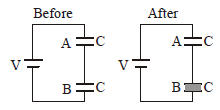
Two identical capacitors are connected in series as shown in the figure. A dielectric slab ( K > 1) is placed between the plates of the capacitor B and the battery remains connected. Select correct statement


1. The charge supplied by the battery increases.
2. The capacitance of the system decreases
3. The electric field in the capacitor B increases.
4. The electrostatic potential energy decreases.
View Answer

On inserting dielectric Capacitance of the system increases so more charge is given by the battery.