Rankers Physics
Topic: Capacitors
Subtopic: Parallel Plate Capacitor

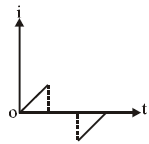
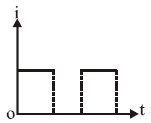
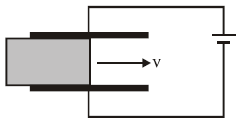
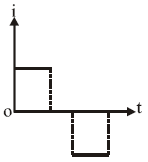
A dielectric slab of area A is inserted between the plates of a capacitor of area 2A with constant speed v as shown in figure. Distance between the plates is d. Image related to The capacitor is connected to a battery of emf E. The current in the circuit varies with time as
Solution:

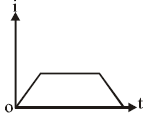
To plot a graph for the current

ii

versus time

tt

, let's break the problem into steps:


1. Capacitor with Dielectric Slab

  • Initial Configuration: The capacitor has plates of total area
    2A2A
     

    and plate separation dd 

    . It is connected to a battery with emf EE 

    .

  • Dielectric Slab: A dielectric slab of area
    AA
     

    is inserted at a constant speed vv 

    .


2. Capacitance with Partial Dielectric

When a dielectric is partially inserted into the capacitor, the total capacitance is the sum of two capacitors:

  • One part with the dielectric slab (
    C1C_1
     

    ).

  • One part without the dielectric slab (
    C2C_2
     

    ).

Capacitance of the two regions:

  1. With Dielectric Slab: 

    C1=κε0AdC_1 = \frac{\kappa \varepsilon_0 A}{d}where

    κ\kappais the dielectric constant.

  2. Without Dielectric Slab: 

    C2=ε0(2AA)d=ε0AdC_2 = \frac{\varepsilon_0 (2A - A)}{d} = \frac{\varepsilon_0 A}{d} 

Thus, the total capacitance

CtotalC_{\text{total}}

is:


Ctotal=C1+C2=κε0Ad+ε0AdC_{\text{total}} = C_1 + C_2 = \frac{\kappa \varepsilon_0 A}{d} + \frac{\varepsilon_0 A}{d}


Ctotal=ε0Ad(κ+1)C_{\text{total}} = \frac{\varepsilon_0 A}{d} (\kappa + 1)


3. Change in Capacitance with Time

As the slab moves with speed

vv

, the area covered by the slab changes with time:


Covered area Acovered=vt\text{Covered area } A_{\text{covered}} = v \cdot t


The effective capacitance changes as:


C(t)=κε0(vt)d+ε0(2Avt)dC(t) = \frac{\kappa \varepsilon_0 (v \cdot t)}{d} + \frac{\varepsilon_0 (2A - v \cdot t)}{d}


C(t)=ε0d[κ(vt)+(2Avt)]C(t) = \frac{\varepsilon_0}{d} \left[ \kappa (v \cdot t) + (2A - v \cdot t) \right]


Simplify:


C(t)=ε0d[2A+(κ1)(vt)]C(t) = \frac{\varepsilon_0}{d} \left[ 2A + (\kappa - 1)(v \cdot t) \right]


4. Current in the Circuit

The current in the circuit is related to the rate of change of capacitance:


i(t)=EdCdti(t) = E \cdot \frac{dC}{dt}


Differentiate

C(t)C(t)

with respect to

tt

:


dCdt=ε0d(κ1)v\frac{dC}{dt} = \frac{\varepsilon_0}{d} (\kappa - 1) v


Thus:


i(t)=Eε0d(κ1)vi(t) = E \cdot \frac{\varepsilon_0}{d} (\kappa - 1) v


5. Graph of ii


vs. tt


The current

i(t)i(t)

is constant because it does not depend on

tt

(the rate of capacitance change is constant). Hence, the graph of

ii

vs.

tt

will be a horizontal line at:


i=Eε0d(κ1)vi = E \cdot \frac{\varepsilon_0}{d} (\kappa - 1) v


Leave a Reply

Your email address will not be published. Required fields are marked *