A parallel plate capacitor of capacitance C consists of two identical plates A and B. A charge q is given to plate A and charge –q is given to plate B. The space between plates is vacuum. The separation between plates is d. The electric intensity at a point situated between plates is :
A parallel plate capacitor has plates of area A and separation d and is charged to a potential difference V. The charging battery is then disconnected and the plates are pulled apart until their separation is 2d. What is the work required to separated the plates?
To calculate the work required to separate the plates of the capacitor, let’s analyze the situation step by step:
1. Initial Setup
- The capacitor has:
- Plate area =
- Initial separation =
- Initial potential difference =
- Plate area =
- After charging, the battery is disconnected, so the charge
on the plates remains constant.
The charge stored in the capacitor is given by:
where
is the capacitance:
Thus, the charge is:
2. Energy Stored in the Capacitor
The energy stored in the capacitor is:
Substituting
:
Initially, the energy is:
When the separation is increased to
, the capacitance decreases to:
The energy becomes:
Since the charge
is constant and
:
Substitute
and
:
3. Work Done to Separate the Plates
The work done to separate the plates is equal to the increase in energy:
Substitute the values:
Final Answer:
The work required to separate the plates is:
Ten capacitors are joined in parallel and charged with a battery up to a potential V. They are then disconnected from the battery and joined in series. Then, the potential of this combination will be:
Let's analyze the problem step by step and derive why the potential difference is 10 V.
1. Capacitors in Parallel (Initial Condition)
When the 10 capacitors, each with capacitance
, are connected in parallel:
- The equivalent capacitance is:
- The total charge stored when connected to a battery of potential
is:
2. Capacitors in Series (Reconfigured System)
After disconnecting the battery, the capacitors are joined in series:
- The equivalent capacitance for 10 capacitors in series is:
- The charge
stored on the series combination remains the same (as charge is conserved):
3. Potential Across the Series Combination
The potential difference across a capacitor or combination of capacitors is related to the charge
and capacitance
:
Substitute
and
:
Thus, the potential across the series combination is
,.
Final Answer:
The potential of the series combination is:
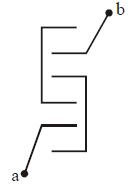
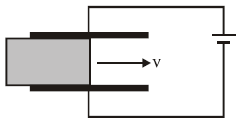
A dielectric slab of area A is inserted between the plates of a capacitor of area 2A with constant speed v as shown in figure. Distance between the plates is d.

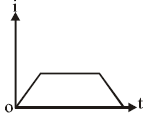
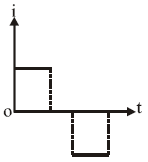
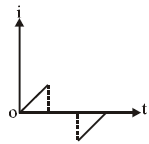
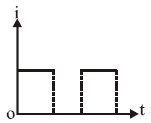
The capacitor is connected to a battery of emf E. The current in the circuit varies with time as
To plot a graph for the current
versus time
, let's break the problem into steps:
1. Capacitor with Dielectric Slab
- Initial Configuration: The capacitor has plates of total area
and plate separation
. It is connected to a battery with emf
.
- Dielectric Slab: A dielectric slab of area
is inserted at a constant speed
.
2. Capacitance with Partial Dielectric
When a dielectric is partially inserted into the capacitor, the total capacitance is the sum of two capacitors:
- One part with the dielectric slab (
).
- One part without the dielectric slab (
).
Capacitance of the two regions:
- With Dielectric Slab:
where
is the dielectric constant.
- Without Dielectric Slab:
Thus, the total capacitance
is:
3. Change in Capacitance with Time
As the slab moves with speed
, the area covered by the slab changes with time:
The effective capacitance changes as:
Simplify:
4. Current in the Circuit
The current in the circuit is related to the rate of change of capacitance:
Differentiate
with respect to
:
Thus:
5. Graph of
vs.
The current
is constant because it does not depend on
(the rate of capacitance change is constant). Hence, the graph of
vs.
will be a horizontal line at:
Plates of area A are arranged as shown. The distance between each plate is d, the net capacitance is :

The arrangement appears to be a system of parallel plates connected alternately to terminals
and
. Let’s determine the net capacitance.
Key Observations:
- The plates form a series-parallel combination.
- The area of each plate is
, and the separation between adjacent plates is
.
- The effective configuration can be reduced to find the equivalent capacitance.
Equivalent Capacitance Derivation:
- Pairing of Plates:
- Adjacent plates (connected alternately) act as capacitors.
- Each capacitor has a capacitance
.
- Parallel and Series Combination:
- There are three capacitors in the arrangement, effectively forming a single network.
- The middle plate shares equal charge with both sides, simplifying to an equivalent capacitance of
.
Thus, the net capacitance is:
A capacitor is charged by a battery and the energy stored is U. The battery is now removed and the separation distance between the plates is doubled. The energy stored now is :
Let’s solve step by step why the energy stored becomes
:
1. Initial Setup
- Capacitance of the capacitor:
where:
= area of the plates,
= distance between the plates,
= permittivity of free space.
- When the capacitor is charged by a battery to a voltage
, the charge stored is:
The energy stored in the capacitor is:
2. When the Distance is Doubled
After the battery is removed, the charge
on the capacitor remains constant because there’s no external connection. However, the capacitance changes due to the increased plate separation.
- New capacitance:
- Energy stored in a capacitor is given by:
Substitute
:
Simplify:
3. Relating
and
From the initial setup:
Substitute
and
:
From the doubling of plate separation:
Final Answer:
The energy stored in the capacitor after doubling the separation is:
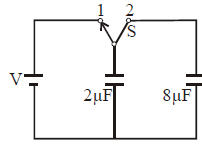
A 2μF capacitor is charged as shown in figure. The percentage of its stored energy dissiplated
after the switch S is turned to position 2 is :

To solve this, let's calculate the percentage of energy dissipated when the switch
is turned to position 2.
Given:
- Initial voltage across
Key Concept:
When two capacitors are connected, the redistribution of charge causes energy loss. The energy dissipated can be calculated using the direct formula:
Here:
is the initial voltage of
.
(initially,
is uncharged).
Step-by-step Calculation:
- Common Voltage after Connection: The final voltage across both capacitors is:
- Initial Energy Stored in
:
- Final Energy Stored: The total energy stored after redistribution is:
Substituting values:
- Energy Dissipated:
- Percentage of Energy Dissipated:
Final Answer:
The percentage of energy dissipated is 80%.
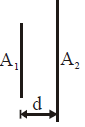
The capacitance of capacitor of plate areas A1 and A2 (A1 < A2) at a distance d is :

The capacitance of a parallel-plate capacitor is given by the general formula:
where:
= capacitance,
= permittivity of free space,
= effective overlapping area of the two plates,
= separation between the plates.
For Plates of Unequal Areas (
):
When two plates of areas
and
are used to form a capacitor, only the smaller area (
) determines the effective overlapping area for charge storage. This is because the excess area of the larger plate (
) does not contribute to the capacitance.
Thus, the capacitance is:
Final Answer:
The capacitance of the capacitor is:
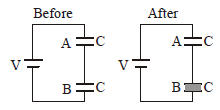
Two identical capacitors are connected in series as shown in the figure. A dielectric slab ( K > 1) is placed between the plates of the capacitor B and the battery remains connected. Select correct statement

On inserting dielectric Capacitance of the system increases so more charge is given by the battery.
A capacitor of capacitance 1μF and charge 1μC is connected to a 2μF capacitor charged to 4 μC with the terminals of unlike sign together. The final charge on the two capacitors is
Let's solve this using the direct formula.
Formula:
The final common voltage
across the capacitors after they are connected is given by:
Step 1: Given Data
Step 2: Final Voltage
Substitute into the formula:
(Note: The negative sign indicates the direction of potential difference.)
Step 3: Final Charges
The final charges on the capacitors are calculated using
:
- For
:
, but in magnitude,
.
- For
:
, but in magnitude,
.
Final Answer:
The final charges are: