Capacitors - NEET Physics Questions
Question 11: difficult

Plates of area A are arranged as shown. The distance between each plate is d, the net capacitance is :
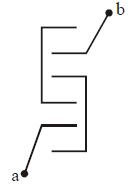
1. \[\frac{\varepsilon_{0}A}{d}\]
2. \[\frac{7\varepsilon_{0}A}{d}\]
3. \[\frac{6\varepsilon_{0}A}{d}\]
4. \[\frac{5\varepsilon_{0}A}{d}\]
View Answer

The arrangement appears to be a system of parallel plates connected alternately to terminals

aa

and

bb

. Let’s determine the net capacitance.

Key Observations:

  1. The plates form a series-parallel combination.
  2. The area of each plate is
    AA
     

    , and the separation between adjacent plates is dd 

    .

  3. The effective configuration can be reduced to find the equivalent capacitance.

Equivalent Capacitance Derivation:

  1. Pairing of Plates:
    • Adjacent plates (connected alternately) act as capacitors.
    • Each capacitor has a capacitance
      C=Ξ΅0AdC = \frac{\varepsilon_0 A}{d}
       

      .

  2. Parallel and Series Combination:
    • There are three capacitors in the arrangement, effectively forming a single network.
    • The middle plate shares equal charge with both sides, simplifying to an equivalent capacitance of
      Ξ΅0Ad\frac{\varepsilon_0 A}{d}
       

      .

Thus, the net capacitance is:


Cnet=Ξ΅0Ad.C_{\text{net}} = \frac{\varepsilon_0 A}{d}.


Question 12: difficult

A capacitor is charged from a cell with the help of a resistor. The circuit has a time constant Ο„. The capacitor collects 10% of the steady charge at time t given by :

1. Ο„ln(1.1)
2. Ο„ ln (10/9)
3. Ο„ ln (0.9)
4. Ο„ ln (0.1)
View Answer

The charging of a capacitor through a resistor is described by the following equation:


Q(t)=Qmax(1βˆ’eβˆ’t/Ο„)Q(t) = Q_{\text{max}} \left( 1 - e^{-t/\tau} \right)


Where:


  • Q(t)Q(t)
     

    is the charge on the capacitor at time tt 

    ,


  • QmaxQ_{\text{max}}
     

    is the maximum (steady-state) charge the capacitor can hold,


  • Ο„\tau
     

    is the time constant, Ο„=Rβ‹…C\tau = R \cdot C 

    , where RR 

    is the resistance and CC 

    is the capacitance,


  • tt
     

    is the time.

Step 1: Given condition (10% of steady charge)

We are told that at time

tt

, the capacitor has collected 10% of the steady charge, so:


Q(t)=0.1β‹…QmaxQ(t) = 0.1 \cdot Q_{\text{max}}


Step 2: Substitute into the charging equation

Substitute

Q(t)=0.1β‹…QmaxQ(t) = 0.1 \cdot Q_{\text{max}}

into the charging formula:


0.1β‹…Qmax=Qmax(1βˆ’eβˆ’t/Ο„)0.1 \cdot Q_{\text{max}} = Q_{\text{max}} \left( 1 - e^{-t/\tau} \right)


Cancel

QmaxQ_{\text{max}}

from both sides:


0.1=1βˆ’eβˆ’t/Ο„0.1 = 1 - e^{-t/\tau}


Step 3: Solve for tt


Rearrange the equation to solve for

eβˆ’t/Ο„e^{-t/\tau}

:


eβˆ’t/Ο„=1βˆ’0.1=0.9e^{-t/\tau} = 1 - 0.1 = 0.9


Take the natural logarithm of both sides:


βˆ’tΟ„=ln⁑(0.9)-\frac{t}{\tau} = \ln(0.9)


t=βˆ’Ο„ln⁑(0.9)t = -\tau \ln(0.9)


Using the fact that

ln⁑(0.9)=βˆ’ln⁑(10/9)\ln(0.9) = -\ln(10/9)

:


t=Ο„ln⁑(109)t = \tau \ln\left(\frac{10}{9}\right)


Final Answer:

The time at which the capacitor has collected 10% of the steady charge is

t=Ο„ln⁑(109)t = \tau \ln\left(\frac{10}{9}\right)

.