Potential Energy & Equilibrium - NEET Physics Questions
← Back to Work Energy and Power

Potential Energy & Equilibrium

Question 1: easy

A cubical vessel of height 1 m is full of water. The minimum work done in taking water-out from vessel will be

1. 5000 J
2. 10000 J
3. 5 J
4. 10 J
View Answer

As side length of cubical tank is 1 m. Volume is 1 m³. Volume of water in 1 m³ is 1000 lit and mass will be 1000 kg.

Height of center of mass of the tank will be 1/2 m.

Potential Energy = 1000 ×10 × 1/2 = 5000 J
Question 2: moderate

A man pulls a bucket full of water from h metre deep well. If the mass of rope is m and mass of bucket full of water is M, then work done by the man is

1. ( m + M/2) gh
2. ( m + M) gh
3. ( m/2  + M) gh
4. ( 2m + M) gh
View Answer

Bucket of mass M will rise by a distance of h.

While center of mass of the rope rises by height of h/2.

So, Work Done = (M+m/2).g.h

Question 3: moderate

Potential energy of a particle at position x is given by U = x² – 5x. Which of the following is equilibrium position of the particle?

1. x = 0
2. x = 2.5 m
3. x = 5 m
4. x = 7.5 m
View Answer

For Equilibrium,

dU/dx = 0

⇒ d(x²-5x)/dx=0

⇒ 2x-5 = 0

⇒ x =2.5 m

Question 4: moderate

In a conservative field, the potential energy U as a function of position x is given by U = x². Then the corresponding conservative force is given by

1. x
2. 2x
3. -x
4. -2x
View Answer

By definition Force F = -dU/dx, so 

F = - d(x²)/dx= -2x

Question 5: easy

Select correct statement regarding stable equilibrium

1. Potential energy of body is minimum in stable equilibrium
2. Slope of potential energy versus position graph is zero at stable equilibrium
3. A restoring force acts on the body when it is slightly displaced from its stable equilibrium position
4. All of these
View Answer

All the statements are true regarding stable equilibrium

Question 6: moderate

In a certain field, the potential energy is U = ax² – bx³, where a and b constants. The particle is in stable equilibrium at x equal to

1. zero
2. a/3b
3. 2a/3b
4. 2a/b
View Answer

Potential Energy is U = ax² – bx³. For Equilibrium F = -dU/dx

⇒ dU/dx= 2ax- 3bx²=0

⇒ x = 2a/3b

Question 7: moderate

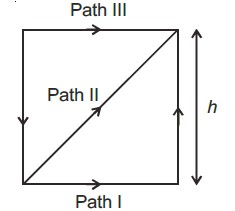
A body of mass m is raised to height h from ground along three different paths viz I, II and III against gravity as shown below. If WI, WII and WIII are the work done along the respective paths of I, II and III, then the correct option is (there is no nonconservative force)

1. WIII > WII > WI
2. WI > WII > WIII
3. WII > WI > WIII
4. WI = WII = WIII
View Answer

Work done by conservative force is independent of path taken so, WI = WII = WIII

Question 8: moderate

A uniform chain has a mass m and length l. It is held on a frictionless table with one-sixth of its length hanging over the edge. The work done in just pulling the hanging part back on the table is

1. mgl/72
2. mgl/36
3. mgl/12
4. mgl/6
View Answer

mass of hanging portion = m/6

Potential energy of handing portion = m/6×g×(-l/12)= -mgl/72

Work done by external agent is negative of change is Potential Energy = mgl/72

Question 9: moderate

The potential energy of a particle oscillating on x-axis is given as : U = 20 + (x – 2)2 Joules. If total mechanical  energy of the particle is 36 J, then its maximum kinetic energy is:

1. 10 J
2. 16 J
3. 20 J
4. 30 J
View Answer

Given  U = 20 + (x – 2)2

For Equilibrium , dU/dx = 2 (x-2) =0, So, x=2 is the point of Equilibrium.

d²U/dx²= 2 >0 so, x= 2 is the point of stable equilibrium.

U min = 20 J

As Total Energy is 36 J.

U min  + K max  = 36 J

⇒ K max  = 16 J

Question 10: easy

If potential energy between electron and proton at a distance r is given by U =-(ke²/3r³), then force acting is

1. F = ke²/r²
2.
3.
4. F = ke²/r
View Answer

Force F = - dU/dr = d ((ke²/3r³))/dr = ke²/r^4