An engine pumps 400 kg of water through height of 10 m in 40 s. Find the power of the pump (g = 10 m/s²).
Power = Work Done / Time Taken
Here , Work Done = 400 ×10 ×10 J = 40000 J
Time Taken = 40 sec , So,
Power = 40000/40 = 1000 W= 1 KW
An engine pumps 400 kg of water through height of 10 m in 40 s. Find the power of the pump (g = 10 m/s²).
Power = Work Done / Time Taken
Here , Work Done = 400 ×10 ×10 J = 40000 J
Time Taken = 40 sec , So,
Power = 40000/40 = 1000 W= 1 KW
An engine pumps 400 kg of water through height of 10 m in 40 s. Find the power of the engine if its efficiency is 80% (g = 10 m/s²).
Power = Work Done / Time Taken
Here , Work Done = 400 ×10 ×10 J = 40000 J
Time Taken = 40 sec , So,
Power = 40000/40 = 1000 W= 1 KW
Efficiency = Output Power/ Input Power × 100
⇒ 80 = 1000/ Input Power × 100
⇒Input Power = 1250 W= 1.25 KW
A force F = (iˆ + ˆj + 2kˆ) N is acting on a particle moving with constant velocity v = (iˆ + ˆj + kˆ) m/s. Power delivered by force is
Power is dot product of Force and Velocity
P = F.v
⇒ P= (iˆ + ˆj + 2kˆ). (iˆ + ˆj + kˆ)= 1+1+2= 4 watt
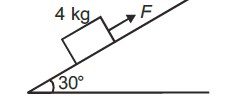
A block of mass 4 kg is pulled along a smooth inclined plane of inclination 30° with constant velocity 3 m/s as shown, power delivered by the force is

As the object is not moving with constant speed net force on it is zero.
so F = mg sin 30 °= 4 × 10 × ½= 20 N
Power is Dot product of force and velocity. So, P = 20 × 3 = 60 W
Water from a stream is falling on the blades of a turbine at the rate of 100 kg/s. If the height of the stream is 100 m, then power delivered to turbine is
Power is Rate of doing work.
Power = mgh/t= (m/t)gh= 100 × 10 × 100 = 100 kW
A body is being moved from rest along a straight line by a machine delivering constant power. The speed of body in time t is proportional to
Power = Constant (K)
F.v= K
⇒m.(dv/dt).v = K
⇒m.v.dv = K.dt
Integrating we get,
⇒∫m.v.dv=∫K.dt
⇒ mv²/2 = Kt
so, V α t½
A pump motor is used to deliver water at a certain rate from a given pipe. To obtain “2” time water from the same pipe in the same time, the amount to which the power of the motor should be increased is :
Force on water coming out is F= ρAv² and Power P=F.v
So, Power = F.v= ρAv³,
if v becomes 2v, Power P1= 8P
A particle moves with a velocity \((5\hat{i} – 3\hat{j} + 6\hat{k})\text{ m s}^{-1}\) horizontally under the action of constant force \((10\hat{i} + 10\hat{j} + 20\hat{k})\text{ N}\). The instantaneous power supplied to the particle is :
Instantaneous power is the dot product of force and velocity: \(P = \vec{F} . \vec{v} = (10)(5) + (10)(-3) + (20)(6) = 50 - 30 + 120 = 140\text{ W}\).
Water falls from a height of \(60\text{ m}\) at the rate of \(15\text{ kg/s}\) to operate a turbine. The losses due to frictional forces are 10% of energy. How much power is generated by the turbine (\(g = 10\text{ m/s}^2\)):
The input power is \(P_{\text{in}} = \frac{dm}{dt} gh = 15 \times 10 \times 60 = 9000\text{ W} = 9\text{ kW}\). Frictional losses are 10%, meaning the output efficiency is 90%. Thus, generated power is \(0.90 \times 9\text{ kW} = 8.1\text{ kW}\).
Water falls from a height of \(60\text{ m}\) at the rate of \(15\text{ kg/s}\) to operate a turbine. The losses due to frictional force are \(10%\) of the input energy. How much power is generated by the turbine? (\(g = 10\text{ m/s}^2\))
The total input power is \(P_{\text{in}} = \frac{dm}{dt} gh = 15 \times 10 \times 60 = 9000\text{ W} = 9\text{ kW}\). Given that \(10%\) of energy is lost to friction, the efficiency is \(90%\), so the power generated is \(P_{\text{out}} = 0.9 \times 9\text{ kW} = 8.1\text{ kW}\).