Work Energy and Power - NEET Physics Questions
← All Chapters

Work Energy and Power

Question 1: moderate

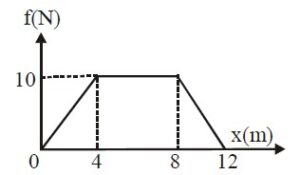
A particle of mass 0.1 kg is subjected to a force which varies with distance as shown in figure. If it starts its journey from rest at x = 0, Work Done from x=0 to x = 12 m is:
1. 60 J
2. 80 J
3. 100 J
4. 120 J
View Answer

Area bounded by force time graph represents work done so, 

Work= ½(12+4)×10= 80 J
Question 2: moderate

A chord is used to lower vertically a block of mass M a distance d at a constant downward acceleration of g/4. Then the work done by the cord on the block is :

1. mg d/4
2. -mg d/4
3. 3mg d/4
4. - 3mg d/4
View Answer

Forces acting on the object are , mg in downward direction and Tension force T in upward direction, as the object moves downward.

mg - T= ma= mg/4

so, T= 3mg/4

Work done by tension force is W= T.d.cos (180°)= -3mgd/4

Question 3: moderate

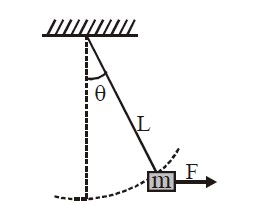
An object of mass m is tied to string of length L and a variable horizontal force is applied on it which starts at zero and gradually increases (it is pulled extremely slowly so that equilibrium exists at all times) until the string makes an angle θ with the vertical. Work done by the force F is :

1. mgL (1 – cosθ)
2. mgL sin θ
3. mgL
4. FL(1 + tanθ)
View Answer

Be definition of Work, Work Done = F.S. cos θ

Taking S and cos θ together like

W= F. (S cos θ)= Force × Component of displacement along force

Here Force F is acting horizontally and displacement toward right is L sin θ, So

Work done = F.L. sin θ

Question 4: moderate

An object of mass m is tied to string of length L and a variable horizontal force is applied on it which starts at zero and gradually increases (it is pulled extremely slowly so that equilibrium exists at all times) until the string makes an angle θ with the vertical. Work done by the gravitational force mg  is :

1. mgL (1 – cosθ)
2. - mgL (1 – cosθ)
3. mgL (1 – sinθ)
4. -mgL (1 – sin θ)
View Answer

Be definition of Work, Work Done = F.S. cos θ

Taking F and cos θ together like

W= (F.  cos θ) . s = Component of Force along displacement ×  displacement 

                    Here gravitational force mg is acting downwards and displacement  in upward direction is (L- L cos θ), So

Work done = mg.(L-Lcosθ)cos (180°)= -mgL(1-cosθ)

Question 5: easy

A force of (3ˆi + 4ˆj)N acts on a body and displaced it by (3ˆi + 4ˆj)m . The work done by the force is

1. 9 J
2. 16 J
3. 25 J
4. 50 J
View Answer

By Definition of Work ,

Work Done = F.S= (3ˆi + 4ˆj).(3ˆi + 4ˆj)= 9+16 =25 J

Question 6: easy

When the bob of a simple pendulum swings, the work done by tension in the string is

1. + ve
2. - ve
3. maximum
4. zero
View Answer

As Angle between tension force and displacement is 90°. Work done is zero

Question 7: moderate

A particle moves along the x-axis from x = 0 to x = 5 m under the influence of a force F (in N) given by F = 3x² –2x + 7. Calculate the work done by this force.

1. 135 J
2. 185 J
3. 100 J
4. 80 J
View Answer

Work Done by Variable force is ∫F.dx, So

W= ∫(3x² –2x + 7).dx=[3x³/3-2x²/2+7x]= [x³-x²+7x] 

Using Proper limits from x=0 to x= 5, we get

W= 125-25+35=135 J

Question 8: moderate

A force of (5 + 3x) N, acting on a body of mass 20 kg along the x-axis, displaces it from x = 2 m to x = 6 m. The work done by the force is

1. 20 J
2. 48 J
3. 68 J
4. 86 J
View Answer

Work Done by Variable force is ∫F.dx, So

W= ∫(5 + 3x).dx= 5x+3x²/2

Using Limits from x=2 to x=6 we get

W= 68 J

Question 9: easy

A 1 kg mass has a kinetic energy of 1 joule when its speed is :

1. 0.45 m/s
2. 1 m/s
3. 1.4 m/s
4. 4.4 m/s
View Answer

Kinetic Energy K = ½mv²

So, 1J = ½(1)v² so, v= √2 m/s= 1.414 m/s

Question 10: easy

When the velocity of a body is doubled :

1. its kinetic energy is doubled
2. its potential energy is doubled
3. its acceleration is doubled
4. its momentum is doubled
View Answer

Momentum of an object is P = m.v

So, when velocity is doubled momentum also doubles