Principal of Conservation of Energy - NEET Physics Questions
← Back to Work Energy and Power

Principal of Conservation of Energy

Question 1: easy

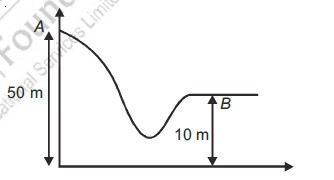
A body is released from position A as shown in figure. The speed of body at position B is
1. 10 m/s
2. 10√2 m/s
3. 20 m/s
4. 20√2 m/s
View Answer

From Principal of Conservation of Energy

Ui + Ki= Uf+ Kf

⇒ mg(50) + 0 = mg(10) + ½ m v²

⇒ v² = 800 

⇒ v = 20√2 m/s
Question 2: moderate

A child on a swing is 1 m above the ground at the lowest point and 6 m above the ground at the highest point. The horizontal speed of the child at the lowest point of the swing is approximately

1. 8 m/s
2. 10 m/s
3. 12 m/s
4. 14 m/s
View Answer

From Principal of conservation of Energy in absence of non-conservative forces,

Ui+ Ki= Uf+ Kf

⇒mg(6) +0 = mg(1) + ½mv²

mg(5)= ½mv²

v²=100 or v =10 m/s

Question 3: easy

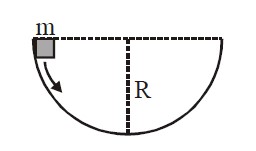
A mass m slips along the wall of a hemispherical surface of radius R. The velocity at the bottom of the surface is

1. √Rg
2. 2√Rg
3. √3Rg
4. √2Rg
View Answer

From Principal of conservation of Energy in absence of non-conservative forces,

Ui+ Ki= Uf+ Kf

mgR+0= 0+ ½mv²

v= √2gR

Question 4: moderate

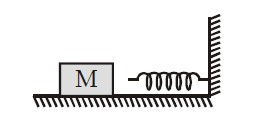
The block of mass M moving on the frictionless horizontal surface collides with the spring of spring constant K and compresses it by length L. The maximum momentum of the block after collision is

1. Zero
2. ML²/K
3. (MK)½ L
4. KL²/2M
View Answer

From Principal of conservation of Energy in absence of non-conservative forces,

Ui+ Ki= Uf+ Kf

½KL²+ 0 = ½mv²

⇒v= √(KL²/m)

Momentum is P= m.v = m. √(KL²/m) =(mK)½ L

Question 5: easy

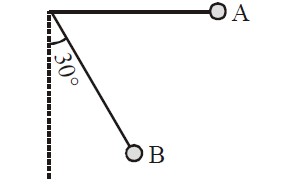
A simple pendulum is released from A as shown. If m and l represent the mass of the bob and length of the pendulum, the gain in kinetic energy at B is

1. mgl/2
2. mgl/√2
3. 2mgl/√3
4. √3mgl/2
View Answer

From Principal of conservation of Energy in absence of non-conservative forces,

Ui+ Ki= Uf+ Kf

⇒ Ui- Uf= Kf - Ki

⇒ Loss in Potential Energy = Gain in Kinetic Energy

⇒ Gain in Kinetic Energy = m.g. l .cos 30° = √3mgl/2

Question 6: moderate

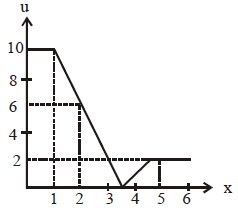
For a body of mass 1 kg U-x graph is shown in If the body is released from rest at x = 2m, then its speed when it crosses x = 5m is

1. 2 √2 ms–1
2. 1 ms–1
3. 2 ms–1
4. 4 ms–1
View Answer

From Principal of Conservation of Energy

Ui + Ki = Uf + Kf

10 +0 = 2 + ½v²

⇒ v ² = 16 ⇒ v = 4 m/s

Question 7: moderate

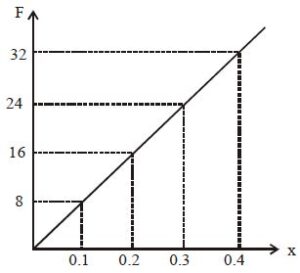
For a spring force-compression graph is shown in figure. A body of mass 5 kg moving with a speed of 8 ms–1 collides the The maximum compression in the spring is

1. 2 m
2. 4 m
3. 6 m
4. 8 m
View Answer

Using this graph we can find value of Spring constant.

F = - K.x

So, K = 80 N/m

Kinetic Energy of the block will convert into spring potential energy

so, ½mv² = ½ k x²

solving x = 2 m

Question 8: moderate

A body of mass 2 kg collides with a massless spring of force constant K = 4 N/m. The spring compresses by 1m. If coefficient of friction between the body and the surface is 0.1, the speed of the body at the time of collision is :

1. 2 m/s
2. 4 m/s
3. 6 m/s
4. 0.5 m/s
View Answer

The Kinetic Energy of the object will go to increase potential energy of the spring and a part of energy will be lost to friction

U1= ½ K x²=  ½ × 4× 1² = 2J

Work done against friction = ü.mg.x= 0.1× 20 × 1= 2  J

So total kinetic energy is 4 = ½× 2 ×v ² ⇒ v = 2 m/s

Question 9: easy

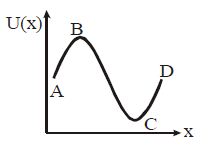
The potential energy of a particle varies with distance x as shown in the graph :

The force acting on the particle is zero at

1. C
2. B
3. B and C
4. A and D
View Answer

For Equilibrium dU/dx =0 so, Points of maxima and minima in U-x graph are point of equilibrium.

So, Points B and C are equilibrium positions

Question 10: moderate

A system absorbs 600 J of the system works equivalent to –900 J by The value of ΔE for the system is :

1. -300 J
2. +300 J
3. -600 J
4. +600 J
View Answer

Work done by external agent = -900 J and energy supplied is 600 J So, change  in kinetic energy is -300 J