Work Energy and Power - NEET Physics Questions
← All Chapters

Work Energy and Power

Question 11: easy

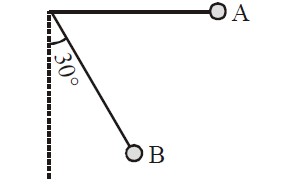
A simple pendulum is released from A as shown. If m and l represent the mass of the bob and length of the pendulum, the gain in kinetic energy at B is
1. mgl/2
2. mgl/√2
3. 2mgl/√3
4. √3mgl/2
View Answer

From Principal of conservation of Energy in absence of non-conservative forces,

Ui+ Ki= Uf+ Kf

⇒ Ui- Uf= Kf - Ki

⇒ Loss in Potential Energy = Gain in Kinetic Energy

⇒ Gain in Kinetic Energy = m.g. l .cos 30° = √3mgl/2

Question 12: easy

If potential energy between electron and proton at a distance r is given by U =-(ke²/3r³), then force acting is

1. F = ke²/r²
2.
3.
4. F = ke²/r
View Answer

Force F = - dU/dr = d ((ke²/3r³))/dr = ke²/r^4

Question 13: easy

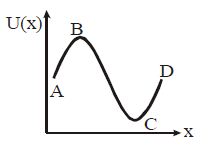
The potential energy of a particle varies with distance x as shown in the graph :

The force acting on the particle is zero at

1. C
2. B
3. B and C
4. A and D
View Answer

For Equilibrium dU/dx =0 so, Points of maxima and minima in U-x graph are point of equilibrium.

So, Points B and C are equilibrium positions

Question 14: easy

A particle moves with a velocity \((5\hat{i} – 3\hat{j} + 6\hat{k})\text{ m s}^{-1}\) horizontally under the action of constant force \((10\hat{i} + 10\hat{j} + 20\hat{k})\text{ N}\). The instantaneous power supplied to the particle is :

1. 100 W
2. 140 W
3. 200 W
4. Zero
View Answer

Instantaneous power is the dot product of force and velocity: \(P = \vec{F} . \vec{v} = (10)(5) + (10)(-3) + (20)(6) = 50 - 30 + 120 = 140\text{ W}\).

Question 15: easy

If the kinetic energy of a body increases by 800%, its momentum increases by

1. 400%
2. 200%
3. 141%
4. 121%
View Answer

The momentum \(P\) is related to kinetic energy \(K\) by \(P = \sqrt{2mK}\). An 800% increase means the new kinetic energy is \(K' = 9K\). Thus, the new momentum is \(P' = \sqrt{9} P = 3P\), representing an increase of 200%.

Question 16: easy

A particle with constant total energy \( E \) moves in one dimension in a region where the potential energy is represented by \( U(x) \). The speed of the particle is zero where:

1. \( \frac{d^2U(x)}{dx^2} = 0 \)
2. \( \frac{dU(x)}{dx} = 0 \)
3. \( U(x) = E \)
4. \( U(x) = 0 \)
View Answer

Total mechanical energy of a particle is the sum of its kinetic energy and potential energy: \( E = K + U(x) \). When the speed of the particle is zero, its kinetic energy \( K = 0 \), which gives \( E = U(x) \).

Question 17: easy

Assertion: Work done by a force depends on frame of reference.


Reason: Force and displacement both depend on frame of reference.

1. Both Assertion and Reason are true and Reason is the correct explanation of Assertion.
2. Both Assertion and Reason are true but Reason is not correct explanation of Assertion.
3. Assertion is true but Reason is false.
4. Assertion and Reason are false.
View Answer

Work done depends on the frame of reference because displacement depends on the frame of reference. However, real forces do not depend on the frame of reference. Hence, the Assertion is true but the Reason is false.

Question 18: easy

Two masses \( 4m \) and \( 9m \) move with equal kinetic energy. The ratio of the magnitude of their momenta is:

1. \( 4 : 9 \)
2. \( 2 : 3 \)
3. \( 9 : 4 \)
4. \( 3 : 2 \)
View Answer

Since kinetic energy \( K \) is the same for both masses, the momentum is proportional to the square root of the mass, \( p = \sqrt{2mK} \). Thus, the ratio of their momenta is \( \frac{p_1}{p_2} = \sqrt{\frac{4m}{9m}} = \frac{2}{3} \).

Question 19: easy

A force \( \vec{F} = (3x\hat{i} + 4\hat{j})\text{ Newton} \) (where \( x \) is in metres) acts on a particle which moves from a position \( (2\text{ m}, 3\text{ m}) \) to \( (3\text{ m}, 0\text{ m}) \). Then the work done is:

1. \( 7.5\text{ J} \)
2. \( -12\text{ J} \)
3. \( -4.5\text{ J} \)
4. \( +4.5\text{ J} \)
View Answer

The work done by the force is \( W = \int_{2}^{3} 3x \, dx + \int_{3}^{0} 4 \, dy = \left[ \frac{3x^2}{2} \right]_2^3 + [4y]_3^0 = 7.5 - 12 = -4.5\text{ J} \).

Question 20: easy

A car of mass \(1000\text{ kg}\) moving at \(20\text{ m/s}\) is brought to rest in \(5\text{ s}\). The average power dissipated due to braking is

1. \(20\text{ kW}\)
2. \(10\text{ kW}\)
3. \(40\text{ kW}\)
4. \(50\text{ kW}\)
View Answer

The initial kinetic energy of the car is \(K_i = \frac{1}{2}mv^2 = \frac{1}{2}(1000)(20)^2 = 2 \times 10^5\text{ J}\) and final kinetic energy is zero. Average power dissipated is the work done divided by time: \(P = \frac{\Delta K}{t} = \frac{2 \times 10^5\text{ J}}{5\text{ s}} = 40\text{ kW}\).