Question 11:
moderate
Potential energy of a particle at position x is given by U = x² – 5x. Which of the following is equilibrium position of the particle?
Potential energy of a particle at position x is given by U = x² – 5x. Which of the following is equilibrium position of the particle?
In a conservative field, the potential energy U as a function of position x is given by U = x². Then the corresponding conservative force is given by
In a certain field, the potential energy is U = ax² – bx³, where a and b constants. The particle is in stable equilibrium at x equal to
Potential Energy is U = ax² – bx³. For Equilibrium F = -dU/dx
⇒ dU/dx= 2ax- 3bx²=0
⇒ x = 2a/3b
An engine pumps 400 kg of water through height of 10 m in 40 s. Find the power of the engine if its efficiency is 80% (g = 10 m/s²).
Power = Work Done / Time Taken
Here , Work Done = 400 ×10 ×10 J = 40000 J
Time Taken = 40 sec , So,
Power = 40000/40 = 1000 W= 1 KW
Efficiency = Output Power/ Input Power × 100
⇒ 80 = 1000/ Input Power × 100
⇒Input Power = 1250 W= 1.25 KW
A block of mass 4 kg is pulled along a smooth inclined plane of inclination 30° with constant velocity 3 m/s as shown, power delivered by the force is
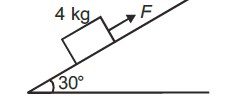
As the object is not moving with constant speed net force on it is zero.
so F = mg sin 30 °= 4 × 10 × ½= 20 N
Power is Dot product of force and velocity. So, P = 20 × 3 = 60 W
Water from a stream is falling on the blades of a turbine at the rate of 100 kg/s. If the height of the stream is 100 m, then power delivered to turbine is
Power is Rate of doing work.
Power = mgh/t= (m/t)gh= 100 × 10 × 100 = 100 kW
A body is being moved from rest along a straight line by a machine delivering constant power. The speed of body in time t is proportional to
Power = Constant (K)
F.v= K
⇒m.(dv/dt).v = K
⇒m.v.dv = K.dt
Integrating we get,
⇒∫m.v.dv=∫K.dt
⇒ mv²/2 = Kt
so, V α t½
A body of mass m is raised to height h from ground along three different paths viz I, II and III against gravity as shown below. If WI, WII and WIII are the work done along the respective paths of I, II and III, then the correct option is (there is no nonconservative force)
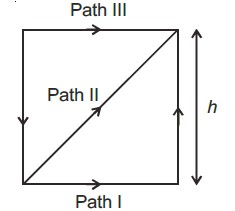
Work done by conservative force is independent of path taken so, WI = WII = WIII
A bullet having mass 10 g is fired towards a fixed wooden block with velocity of 30 m/s. If it comes out of the block with velocity of 20 m/s, then the total work done by the resistive forces is
By Work Energy Theorem,
Work Done= Change in Kinetic Energy
⇒W= ½×(10/ 1000) × ( 20²- 30²) = -500/200= - 2.5 J
A uniform chain has a mass m and length l. It is held on a frictionless table with one-sixth of its length hanging over the edge. The work done in just pulling the hanging part back on the table is
mass of hanging portion = m/6
Potential energy of handing portion = m/6×g×(-l/12)= -mgl/72
Work done by external agent is negative of change is Potential Energy = mgl/72