A force of (3ˆi + 4ˆj)N acts on a body and displaced it by (3ˆi + 4ˆj)m . The work done by the force is
By Definition of Work ,
Work Done = F.S= (3ˆi + 4ˆj).(3ˆi + 4ˆj)= 9+16 =25 J
A force of (3ˆi + 4ˆj)N acts on a body and displaced it by (3ˆi + 4ˆj)m . The work done by the force is
By Definition of Work ,
Work Done = F.S= (3ˆi + 4ˆj).(3ˆi + 4ˆj)= 9+16 =25 J
When the bob of a simple pendulum swings, the work done by tension in the string is
As Angle between tension force and displacement is 90°. Work done is zero
A 1 kg mass has a kinetic energy of 1 joule when its speed is :
When the velocity of a body is doubled :
Momentum of an object is P = m.v
So, when velocity is doubled momentum also doubles
A cubical vessel of height 1 m is full of water. The minimum work done in taking water-out from vessel will be
As side length of cubical tank is 1 m. Volume is 1 m³. Volume of water in 1 m³ is 1000 lit and mass will be 1000 kg.
Height of center of mass of the tank will be 1/2 m.
Potential Energy = 1000 ×10 × 1/2 = 5000 J
Select correct statement regarding stable equilibrium
All the statements are true regarding stable equilibrium
An engine pumps 400 kg of water through height of 10 m in 40 s. Find the power of the pump (g = 10 m/s²).
Power = Work Done / Time Taken
Here , Work Done = 400 ×10 ×10 J = 40000 J
Time Taken = 40 sec , So,
Power = 40000/40 = 1000 W= 1 KW
A force F = (iˆ + ˆj + 2kˆ) N is acting on a particle moving with constant velocity v = (iˆ + ˆj + kˆ) m/s. Power delivered by force is
Power is dot product of Force and Velocity
P = F.v
⇒ P= (iˆ + ˆj + 2kˆ). (iˆ + ˆj + kˆ)= 1+1+2= 4 watt
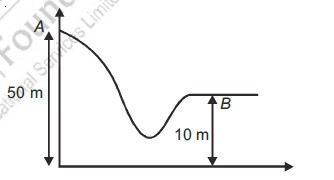
A body is released from position A as shown in figure. The speed of body at position B is
From Principal of Conservation of Energy
Ui + Ki= Uf+ Kf
⇒ mg(50) + 0 = mg(10) + ½ m v²
⇒ v² = 800
⇒ v = 20√2 m/s
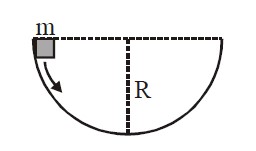
A mass m slips along the wall of a hemispherical surface of radius R. The velocity at the bottom of the surface is

From Principal of conservation of Energy in absence of non-conservative forces,
Ui+ Ki= Uf+ Kf
mgR+0= 0+ ½mv²
v= √2gR