Thermodynamics - NEET Physics Questions
Question 11: easy

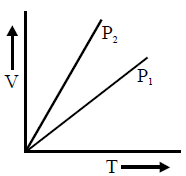
For V versus T curves at constant pressures P1 and P2 for an ideal gas shown in fig. :
1. P1 > P2
2. P1 < P2
3. P1 = P2
4. P1 ≥ P2
View Answer

To analyze the \( V \) versus \( T \) curves for an ideal gas at constant pressures \( P_1 \) and \( P_2 \):

According to Charles's Law:

\[
\frac{V}{T} = \frac{nR}{P}
\]

This implies:

1. At constant pressure, the volume \( V \) is directly proportional to the temperature \( T \), resulting in a straight line.

2. For a given temperature, the volume \( V \) will be greater at a lower pressure \( P \), because \( V \propto \frac{1}{P} \) for a fixed amount of gas.

In the graph:
- The line with a steeper slope corresponds to a lower pressure (since a lower \( P \) results in a larger \( V \) for the same \( T \)).

Since \( P_2 \) has a steeper slope than \( P_1 \), we conclude that:

\[
P_1 > P_2
\]

Therefore, the correct answer is \( P_1 > P_2 \).
Question 12: easy

The temperature of a gas contained in a closed vessel increases by 2°C, when the pressure is increased by 2%. The initial temperature of the gas is :

1. 200 K
2. 100 K
3. 200 °C
4. 100 °C
View Answer

Given:

- The increase in temperature \(\Delta T = 2^\circ \text{C} = 2 \text{ K}\)
- The increase in pressure \(\frac{\Delta P}{P} = 2\% = 0.02\)

Using the relation for a gas at constant volume, \(\frac{\Delta P}{P} = \frac{\Delta T}{T}\):

\[
0.02 = \frac{2}{T}
\]

Solving for \(T\):

\[
T = \frac{2}{0.02} = 100 \text{ K}
\]

Answer: \(T = 100 \, \text{K}\)

Question 13: moderate

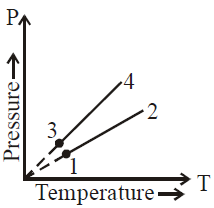
Pressure versus temperature graph of an ideal gas of equal number of moles (μ) of different volumes are plotted as shown in figure. Choose the correct alternative :

1. V1 = V2, V3 = V4 and V2 > V3
2. V1 = V2, V3 = V4 and V2 < V3
3. V1 = V2 = V3 = V4
4. V4 > V3 > V2 > V1
View Answer

For an ideal gas, at constant volume, the pressure \( P \) is directly proportional to the temperature \( T \) (Gay-Lussac's Law):

\[
P \propto T
\]

In the graph, each line represents a pressure-temperature relationship at different volumes. A steeper slope indicates a smaller volume (since \( P = \frac{nRT}{V} \) and a higher \( V \) gives a less steep line).

From the figure:
1. Lines \( 1 \) and \( 2 \) have the same slope, indicating \( V_1 = V_2 \).
2. Lines \( 3 \) and \( 4 \) also have the same slope, indicating \( V_3 = V_4 \).
3. The slope of lines \( 3 \) and \( 4 \) is steeper than that of lines \( 1 \) and \( 2 \), meaning \( V_2 > V_3 \).

Thus, the correct answer is \( V_1 = V_2 \), \( V_3 = V_4 \), and \( V_2 > V_3 \).

Question 14: easy

An ideal gas has a volume of 3V at 2 atmosphere pressure. Keeping the temperature constant, its pressure is doubled. The volume of the gas will be :

1. 6V
2. 3V
3. 1.5V
4. 1V
View Answer

Since the temperature is constant, we can use Boyle's Law, which states that \( P_1 V_1 = P_2 V_2 \).

Given:
- Initial pressure, \( P_1 = 2 \) atm
- Initial volume, \( V_1 = 3V \)
- Final pressure, \( P_2 = 2 \times P_1 = 4 \) atm

Using Boyle's Law:

\[
P_1 V_1 = P_2 V_2
\]
\[
2 \times 3V = 4 \times V_2
\]
\[
6V = 4V_2
\]
\[
V_2 = \frac{6V}{4} = 1.5V
\]

So, the final volume \( V_2 \) is \( 1.5V \).

Question 15: difficult

A closed vessel A having volume V contains N2 gas at pressure P and temperature T. Another closed vessel B having the same volume V contains. He at the same pressure P but temperature 2T. The ratio of masses of N2 and He in the vessels A and B is :

1. 1 : 2
2. 3 : 2
3. 5 : 2
4. 14 :1
View Answer

To find the ratio of the masses of \( \text{N}_2 \) and \( \text{He} \) in vessels \( A \) and \( B \), we use the ideal gas law:

\[
PV = \frac{m}{M} RT
\]

where:
- \( m \) is the mass of the gas,
- \( M \) is the molar mass,
- \( P, V, R, T \) are pressure, volume, gas constant, and temperature, respectively.

For vessel \( A \) (containing \( \text{N}_2 \)):
\[
m_{\text{N}_2} = \frac{PVM_{\text{N}_2}}{RT}
\]

For vessel \( B \) (containing \( \text{He} \) at temperature \( 2T \)):
\[
m_{\text{He}} = \frac{PV M_{\text{He}}}{R \cdot 2T} = \frac{PVM_{\text{He}}}{2RT}
\]

Now, the ratio of the masses \( \frac{m_{\text{N}_2}}{m_{\text{He}}} \) is:

\[
\frac{m_{\text{N}_2}}{m_{\text{He}}} = \frac{\frac{PVM_{\text{N}_2}}{RT}}{\frac{PVM_{\text{He}}}{2RT}} = \frac{M_{\text{N}_2}}{M_{\text{He}}} \times 2
\]

Since \( M_{\text{N}_2} = 28 \) and \( M_{\text{He}} = 4 \):

\[
\frac{m_{\text{N}_2}}{m_{\text{He}}} = \frac{28}{4} \times 2 = 14
\]

Thus, the ratio of masses of \( \text{N}_2 \) to \( \text{He} \) is  14:1.

Question 16: easy

At a given volume and temperature, the pressure of a gas :

1. varies inversely as its mass
2. varies inversely as the square of its mass
3. varies directly as its mass
4. is independent of its mass
View Answer

At constant volume and temperature, the ideal gas law is:

\[
PV = nRT
\]

Since \( n = \frac{\text{mass}}{\text{molar mass}} \), we can rewrite the equation as:

\[
P \propto \frac{\text{mass}}{M}
\]

Thus, for a given volume and temperature, the pressure \( P \) varies directly with the mass of the gas.

Question 17: moderate

A given volume of air at 17°C exerts a pressure of 870 mm of mercury. The temperature at which the pressure becomes 1800 mm of Hg is :

1. 300 K
2. 400 K
3. 500 K
4. 600 K
View Answer

To solve this, we can use Gay-Lussac's Law, which states:

\[
\frac{P_1}{T_1} = \frac{P_2}{T_2}
\]

Given:
- Initial pressure \( P_1 = 870 \, \text{mm Hg} \),
- Final pressure \( P_2 = 1800 \, \text{mm Hg} \),
- Initial temperature \( T_1 = 17^\circ \text{C} = 17 + 273 = 290 \, \text{K} \).

Rearrange to find \( T_2 \):

\[
T_2 = \frac{P_2 \times T_1}{P_1}
\]

Substitute the values:

\[
T_2 = \frac{1800 \times 290}{870}
\]

Calculating this:

\[
T_2 = 600 \, \text{K}
\]

So, the temperature at which the pressure becomes 1800 mm of Hg is  600 K.

Question 18: moderate

Which of the following methods will enable the volume of an ideal gas to be made four times ?
(Consider absolute temperature)

1. Quarter the pressure at constant temperature
2. Quarter the temperature at constant pressure
3. Half the temperature, double the pressure
4. Double the temperature, double the pressure
View Answer

To make the volume of an ideal gas four times its initial volume, we can use Boyle's Law, which states:

\[
P \propto \frac{1}{V} \quad \text{(at constant temperature)}
\]

If the initial pressure is \( P \) and the initial volume is \( V \), we want the final volume \( V_{\text{final}} = 4V \).

According to Boyle's Law:

\[
P_{\text{final}} \times V_{\text{final}} = P \times V
\]

Substituting \( V_{\text{final}} = 4V \):

\[
P_{\text{final}} \times 4V = P \times V
\]

\[
P_{\text{final}} = \frac{P}{4}
\]

So, to make the volume four times, we quarter the pressure at constant temperature.

Question 19: easy

A vessel has 6 g of hydrogen at pressure P and temperature 500 K. Their is a small hole in it so that hydogen leaks out. How much hydrogen leaks out if the final pressure is P/2 and temperature falls to 300 K ?

1. 2 g
2. 3 g
3. 4 g
4. 1 g
View Answer

To solve this, we can use the ideal gas law in terms of the number of moles \( n \):

\[
PV = nRT
\]

Let:
- Initial moles of hydrogen be \( n_1 \),
- Final moles of hydrogen be \( n_2 \).

Given data:
- Initial pressure \( P \),
- Final pressure \( P/2 \),
- Initial temperature \( T_1 = 500 \, \text{K} \),
- Final temperature \( T_2 = 300 \, \text{K} \),
- Mass of hydrogen initially = 6 g.

Since \( n = \frac{PV}{RT} \), we can write the initial and final moles as:

\[
n_1 = \frac{PV}{RT_1} \quad \text{and} \quad n_2 = \frac{(P/2)V}{R \cdot 300}
\]

Taking the ratio \( \frac{n_2}{n_1} \):

\[
\frac{n_2}{n_1} = \frac{(P/2) \cdot V / (R \cdot 300)}{P \cdot V / (R \cdot 500)} = \frac{1}{2} \times \frac{500}{300} = \frac{5}{12}
\]

Since initial moles \( n_1 = \frac{6}{2} = 3 \) moles (using molar mass of H₂ = 2 g/mol), then final moles \( n_2 = \frac{5}{12} \times 3 = 2.5 \) moles.

Thus, moles leaked out = \( 3 - 2.5 = 0.5 \) moles, corresponding to \( 0.5 \times 2 = 1 \) gram of hydrogen.

So, 1 g of hydrogen leaks out.

Question 20: moderate

Find number of molecules of a gas at P = 1.4 × 10⁷ N/m², T = 227°C and V = 2 × 10–³ m³ :

1. \[ 10\times 10^{24}\]
2. \[ 4.06\times 10^{24}\]
3. \[ 14\times 10^{30}\]
4. \[ 30\times 10^{20}\]
View Answer

To find the number of molecules \( N \) of a gas, we can use the ideal gas law in terms of the number of molecules:

\[
PV = NkT
\]

where:
- \( P = 1.4 \times 10^7 \, \text{N/m}^2 \)
- \( V = 2 \times 10^{-3} \, \text{m}^3 \)
- \( T = 227^\circ \text{C} = 227 + 273 = 500 \, \text{K} \)
- \( k = 1.38 \times 10^{-23} \, \text{J/K} \) (Boltzmann constant)

Rearrange to solve for \( N \):

\[
N = \frac{PV}{kT}
\]

Substitute the values:

\[
N = \frac{(1.4 \times 10^7) \times (2 \times 10^{-3})}{(1.38 \times 10^{-23}) \times 500}
\]

Calculating this:

\[
N \approx 4.06 \times 10^{24}
\]

So, the number of molecules is \( 4.06 \times 10^{24} \).