Thermal Physics - NEET Physics Questions
← All Chapters

Thermal Physics

Question 41: difficult

10 gm of ice at –20°C is added to 10 gm of water at 50°C Specific heat of water = 1 cal / gm-°C, specific heat of ice = 0.5 cal /gm-°C. Latent heat of ice = 80 cal /gm. Then, resulting temperature is :

1. –20°C
2. 15°C
3. 0°C
4. 50°C
View Answer

1. Heat gained by ice to reach 0°C:
\[
Q_{\text{ice heating}} = 10 \, \text{g} \cdot 0.5 \, \text{cal/g°C} \cdot 20°C = 100 \, \text{cal}
\]

2. Heat gained by ice to melt:
\[
Q_{\text{ice melting}} = 10 \, \text{g} \cdot 80 \, \text{cal/g} = 800 \, \text{cal}
\]

Total heat gained by ice:
\[
Q_{\text{total ice}} = 100 \, \text{cal} + 800 \, \text{cal} = 900 \, \text{cal}
\]

3. Heat lost by water:
\[
Q_{\text{water cooling}} = 10 \, \text{g} \cdot 1 \, \text{cal/g°C} \cdot (50 - T) = 500 - 10T \, \text{cal}
\]

4. Set heat gained equal to heat lost:
\[
500 - 10T = 900 \Rightarrow -10T = 400 \Rightarrow T = -40°C
\]

Since this temperature is below 0°C, all the ice will not melt.

5. Equilibrium Calculation:
Let \( x \) be the mass of ice that melts:
\[
500 = 70x + 100 \Rightarrow 400 = 70x \Rightarrow x \approx 5.71 \, \text{g}
\]

Result:
The final temperature of the system will be **0°C**.
Question 42: moderate

Two spheres A and B have diameters in the ratio 1 : 2, densities in the ratio 2 : 1 and specific heats in the ratio 1 : 3; find the ratio of their thermal capacities :

1. 1 : 6
2. 1 : 12
3. 1 : 3
4. 1 : 4
View Answer

Given:

- Diameter ratio = 1:2
- Density ratio = 2:1
- Specific heat ratio = 1:3

Step 1: Mass ratio
Mass is proportional to \( \text{density} \times \text{volume} \).
Volume is proportional to the cube of the diameter, so the volume ratio is \( (1:2)^3 = 1:8 \).

Thus, mass ratio = \( \text{density} \times \text{volume} = \frac{2 \times 1}{1 \times 8} = 1:4 \).

Step 2: Thermal capacity ratio
Thermal capacity = mass × specific heat.

So, thermal capacity ratio = \( \frac{1 \times 1}{4 \times 3} = 1:12 \).

Final Answer:
The ratio of the thermal capacities is 1:12.

Question 43: moderate

Two liquids A and B are at temperatures of 75°C and 15°C. Their masses are in the ratio of 2 : 3 and their specific heats in the ratio 3 : 4. What is the resulting temperature :

1. 90°C
2. 70°C
3. 35°C
4. 60°C
View Answer

To find the resulting temperature when two liquids A and B are mixed, we can use the principle of conservation of heat energy: the heat lost by the hotter liquid (A) equals the heat gained by the cooler liquid (B).

Given:
- Temperature of liquid A = 75°C
- Temperature of liquid B = 15°C
- Masses of A and B are in the ratio 2:3, so let the masses of A and B be \( 2m \) and \( 3m \), respectively.
- Specific heats of A and B are in the ratio 3:4, so let the specific heats of A and B be \( 3c \) and \( 4c \), respectively.

Let the final temperature of the mixture be \( T \).

Step 1: Heat lost by liquid A (hotter liquid):
\[
Q_A = \text{mass of A} \times \text{specific heat of A} \times (\text{initial temp of A} - T)
\]
\[
Q_A = 2m \times 3c \times (75 - T) = 6mc(75 - T)
\]

Step 2: Heat gained by liquid B (cooler liquid):
\[
Q_B = \text{mass of B} \times \text{specific heat of B} \times (T - \text{initial temp of B})
\]
\[
Q_B = 3m \times 4c \times (T - 15) = 12mc(T - 15)
\]

Step 3: Apply the conservation of heat:
Heat lost by A = Heat gained by B
\[
6mc(75 - T) = 12mc(T - 15)
\]

 Step 4: Simplify and solve for \( T \):
Cancel out \( mc \) from both sides:
\[
6(75 - T) = 12(T - 15)
\]
Expand both sides:
\[
450 - 6T = 12T - 180
\]
Combine like terms:
\[
450 + 180 = 12T + 6T
\]
\[
630 = 18T
\]
Solve for \( T \):
\[
T = \frac{630}{18} = 35 \, ^\circ\text{C}
\]

Final Answer:
The resulting temperature is 35°C.

Question 44: moderate

Steam is passed into 54 gm of water at 30°C till the temperature of mixture becomes 90°C. If the latent heat of steam is 530 cal/gm, the mass of the mixture will be :

1. 80 gm
2. 60 gm
3. 50 gm
4. 24 gm
View Answer

Here’s a short solution:

Given

- Mass of water = 54 gm
- Initial temperature of water = 30°C, Final temperature = 90°C
- Latent heat of steam = 530 cal/gm
- Specific heat of water = 1 cal/gm°C

Step 1: Heat gained by water to reach 90°C:

\[
Q_{\text{gained}} = m_{\text{water}} \times c_{\text{water}} \times \Delta T = 54 \times 1 \times (90 - 30) = 3240 \, \text{cal}
\]

Step 2: Heat lost by steam:

\[
Q_{\text{lost}} = m_s \times (530 + 10) = 540 m_s
\]

Step 3: Equating heat gained and heat lost:

\[
3240 = 540 m_s \quad \Rightarrow \quad m_s = \frac{3240}{540} = 6 \, \text{gm}
\]

Step 4: Total mass of the mixture:

\[
m_{\text{mixture}} = 54 \, \text{gm} + 6 \, \text{gm} = 60 \, \text{gm}
\]

Final Answer:
The mass of the mixture is 60 grams.

Question 45: easy

The temperature of a gas contained in a closed vessel increases by 2°C, when the pressure is increased by 2%. The initial temperature of the gas is :

1. 200 K
2. 100 K
3. 200 °C
4. 100 °C
View Answer

Given:

- The increase in temperature \(\Delta T = 2^\circ \text{C} = 2 \text{ K}\)
- The increase in pressure \(\frac{\Delta P}{P} = 2\% = 0.02\)

Using the relation for a gas at constant volume, \(\frac{\Delta P}{P} = \frac{\Delta T}{T}\):

\[
0.02 = \frac{2}{T}
\]

Solving for \(T\):

\[
T = \frac{2}{0.02} = 100 \text{ K}
\]

Answer: \(T = 100 \, \text{K}\)

Question 46: moderate

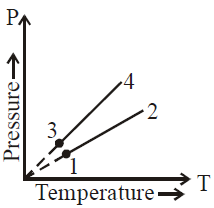
Pressure versus temperature graph of an ideal gas of equal number of moles (μ) of different volumes are plotted as shown in figure. Choose the correct alternative :

1. V1 = V2, V3 = V4 and V2 > V3
2. V1 = V2, V3 = V4 and V2 < V3
3. V1 = V2 = V3 = V4
4. V4 > V3 > V2 > V1
View Answer

For an ideal gas, at constant volume, the pressure \( P \) is directly proportional to the temperature \( T \) (Gay-Lussac's Law):

\[
P \propto T
\]

In the graph, each line represents a pressure-temperature relationship at different volumes. A steeper slope indicates a smaller volume (since \( P = \frac{nRT}{V} \) and a higher \( V \) gives a less steep line).

From the figure:
1. Lines \( 1 \) and \( 2 \) have the same slope, indicating \( V_1 = V_2 \).
2. Lines \( 3 \) and \( 4 \) also have the same slope, indicating \( V_3 = V_4 \).
3. The slope of lines \( 3 \) and \( 4 \) is steeper than that of lines \( 1 \) and \( 2 \), meaning \( V_2 > V_3 \).

Thus, the correct answer is \( V_1 = V_2 \), \( V_3 = V_4 \), and \( V_2 > V_3 \).

Question 47: easy

An ideal gas has a volume of 3V at 2 atmosphere pressure. Keeping the temperature constant, its pressure is doubled. The volume of the gas will be :

1. 6V
2. 3V
3. 1.5V
4. 1V
View Answer

Since the temperature is constant, we can use Boyle's Law, which states that \( P_1 V_1 = P_2 V_2 \).

Given:
- Initial pressure, \( P_1 = 2 \) atm
- Initial volume, \( V_1 = 3V \)
- Final pressure, \( P_2 = 2 \times P_1 = 4 \) atm

Using Boyle's Law:

\[
P_1 V_1 = P_2 V_2
\]
\[
2 \times 3V = 4 \times V_2
\]
\[
6V = 4V_2
\]
\[
V_2 = \frac{6V}{4} = 1.5V
\]

So, the final volume \( V_2 \) is \( 1.5V \).

Question 48: difficult

A closed vessel A having volume V contains N2 gas at pressure P and temperature T. Another closed vessel B having the same volume V contains. He at the same pressure P but temperature 2T. The ratio of masses of N2 and He in the vessels A and B is :

1. 1 : 2
2. 3 : 2
3. 5 : 2
4. 14 :1
View Answer

To find the ratio of the masses of \( \text{N}_2 \) and \( \text{He} \) in vessels \( A \) and \( B \), we use the ideal gas law:

\[
PV = \frac{m}{M} RT
\]

where:
- \( m \) is the mass of the gas,
- \( M \) is the molar mass,
- \( P, V, R, T \) are pressure, volume, gas constant, and temperature, respectively.

For vessel \( A \) (containing \( \text{N}_2 \)):
\[
m_{\text{N}_2} = \frac{PVM_{\text{N}_2}}{RT}
\]

For vessel \( B \) (containing \( \text{He} \) at temperature \( 2T \)):
\[
m_{\text{He}} = \frac{PV M_{\text{He}}}{R \cdot 2T} = \frac{PVM_{\text{He}}}{2RT}
\]

Now, the ratio of the masses \( \frac{m_{\text{N}_2}}{m_{\text{He}}} \) is:

\[
\frac{m_{\text{N}_2}}{m_{\text{He}}} = \frac{\frac{PVM_{\text{N}_2}}{RT}}{\frac{PVM_{\text{He}}}{2RT}} = \frac{M_{\text{N}_2}}{M_{\text{He}}} \times 2
\]

Since \( M_{\text{N}_2} = 28 \) and \( M_{\text{He}} = 4 \):

\[
\frac{m_{\text{N}_2}}{m_{\text{He}}} = \frac{28}{4} \times 2 = 14
\]

Thus, the ratio of masses of \( \text{N}_2 \) to \( \text{He} \) is  14:1.

Question 49: easy

At a given volume and temperature, the pressure of a gas :

1. varies inversely as its mass
2. varies inversely as the square of its mass
3. varies directly as its mass
4. is independent of its mass
View Answer

At constant volume and temperature, the ideal gas law is:

\[
PV = nRT
\]

Since \( n = \frac{\text{mass}}{\text{molar mass}} \), we can rewrite the equation as:

\[
P \propto \frac{\text{mass}}{M}
\]

Thus, for a given volume and temperature, the pressure \( P \) varies directly with the mass of the gas.

Question 50: moderate

A given volume of air at 17°C exerts a pressure of 870 mm of mercury. The temperature at which the pressure becomes 1800 mm of Hg is :

1. 300 K
2. 400 K
3. 500 K
4. 600 K
View Answer

To solve this, we can use Gay-Lussac's Law, which states:

\[
\frac{P_1}{T_1} = \frac{P_2}{T_2}
\]

Given:
- Initial pressure \( P_1 = 870 \, \text{mm Hg} \),
- Final pressure \( P_2 = 1800 \, \text{mm Hg} \),
- Initial temperature \( T_1 = 17^\circ \text{C} = 17 + 273 = 290 \, \text{K} \).

Rearrange to find \( T_2 \):

\[
T_2 = \frac{P_2 \times T_1}{P_1}
\]

Substitute the values:

\[
T_2 = \frac{1800 \times 290}{870}
\]

Calculating this:

\[
T_2 = 600 \, \text{K}
\]

So, the temperature at which the pressure becomes 1800 mm of Hg is  600 K.