Calorimetry - NEET Physics Questions
Question 1: easy

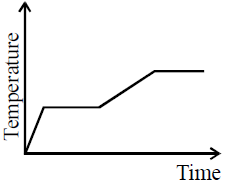
Heat is supplied to a certain homogeneous sample of matter at a uniform rate. Its temperature is plotted against time as shown, which of the following conclusion can be drawn ?
1. It's specific heat capacity is greater in the solid state than in liquid state
2. It's specific heat capacity is greater in the liquid state than in the solid state.
3. It specific heat capacity in liquid state is equal to that of in solid state.
4. data insufficient.
View Answer

Given the graph and your observation, we can analyze whether the specific heat capacity is greater in the liquid state than in the solid state.

In a temperature vs. time graph, under uniform heat supply, the slope of the graph during the temperature rise is inversely proportional to the specific heat capacity (\(C\)). Mathematically, for a given heat input rate:

\[
\text{Rate of temperature increase} \propto \frac{1}{C}
\]

- Solid phase: In the first sloped section (just before the first horizontal plateau), the slope is steeper, indicating a faster temperature increase. This implies that the specific heat capacity of the substance in the solid state is lower.

- Liquid phase: After the first plateau (phase change), the slope in the second sloped section (where the substance is in the liquid state) is less steep, indicating a slower temperature increase. This suggests that more heat is required to raise the temperature in this phase, which means the specific heat capacity is higher in the liquid state.

.
Question 2: easy

5g ice at 0°C is mixed with 5g steam at 100°C. What is final temperature ?

1. 0°C
2. 50°C
3. 100°C
4. 75°C
View Answer

To find the final temperature when 5 g of ice at 0°C is mixed with 5 g of steam at 100°C, we need to consider the energy exchange between the ice and the steam.

We proceed step by step:

1. Heat required to melt the ice into water at 0°C:

\[
Q_1 = m_{\text{ice}} \times L_f = 5 \, \text{g} \times 80 \, \text{cal/g} = 400 \, \text{cal}
\]
This is the heat required to convert 5 g of ice at 0°C into 5 g of water at 0°C.

2. Heat released by steam as it condenses into water at 100°C:

\[
Q_2 = m_{\text{steam}} \times L_v = 5 \, \text{g} \times 540 \, \text{cal/g} = 2700 \, \text{cal}
\]
This is the heat released when 5 g of steam condenses into water at 100°C.

3. Heat required to raise the temperature of 5 g of water from 0°C to 100°C:

\[
Q_3 = m_{\text{water}} \times c \times \Delta T = 5 \, \text{g} \times 1 \, \text{cal/g°C} \times (100 - 0) = 5 \times 100 = 500 \, \text{cal}
\]

 Total heat available from the steam:

- The steam releases 2700 cal by condensing.
- The ice requires 400 cal to melt, and then 500 cal to be heated from 0°C to 100°C, totaling 900 cal.

Since the heat available from the steam (2700 cal) is more than the 900 cal required to melt the ice and raise its temperature to 100°C, the final temperature will be 100°C.

In conclusion, all the ice melts and the final temperature of the mixture is 100°C.

Question 3: easy

Find the quantity of heat required to convert 40g, ice at – 20°C into water at 20°C ?

1. 4400 cal
2. 2200 cal
3. 18480 cal
4. 1100 cal
View Answer

To calculate the heat required to convert 40 g of ice at –20°C into water at 20°C, we need to consider three steps:

1. Heating ice from -20°C to 0°C:
\[
Q_1 = m \times c_{\text{ice}} \times \Delta T = 40 \, \text{g} \times 0.5 \, \text{cal/g°C} \times (0 - (-20)) = 40 \times 0.5 \times 20 = 400 \, \text{cal}
\]

2. Melting ice at 0°C (latent heat of fusion):
\[
Q_2 = m \times L_f = 40 \, \text{g} \times 80 \, \text{cal/g} = 3200 \, \text{cal}
\]

3. Heating water from 0°C to 20°C:
\[
Q_3 = m \times c_{\text{water}} \times \Delta T = 40 \, \text{g} \times 1 \, \text{cal/g°C} \times (20 - 0) = 40 \times 1 \times 20 = 800 \, \text{cal}
\]

Total heat required:

\[
Q_{\text{total}} = Q_1 + Q_2 + Q_3 = 400 + 3200 + 800 = 4400 \, \text{cal}
\]

Thus, the total heat required is 4400 calories.

Question 4: easy

Calculate amount of heat (in calorie) require to convert 5 gm ice 0°C to steam 100°C :

1. 3100
2. 3200
3. 3600
4. 4200
View Answer

To calculate the heat required to convert 5 g of ice at 0°C to steam at 100°C, we need to consider the following steps:

1. Heat to melt ice (latent heat of fusion):
\[
Q_1 = m \times L_f = 5 \, \text{g} \times 80 \, \text{cal/g} = 400 \, \text{cal}
\]

2. Heat to raise temperature of water from 0°C to 100°C:
\[
Q_2 = m \times c \times \Delta T = 5 \, \text{g} \times 1 \, \text{cal/g°C} \times (100 - 0) = 5 \times 100 = 500 \, \text{cal}
\]

3. Heat to convert water at 100°C to steam (latent heat of vaporization):
\[
Q_3 = m \times L_v = 5 \, \text{g} \times 540 \, \text{cal/g} = 2700 \, \text{cal}
\]

Total heat required:
\[
Q_{\text{total}} = Q_1 + Q_2 + Q_3 = 400 + 500 + 2700 = 3600 \, \text{cal}
\]

Thus, the total heat required is 3600 calories.

Question 5: easy

Two liquids A and B are at 32°C and 24°C respectively. When equal masses of both are mixed then temperature of mixture becomes 28°C. The ratio of specific heat is :

1. 3 : 2
2. 2 : 3
3. 1 : 1
4. 4 : 3
View Answer

To find the ratio of the specific heats of two liquids A and B when they are mixed, we can use the principle of conservation of energy, which states that the heat lost by the hotter liquid equals the heat gained by the colder liquid.

 Given:
- Temperature of liquid A, \( T_A = 32°C \)
- Temperature of liquid B, \( T_B = 24°C \)
- Final temperature of the mixture, \( T_f = 28°C \)

Let \( c_A \) and \( c_B \) be the specific heats of liquids A and B, respectively. Since equal masses of both liquids are mixed, we can denote the mass as \( m \).

 Heat Lost by A:
\[
Q_A = m \cdot c_A \cdot (T_A - T_f) = m \cdot c_A \cdot (32 - 28) = 4m c_A
\]

 Heat Gained by B:
\[
Q_B = m \cdot c_B \cdot (T_f - T_B) = m \cdot c_B \cdot (28 - 24) = 4m c_B
\]

 Setting Heat Lost Equal to Heat Gained:
\[
Q_A = Q_B
\]
\[
4m c_A = 4m c_B
\]

Canceling \( 4m \) from both sides:
\[
c_A = c_B
\]

Conclusion:
The ratio of the specific heats of liquids A and B is:
\[
\frac{c_A}{c_B} = 1
\]

Thus, the ratio of the specific heats is 1:1.

Question 6: easy

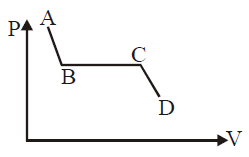
The portion AB of the indicator diagram representing the state of matter denotes :

1. The liquid state of matter
2. Gaseous state of matter
3. Change from liquid to gaseous state
4. Change from gaseous state to liquid state
View Answer

If the portion AB is slant, it indicates that both pressure (P) and volume (V) are changing. In thermodynamic terms, this suggests that AB could represent a compression or expansion, process where both pressure decreases and volume decreases.

Given that you mentioned that the correct answer is "the liquid state of matter," it is likely that AB represents the compression of a liquid.

In many thermodynamic diagrams, when a liquid is compressed or expands slightly, both its pressure and volume can change, though not as dramatically as in gases. This phase corresponds to the liquid region of a substance's phase diagram, where both pressure and volume are decreasing, which is why AB represents the liquid state.

To summarize:
- AB is slant: Both pressure and volume are decreasing.
- Liquid state: Liquids are not perfectly incompressible; hence, both pressure and volume can change, but the changes in volume are relatively small compared to gases.

This slant line indicates the behaviour of a liquid as it is compressed, leading to the conclusion that AB represents the liquid state of matter.