Calorimetry - NEET Physics Questions
Question 1: moderate

A tap supplies water at 10°C and another tap at 100°C. How much hot water must be taken so that we get 20 kg water at 35°C ?

1. 7.2 kg
2. 10 kg
3. 5.6 kg
4. 14.4 kg
View Answer

We can solve this problem using the concept of heat exchange. Let \( m_h \) be the mass of hot water at 100°C, and \( m_c \) be the mass of cold water at 10°C. The total mass of water is given as 20 kg, so:

\[
m_h + m_c = 20 \, \text{kg}
\]

We also know that the final temperature of the mixture is 35°C. The heat gained by cold water must equal the heat lost by hot water:

\[
\text{Heat gained by cold water} = \text{Heat lost by hot water}
\]

Let the specific heat of water be \( c = 4200 \, \text{J/kg}^\circ \text{C} \). Using the formula for heat change:

\[
m_c c (35 - 10) = m_h c (100 - 35)
\]

Since the specific heat \( c \) is the same for both, it cancels out:

\[
m_c (35 - 10) = m_h (100 - 35)
\]
\[
m_c \times 25 = m_h \times 65
\]

We also know \( m_h + m_c = 20 \), so \( m_c = 20 - m_h \). Substituting this into the equation:

\[
(20 - m_h) \times 25 = m_h \times 65
\]
\[
500 - 25 m_h = 65 m_h
\]
\[
500 = 90 m_h
\]
\[
m_h = \frac{500}{90} \approx 5.56 \, \text{kg}
\]

Thus, the mass of hot water needed is approximately 5.56 kg.
Question 2: moderate

Solid ball of 200 gm at 20°C is dropped in an equal amount of water at 80°C. The resulting temperature is 60°C. This means the specific heat of solid is :

1. one fourth of water
2. one half of water
3. twice of water
4. four times of water
View Answer

Given:
- Mass of water \( m_w = 0.2 \, \text{kg} \)
- Initial temperature of water \( T_w = 80^\circ \text{C} \)
- Final temperature \( T_f = 60^\circ \text{C} \)
- Specific heat of water \( c_w = 4200 \, \text{J/kg}^\circ \text{C} \)
- Mass of solid \( m_s = 0.2 \, \text{kg} \)
- Initial temperature of solid \( T_s = 20^\circ \text{C} \)
- Specific heat of solid \( c_s \) (to be found)

Heat lost by water:
\[
Q_{\text{lost (water)}} = m_w c_w (T_w - T_f) = 0.2 \times 4200 \times (80 - 60) = 16800 \, \text{J}
\]

Heat gained by solid:
\[
Q_{\text{gained (solid)}} = m_s c_s (T_f - T_s) = 0.2 \times c_s \times (60 - 20) = 8 c_s
\]

From the heat exchange equation:
\[
16800 = 8 c_s
\]
\[
c_s = \frac{16800}{8} = 2100 \, \text{J/kg}^\circ \text{C}
\]

Since the specific heat of water is \( 4200 \, \text{J/kg}^\circ \text{C} \), we see that the specific heat of the solid is:

\[
c_s = \frac{4200}{2} = 2100 \, \text{J/kg}^\circ \text{C}
\]

Thus, the specific heat of the solid is indeed half of the specific heat of water.

Question 3: moderate

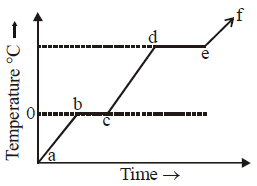
The following figure represents the temperature versus time plot for a given amount of a substance when heat energy is supplied to it at a fixed rate.

Which part of the above plot represent a phase change ?

1. a to b and e to f
2. b to c and c to d
3. d to e and e to f
4. b to c and d to e
View Answer

In Part b to c temperature remains constant even when heat is supplied

Similarly in part d to e temperature remains constant

So state is changing in part b to c and in d to e.

Question 4: moderate

Two spheres A and B have diameters in the ratio 1 : 2, densities in the ratio 2 : 1 and specific heats in the ratio 1 : 3; find the ratio of their thermal capacities :

1. 1 : 6
2. 1 : 12
3. 1 : 3
4. 1 : 4
View Answer

Given:

- Diameter ratio = 1:2
- Density ratio = 2:1
- Specific heat ratio = 1:3

Step 1: Mass ratio
Mass is proportional to \( \text{density} \times \text{volume} \).
Volume is proportional to the cube of the diameter, so the volume ratio is \( (1:2)^3 = 1:8 \).

Thus, mass ratio = \( \text{density} \times \text{volume} = \frac{2 \times 1}{1 \times 8} = 1:4 \).

Step 2: Thermal capacity ratio
Thermal capacity = mass × specific heat.

So, thermal capacity ratio = \( \frac{1 \times 1}{4 \times 3} = 1:12 \).

Final Answer:
The ratio of the thermal capacities is 1:12.

Question 5: moderate

Two liquids A and B are at temperatures of 75°C and 15°C. Their masses are in the ratio of 2 : 3 and their specific heats in the ratio 3 : 4. What is the resulting temperature :

1. 90°C
2. 70°C
3. 35°C
4. 60°C
View Answer

To find the resulting temperature when two liquids A and B are mixed, we can use the principle of conservation of heat energy: the heat lost by the hotter liquid (A) equals the heat gained by the cooler liquid (B).

Given:
- Temperature of liquid A = 75°C
- Temperature of liquid B = 15°C
- Masses of A and B are in the ratio 2:3, so let the masses of A and B be \( 2m \) and \( 3m \), respectively.
- Specific heats of A and B are in the ratio 3:4, so let the specific heats of A and B be \( 3c \) and \( 4c \), respectively.

Let the final temperature of the mixture be \( T \).

Step 1: Heat lost by liquid A (hotter liquid):
\[
Q_A = \text{mass of A} \times \text{specific heat of A} \times (\text{initial temp of A} - T)
\]
\[
Q_A = 2m \times 3c \times (75 - T) = 6mc(75 - T)
\]

Step 2: Heat gained by liquid B (cooler liquid):
\[
Q_B = \text{mass of B} \times \text{specific heat of B} \times (T - \text{initial temp of B})
\]
\[
Q_B = 3m \times 4c \times (T - 15) = 12mc(T - 15)
\]

Step 3: Apply the conservation of heat:
Heat lost by A = Heat gained by B
\[
6mc(75 - T) = 12mc(T - 15)
\]

 Step 4: Simplify and solve for \( T \):
Cancel out \( mc \) from both sides:
\[
6(75 - T) = 12(T - 15)
\]
Expand both sides:
\[
450 - 6T = 12T - 180
\]
Combine like terms:
\[
450 + 180 = 12T + 6T
\]
\[
630 = 18T
\]
Solve for \( T \):
\[
T = \frac{630}{18} = 35 \, ^\circ\text{C}
\]

Final Answer:
The resulting temperature is 35°C.

Question 6: moderate

Steam is passed into 54 gm of water at 30°C till the temperature of mixture becomes 90°C. If the latent heat of steam is 530 cal/gm, the mass of the mixture will be :

1. 80 gm
2. 60 gm
3. 50 gm
4. 24 gm
View Answer

Here’s a short solution:

Given

- Mass of water = 54 gm
- Initial temperature of water = 30°C, Final temperature = 90°C
- Latent heat of steam = 530 cal/gm
- Specific heat of water = 1 cal/gm°C

Step 1: Heat gained by water to reach 90°C:

\[
Q_{\text{gained}} = m_{\text{water}} \times c_{\text{water}} \times \Delta T = 54 \times 1 \times (90 - 30) = 3240 \, \text{cal}
\]

Step 2: Heat lost by steam:

\[
Q_{\text{lost}} = m_s \times (530 + 10) = 540 m_s
\]

Step 3: Equating heat gained and heat lost:

\[
3240 = 540 m_s \quad \Rightarrow \quad m_s = \frac{3240}{540} = 6 \, \text{gm}
\]

Step 4: Total mass of the mixture:

\[
m_{\text{mixture}} = 54 \, \text{gm} + 6 \, \text{gm} = 60 \, \text{gm}
\]

Final Answer:
The mass of the mixture is 60 grams.

Question 7: moderate

If there are no heat losses, the heat released by the condensation of x gm of steam at 100ºC into water at 100ºC can be used to convert y gm of ice at 0ºC into water at 100ºC. Then the ratio y : x is nearly :

1. 1 : 1
2. 2.5 : 1
3. 2 : 1
4. 3 : 1
View Answer

1. Heat released by \(x\) gm steam at \(100^\circ C\):
\[
Q_{\text{steam}} = x \times 540
\]

2. Heat required to convert \(y\) gm ice at \(0^\circ C\) to water at \(100^\circ C\):
\[
Q_{\text{ice}} = y \times 80 + y \times 100 = y \times 180
\]

3. Equating:
\[
x \times 540 = y \times 180
\]

\[
\frac{y}{x} = 3
\]

So, \( y : x = 3 : 1 \).