Calorimetry - NEET Physics Questions
Question 11: easy

Two liquids A and B are at 32°C and 24°C respectively. When equal masses of both are mixed then temperature of mixture becomes 28°C. The ratio of specific heat is :

1. 3 : 2
2. 2 : 3
3. 1 : 1
4. 4 : 3
View Answer

To find the ratio of the specific heats of two liquids A and B when they are mixed, we can use the principle of conservation of energy, which states that the heat lost by the hotter liquid equals the heat gained by the colder liquid.

 Given:
- Temperature of liquid A, \( T_A = 32°C \)
- Temperature of liquid B, \( T_B = 24°C \)
- Final temperature of the mixture, \( T_f = 28°C \)

Let \( c_A \) and \( c_B \) be the specific heats of liquids A and B, respectively. Since equal masses of both liquids are mixed, we can denote the mass as \( m \).

 Heat Lost by A:
\[
Q_A = m \cdot c_A \cdot (T_A - T_f) = m \cdot c_A \cdot (32 - 28) = 4m c_A
\]

 Heat Gained by B:
\[
Q_B = m \cdot c_B \cdot (T_f - T_B) = m \cdot c_B \cdot (28 - 24) = 4m c_B
\]

 Setting Heat Lost Equal to Heat Gained:
\[
Q_A = Q_B
\]
\[
4m c_A = 4m c_B
\]

Canceling \( 4m \) from both sides:
\[
c_A = c_B
\]

Conclusion:
The ratio of the specific heats of liquids A and B is:
\[
\frac{c_A}{c_B} = 1
\]

Thus, the ratio of the specific heats is 1:1.
Question 12: moderate

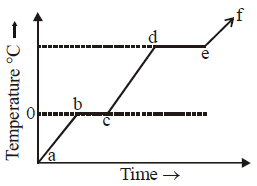
The following figure represents the temperature versus time plot for a given amount of a substance when heat energy is supplied to it at a fixed rate.

Which part of the above plot represent a phase change ?

1. a to b and e to f
2. b to c and c to d
3. d to e and e to f
4. b to c and d to e
View Answer

In Part b to c temperature remains constant even when heat is supplied

Similarly in part d to e temperature remains constant

So state is changing in part b to c and in d to e.

Question 13: difficult

10 gm of ice at –20°C is added to 10 gm of water at 50°C Specific heat of water = 1 cal / gm-°C, specific heat of ice = 0.5 cal /gm-°C. Latent heat of ice = 80 cal /gm. Then, resulting temperature is :

1. –20°C
2. 15°C
3. 0°C
4. 50°C
View Answer

1. Heat gained by ice to reach 0°C:
\[
Q_{\text{ice heating}} = 10 \, \text{g} \cdot 0.5 \, \text{cal/g°C} \cdot 20°C = 100 \, \text{cal}
\]

2. Heat gained by ice to melt:
\[
Q_{\text{ice melting}} = 10 \, \text{g} \cdot 80 \, \text{cal/g} = 800 \, \text{cal}
\]

Total heat gained by ice:
\[
Q_{\text{total ice}} = 100 \, \text{cal} + 800 \, \text{cal} = 900 \, \text{cal}
\]

3. Heat lost by water:
\[
Q_{\text{water cooling}} = 10 \, \text{g} \cdot 1 \, \text{cal/g°C} \cdot (50 - T) = 500 - 10T \, \text{cal}
\]

4. Set heat gained equal to heat lost:
\[
500 - 10T = 900 \Rightarrow -10T = 400 \Rightarrow T = -40°C
\]

Since this temperature is below 0°C, all the ice will not melt.

5. Equilibrium Calculation:
Let \( x \) be the mass of ice that melts:
\[
500 = 70x + 100 \Rightarrow 400 = 70x \Rightarrow x \approx 5.71 \, \text{g}
\]

Result:
The final temperature of the system will be **0°C**.

Question 14: moderate

Two spheres A and B have diameters in the ratio 1 : 2, densities in the ratio 2 : 1 and specific heats in the ratio 1 : 3; find the ratio of their thermal capacities :

1. 1 : 6
2. 1 : 12
3. 1 : 3
4. 1 : 4
View Answer

Given:

- Diameter ratio = 1:2
- Density ratio = 2:1
- Specific heat ratio = 1:3

Step 1: Mass ratio
Mass is proportional to \( \text{density} \times \text{volume} \).
Volume is proportional to the cube of the diameter, so the volume ratio is \( (1:2)^3 = 1:8 \).

Thus, mass ratio = \( \text{density} \times \text{volume} = \frac{2 \times 1}{1 \times 8} = 1:4 \).

Step 2: Thermal capacity ratio
Thermal capacity = mass × specific heat.

So, thermal capacity ratio = \( \frac{1 \times 1}{4 \times 3} = 1:12 \).

Final Answer:
The ratio of the thermal capacities is 1:12.

Question 15: moderate

Two liquids A and B are at temperatures of 75°C and 15°C. Their masses are in the ratio of 2 : 3 and their specific heats in the ratio 3 : 4. What is the resulting temperature :

1. 90°C
2. 70°C
3. 35°C
4. 60°C
View Answer

To find the resulting temperature when two liquids A and B are mixed, we can use the principle of conservation of heat energy: the heat lost by the hotter liquid (A) equals the heat gained by the cooler liquid (B).

Given:
- Temperature of liquid A = 75°C
- Temperature of liquid B = 15°C
- Masses of A and B are in the ratio 2:3, so let the masses of A and B be \( 2m \) and \( 3m \), respectively.
- Specific heats of A and B are in the ratio 3:4, so let the specific heats of A and B be \( 3c \) and \( 4c \), respectively.

Let the final temperature of the mixture be \( T \).

Step 1: Heat lost by liquid A (hotter liquid):
\[
Q_A = \text{mass of A} \times \text{specific heat of A} \times (\text{initial temp of A} - T)
\]
\[
Q_A = 2m \times 3c \times (75 - T) = 6mc(75 - T)
\]

Step 2: Heat gained by liquid B (cooler liquid):
\[
Q_B = \text{mass of B} \times \text{specific heat of B} \times (T - \text{initial temp of B})
\]
\[
Q_B = 3m \times 4c \times (T - 15) = 12mc(T - 15)
\]

Step 3: Apply the conservation of heat:
Heat lost by A = Heat gained by B
\[
6mc(75 - T) = 12mc(T - 15)
\]

 Step 4: Simplify and solve for \( T \):
Cancel out \( mc \) from both sides:
\[
6(75 - T) = 12(T - 15)
\]
Expand both sides:
\[
450 - 6T = 12T - 180
\]
Combine like terms:
\[
450 + 180 = 12T + 6T
\]
\[
630 = 18T
\]
Solve for \( T \):
\[
T = \frac{630}{18} = 35 \, ^\circ\text{C}
\]

Final Answer:
The resulting temperature is 35°C.

Question 16: moderate

Steam is passed into 54 gm of water at 30°C till the temperature of mixture becomes 90°C. If the latent heat of steam is 530 cal/gm, the mass of the mixture will be :

1. 80 gm
2. 60 gm
3. 50 gm
4. 24 gm
View Answer

Here’s a short solution:

Given

- Mass of water = 54 gm
- Initial temperature of water = 30°C, Final temperature = 90°C
- Latent heat of steam = 530 cal/gm
- Specific heat of water = 1 cal/gm°C

Step 1: Heat gained by water to reach 90°C:

\[
Q_{\text{gained}} = m_{\text{water}} \times c_{\text{water}} \times \Delta T = 54 \times 1 \times (90 - 30) = 3240 \, \text{cal}
\]

Step 2: Heat lost by steam:

\[
Q_{\text{lost}} = m_s \times (530 + 10) = 540 m_s
\]

Step 3: Equating heat gained and heat lost:

\[
3240 = 540 m_s \quad \Rightarrow \quad m_s = \frac{3240}{540} = 6 \, \text{gm}
\]

Step 4: Total mass of the mixture:

\[
m_{\text{mixture}} = 54 \, \text{gm} + 6 \, \text{gm} = 60 \, \text{gm}
\]

Final Answer:
The mass of the mixture is 60 grams.

Question 17: easy

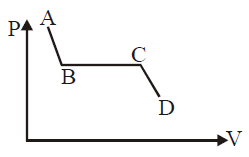
The portion AB of the indicator diagram representing the state of matter denotes :

1. The liquid state of matter
2. Gaseous state of matter
3. Change from liquid to gaseous state
4. Change from gaseous state to liquid state
View Answer

If the portion AB is slant, it indicates that both pressure (P) and volume (V) are changing. In thermodynamic terms, this suggests that AB could represent a compression or expansion, process where both pressure decreases and volume decreases.

Given that you mentioned that the correct answer is "the liquid state of matter," it is likely that AB represents the compression of a liquid.

In many thermodynamic diagrams, when a liquid is compressed or expands slightly, both its pressure and volume can change, though not as dramatically as in gases. This phase corresponds to the liquid region of a substance's phase diagram, where both pressure and volume are decreasing, which is why AB represents the liquid state.

To summarize:
- AB is slant: Both pressure and volume are decreasing.
- Liquid state: Liquids are not perfectly incompressible; hence, both pressure and volume can change, but the changes in volume are relatively small compared to gases.

This slant line indicates the behaviour of a liquid as it is compressed, leading to the conclusion that AB represents the liquid state of matter.

Question 18: moderate

If there are no heat losses, the heat released by the condensation of x gm of steam at 100ºC into water at 100ºC can be used to convert y gm of ice at 0ºC into water at 100ºC. Then the ratio y : x is nearly :

1. 1 : 1
2. 2.5 : 1
3. 2 : 1
4. 3 : 1
View Answer

1. Heat released by \(x\) gm steam at \(100^\circ C\):
\[
Q_{\text{steam}} = x \times 540
\]

2. Heat required to convert \(y\) gm ice at \(0^\circ C\) to water at \(100^\circ C\):
\[
Q_{\text{ice}} = y \times 80 + y \times 100 = y \times 180
\]

3. Equating:
\[
x \times 540 = y \times 180
\]

\[
\frac{y}{x} = 3
\]

So, \( y : x = 3 : 1 \).