Question 11:
moderate
Two mirrors at an angle θ produce 5 images of a point. The number of images produced when θ is decreased to 30° is
Two mirrors at an angle θ produce 5 images of a point. The number of images produced when θ is decreased to 30° is
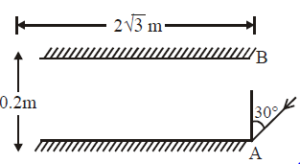
Two plane mirrors A and B are aligned parallel to each other, as shown in the figure. A light ray is incident at an angle of 30° at a point just inside one end of A. The plane of incidence coincides with the plane of the figure. The maximum number of times the ray undergoes reflections (including the first one) before it emerges out is :
Assertion (A): Keeping a point object fixed, if a plane mirror is moved, the image will also move.
Reason (R): In case of a plane mirror, distance of object and its image is equal from any point on the mirror.
Assertion (A) is true; the image position is relative to the mirror, so it moves with the mirror. Reason (R) is true as per the property of plane mirrors, where \(OP = IP\). (R) correctly explains (A) as image movement maintains this property.
Assertion (A): A virtual image formed by plane mirror may be inverted.
Reason (R): Longitudinal magnification in this case of plane mirror is \(-1\).
Assertion A is true because a plane mirror forms a laterally inverted image. Reason R is true because for a plane mirror, longitudinal magnification \(m_L = - (v/u)^2 = -1\). However, longitudinal magnification does not explain lateral inversion.
Assertion (A): If there is relative motion between a point object & a plane mirror then there must be relative motion between object and image formed by mirror.
Reason (R): If the gap between object and mirror will change, the gap between object and image remains same.
Assertion A is true because if the object moves relative to the mirror, its image also moves, causing relative motion between object and image. Reason R is false because for a plane mirror, the object-image gap is twice the object-mirror gap, so if the object-mirror gap changes, the object-image gap also changes.
Assertion (A): A parallel beam of light travelling in air can be displaced laterally by a parallel transparent slab by distance more than the thickness of the plate.
Reason (R): The lateral displacement of light travelling in air increases with fall in value of refractive index of slab.
Assertion A is false as the lateral displacement of light through a parallel slab is always less than or equal to its thickness. Reason R is false because lateral displacement decreases as the refractive index of the slab falls.
Assertion (A): The minimum length of mirror required to form complete image of man of height \(H) is \(H/2\).
Reason (R): Image of an object is obtained if incident light ray reaches the reflecting surface.
The minimum length of a plane mirror to see a full image of a person of height \(H) is \(H/2\). Image formation occurs when light rays reach and reflect from a surface. Both statements are true, but R is a general principle and does not explain the specific \(H/2\) relation.
Assertion (A): Any ray of light suffers a deviation of \(180° – 2i\) after one reflection from plane mirror.
Reason (R): For normal incidence of light on the plane mirror deviation is zero.
For a plane mirror, the angle of deviation \(delta\) for an incident ray is given by \(delta = 180° - 2i\), where \(i\) is the angle of incidence. Thus, Assertion (A) is true. For normal incidence, \(i=0\), and the ray retraces its path, meaning its direction is reversed. This corresponds to a deviation of \(180°\), not zero. Hence, Reason (R) is false.
Assertion (A): In case of single refraction by plane surface image and object are on the same side.
Reason (R): If object is real, image will be virtual and vice-versa.
For a plane refracting surface, a real object always forms a virtual image. This virtual image is formed on the same side of the plane surface as the object itself, as light rays appear to diverge from it after refraction.
Assertion (A): Law of reflection is applicable for all type of mirrors.
Reason (R): Rays which are parallel to principal axis are known as paraxial rays.
Laws of reflection are fundamental and apply to all mirrors, so (A) is true. Paraxial rays are rays close and parallel to the principal axis, so (R) is true. (R) defines a term, it does not explain the universality of reflection laws.