Question 21:
easy
The image of an object placed perpendicular to the principal axis of a mirror, will be erect if :
The image of an object placed perpendicular to the principal axis of a mirror, will be erect if :
An object O is placed in front of a plane mirror and concave mirror as shown in fig. If ‘f’ is the focal length of concave mirror then the separation between the two mirrors so that the images formed by mirrors coincide:
A light ray traveling parallel to the principal axis of a concave mirror strikes the mirror at angle of incidence q. If radius of curvature of the mirror is R, then after reflection, the ray meets the principal axis at distance d from the centre of curvature, then d is
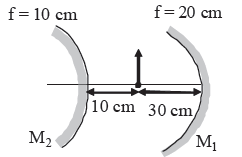
In the figure shown find the total magnification after two successive reflections first on M1 & then on M2 (Take Ist reflection from concave mirror)
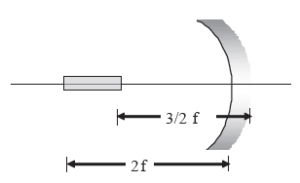
A linear object is placed along the axis of a mirror as shown in fig. If ‘f’ is the focal length of the mirror then the length of image is
A clock hung on a wall has marks instead of numerals on its dial. On the adjoining wall, there is a plane mirror and the image of the clock in the mirror indicates the time 7 : 10. Then the time on the clock is :
Two plane mirrors are parallel to each other and spaced 20 cm apart. An object is kept between them at 15 cm from A. Out of the following at which point, an image is not formed in mirror A: (distance measured from mirror A)
A short linear object of length L lies on the axis of a spherical mirror of focal length ƒ at a distance u from the mirror. Its image has an axial length L’ equal to :
When seen in green light, the saffron and green portions of our national flag will appear to be :
When a light ray enters refracting medium, it is found that the magnitude of the angle of refraction is equal to half the angle of reflection. If n is the refractive index of the medium, then the angle of incidence is :