Ray Optics - NEET Physics Questions
Question 11: difficult

When an object is placed at a distance of 25 cm from a mirror, the magnification is m1. The object is moved 15 cm further away from mirror with respect to the earlier position and the magnification becomes m2. If m1/m2 = 4 , then calculate the focal length of the mirror :
1. –20 cm
2. 20 cm
3. 30 cm
4. -30 cm
View Answer
Question 12: moderate

A person looks into a shaving mirror. The size of image of his face is twice the actual size of his face. If the face is at a distance 20 cm then find the radius of curvature of the mirror :

1. 80 cm
2. 60 cm
3. 160 cm
4. 20 cm
View Answer
Question 13: difficult

A square of side 2 cm is placed at a distance of 30 cm from a concave mirror of focal length 20 cm. The centre of the square is at the axis of the mirror and the plane is perpendicular to the axis. The area enclosed by the image is :

1. 4 cm²
2. 16 cm²
3. 25/16 cm²
4. 16/25 cm²
View Answer
Question 14: moderate

An object of length 2.5 cm is placed at a distance of 1.5f from a concave mirror of focal length f. The length of the object is perpendicular to the principal axis. Find the length of image ?

1. 2.5 cm
2. 5 cm
3. 10 cm
4. 15 cm
View Answer
Question 15: easy

An object is placed on the principal axis of a concave mirror of focal length 10 cm at a distance of 8 cm from the pole. Find position and nature of the image :

1. 40 cm, Real
2. 40 cm, Virtual
3. 20 cm, Real
4. 20 cm, Virtual
View Answer
Question 16: difficult

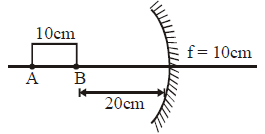
A rod of length 10 cm lies along the principal axis of a concave mirror of focal length 10 cm in such a way that the end closer to the pole is 20 cm away from it. Find the length of the image :

1. 5 cm
2. 15 cm
3. 30 cm
4. 10 cm
View Answer
Question 17: difficult

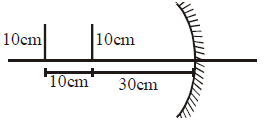
A U-shaped wire is placed before a concave mirror having focal length 10 cm. Find the total length of the image :

1. 45 cm
2. 30 cm
3. 50 cm
4. 10 cm
View Answer
Question 18: easy

A point object is placed at a distance of 30 cm from a convex mirror of focal length 30 cm. The image will form at :

1. Infinity
2. Pole
3. Focus
4. 15 cm behind the mirror
View Answer
Question 19: easy

Mark the correct options :

1. If the reflected rays are converging, we have a real object
2. If the final reflected rays are converging, we have a real image
3. The image of a virtual object is called a virtual image
4. If the image is virtual, the corresponding object is called a virtual object
View Answer
Question 20: easy

Which of the following (referred to a spherical mirror) depend on whether the rays are paraxial or not ?

1. Pole
2. Focus
3. Radius of curvature
4. Principal axis
View Answer