Question 51:
difficult
What will be the resultant magnetic field at origin due to four infinite length wires. If each wire produces magnetic field ‘B’ at origin:
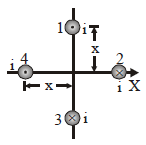
What will be the resultant magnetic field at origin due to four infinite length wires. If each wire produces magnetic field ‘B’ at origin:
Two particles, each of mass m and charge q, are attached to the two ends of a massless rigid rod of length 2R. The rod is rotated at constant angular speed about a perpendicular axis passing through its centre. The ratio of the magnitudes of the magnetic moment of the system and its angular momentum about the centre of the rod is :
A magnetic substance has susceptibility –0.05 at 300 K. The magnetic susceptibility of the substance at 600 K will be :
Two very long straight parallel wires carry steady currents i and 2i in opposite directions. The
distance between the wires is d. At a certain instant of time a point charge q is at a point
equidistant from the two wires in the plane of the wires. Its instantaneous velocity \(\overrightarrow{v}\)
is perpendicular to this plane. The magnitude of the force due to the magnetic field acting on the charge at this instant is :
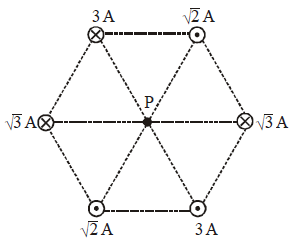
Consider a set of six infinite long straight parallel wires arranged perpendicular to the plane of paper in a hexagon as shown. The length of the each side of the hexagon is 3 cm. What is the magnitude and direction of the magnetic field at point P ?
A long solenoid carrying a current produces a magnetic field B along its axis. If the current is
doubled and the number of turns per unit length is halved, the new value of the magnetic field
is :
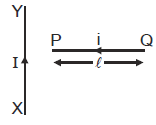
A wire PQ carries a current ‘i’ is placed perpendicular to a long wire XY carrying a current
I. The direction of force on PQ will be:
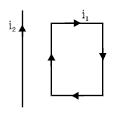
A rectangular loop carrying a current i1, is situated near a long straight wire carrying a steady current i2. The wire is parallel to one of the sides of the loop and is in the plane of the loop as shown in the figure. Then the current loop will :
A helium nucleus is moving in a circular path of radius \(0.8\text{ m}\). If it takes \(2\text{ sec}\) to complete one revolution, the magnetic field produced at the centre of the circle is:
Current is \(I = \frac{q}{T} = \frac{2e}{2} = e = 1.6 \times 10^{-19}\text{ A}\). The magnetic field at the centre is \(B = \frac{\mu_0 I}{2R} = \frac{\mu_0 (1.6 \times 10^{-19})}{2(0.8)} = \mu_0 \times 10^{-19}\text{ T}\).
If a charged particle goes unaccelerated in a region containing electric & magnetic fields:
(a) \(\vec{E}\) must be perpendicular to \(\vec{B}\)
(b) \(\vec{v}\) must be perpendicular to \(\vec{E}\)
(c) \(\vec{v}\) must be perpendicular to \(\vec{B}\)
(d) \(E\) must be equal to \(vB\)
For the net force to be zero, \(\vec{F}_e + \vec{F}_b = 0 ⇒ \vec{E} = -(\vec{v} \times \vec{B})\). Since \(\vec{E}\) is the cross product, it must be perpendicular to both \(\vec{B}\) and \(\vec{v}\).