Ampere's Circuital Law - NEET Physics Questions
Question 1: moderate

A long solenoid has 200 turns per cm and carries a current i. The magnetic field at its centre is 6.28 × 10–² weber/m². Another long solenoid has 100 turns per cm and it carries a current i/3. The value of the magnetic field at its centre is

1. \[1.05\times 10^{-2} weber/m^{2}\]
2. \[1.05\times 10^{-5} weber/m^{2}\]
3. \[1.05\times 10^{-3} weber/m^{2}\]
4. \[1.05\times 10^{-4} weber/m^{2}\]
View Answer

To solve this problem, we use the formula for the magnetic field inside a long solenoid:


B=μ0ni,B = \mu_0 n i,


where:


  • BB
     

    is the magnetic field at the center of the solenoid,


  • μ0=4π×107T\cdotpm/A\mu_0 = 4\pi \times 10^{-7} \, \text{T·m/A}
     

    is the permeability of free space,


  • nn
     

    is the number of turns per unit length (in meters),


  • ii
     

    is the current in the solenoid.


Step 1: Magnetic Field for the First Solenoid

The first solenoid has:


  • n1=200turns per cm=200×100=20000turns per metern_1 = 200 \, \text{turns per cm} = 200 \times 100 = 20000 \, \text{turns per meter}
     

    ,


  • i1=ii_1 = i
     

    ,


  • B1=6.28×10²weber/m2B_1 = 6.28 \times 10^{-2} \, \text{weber/m}^2
     

    .

Using the formula for

BB

, substitute

B1B_1

to find

ii

:


B1=μ0n1i,B_1 = \mu_0 n_1 i,


6.28×102=(4π×107)20000i.6.28 \times 10^{-2} = (4\pi \times 10^{-7}) \cdot 20000 \cdot i.


Simplify:


i=6.28×1024π×10720000.i = \frac{6.28 \times 10^{-2}}{4\pi \times 10^{-7} \cdot 20000}.


Substitute

4π12.574\pi \approx 12.57

:


i=6.28×10212.57×10720000=6.28×1022.514×102.i = \frac{6.28 \times 10^{-2}}{12.57 \times 10^{-7} \cdot 20000} = \frac{6.28 \times 10^{-2}}{2.514 \times 10^{-2}}.


i=2.5A.i = 2.5 \, \text{A}.


Step 2: Magnetic Field for the Second Solenoid

The second solenoid has:


  • n2=100turns per cm=100×100=10000turns per metern_2 = 100 \, \text{turns per cm} = 100 \times 100 = 10000 \, \text{turns per meter}
     

    ,


  • i2=i3=2.53=0.833Ai_2 = \frac{i}{3} = \frac{2.5}{3} = 0.833 \, \text{A}
     

    .

Using the formula for

BB

:


B2=μ0n2i2,B_2 = \mu_0 n_2 i_2,


Substitute the values:


B2=(4π×107)100000.833.B_2 = (4\pi \times 10^{-7}) \cdot 10000 \cdot 0.833.


Simplify:


B2=4π×1078330.B_2 = 4\pi \times 10^{-7} \cdot 8330.


Substitute

4π12.574\pi \approx 12.57

:


B2=12.57×1078330=1.048×102.B_2 = 12.57 \times 10^{-7} \cdot 8330 = 1.048 \times 10^{-2}.


Final Answer:


B2=1.05×10²weber/m2\boxed{B_2 = 1.05 \times 10^{-2} \, \text{weber/m}^2}


Question 2: moderate

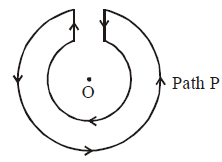
In the adjacent figure is shown a closed path P. A long straight conductor carrying a current I passes through O and perpendicular to the plane of the paper. Then which of the following holds good ?


1. \[\int_{P}^{}\overrightarrow{B}.\overrightarrow{dl}=0\]
2. \[\int_{P}^{}\overrightarrow{B}.\overrightarrow{dl}=\mu_{0}I\]
3. \[\int_{P}^{}\overrightarrow{B}.\overrightarrow{dl}>\mu_{0}I\]
4. None of these
View Answer

As Current enclosed is zero.  \[\int_{P}^{}\overrightarrow{B}.\overrightarrow{dl}=0\]

Question 3: moderate

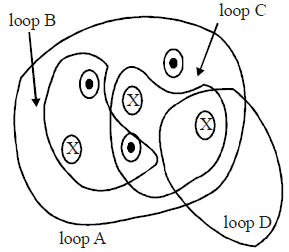
Consider six wires coming into or out of the page, all with the same current. Rank the line integral of the magnetic field (from most positive to most negative) taken counter-clockwise around each

loop shown.

1. B > C > D > A
2. B > C = D > A
3. B > A > C = D  
4. C > B = D > A
View Answer

Current enclosed in A = 3i -3i =0

Current enclosed in B = 2i-i=i

Current enclosed in C = - 2i + i= - i

Current enclosed in D= -i

so Correct order of integral of B.dl is B > A > C = D

Question 4: moderate

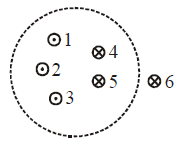
Six wires of current I1 = 1A, I2 = 2A, I3 = 3A, I4 = 1A, I5 = 4A, I6 = 5A cut the page perpendicular at points 1,2,3,4,5 and 6. The value of time integral of \(\overrightarrow{B}\) around the dotted closed path \(\left( i.e, \oint_{}^{}\overrightarrow{B} \overrightarrow{dl} \right)\)  is :

1. zero
2. \[\mu_{0} wb m^{-1}\]
3. \[2\mu_{0} wb m^{-1}\]
4. \[4\mu_{0} wb m^{-1}\]
View Answer

current enclosed is (1+2+3-1-4)= 1A

using ampere circuital law we get the answer.