Ampere's Circuital Law - NEET Physics Questions
Question 1: difficult

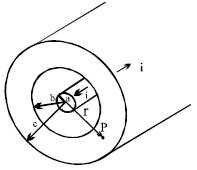
A coaxial cable having radius “a” of inner wire and inner and outer radii “b” and “c” respectively
of the outer shell carries equal and opposite currents of magnitude i on the inner and outer
conductors as shown. What is the magnitude of the magnetic induction at point P of the cable at
a distance r (b < r < c) from the axis?
1. Zero
2. \[\frac{\mu_{0}ir}{2\pi a^{2}}\]
3. \[\frac{\mu_{0}i}{2\pi r}\]
4. \[\frac{\mu_{0}i}{2\pi r}\frac{c^{2}-r^{2}}{c^{2}-b^{2}}\]
View Answer

To calculate the magnetic field

BB

at a point

PP

within the outer shell of a coaxial cable (

b<r<cb < r < c

), carrying equal and opposite currents

ii

on the inner and outer conductors, we use Ampère's law and superposition principles.


1. Current Distribution in the Outer Shell

The outer shell carries current

i-i

, distributed uniformly across the cross-sectional area of the shell between radii

bb

and

cc

.

The current density

JJ

in the shell is:


J=iπ(c2b2).J = \frac{-i}{\pi (c^2 - b^2)}.


The current enclosed within a radius

rr

(

b<r<cb < r < c

) in the outer shell is the current

i-i

contributed by the region from

bb

to

rr

:


Ienc,shell=Jarea of shell portion=Jπ(r2b2).I_{\text{enc,shell}} = J \cdot \text{area of shell portion} = J \cdot \pi (r^2 - b^2).


Substituting

JJ

:


Ienc,shell=iπ(c2b2)π(r2b2)=i(r2b2)c2b2.I_{\text{enc,shell}} = \frac{-i}{\pi (c^2 - b^2)} \cdot \pi (r^2 - b^2) = \frac{-i (r^2 - b^2)}{c^2 - b^2}.


2. Net Enclosed Current at Radius rr


At any point

PP

within the shell (

b<r<cb < r < c

), the net current enclosed by a loop of radius

rr

is:


Ienc=current from the inner wire+current from the outer shell.I_{\text{enc}} = \text{current from the inner wire} + \text{current from the outer shell}.


The inner wire contributes

+i+i

, and the shell contributes

Ienc,shellI_{\text{enc,shell}}

:


Ienc=i+i(r2b2)c2b2.I_{\text{enc}} = i + \frac{-i (r^2 - b^2)}{c^2 - b^2}.


Simplify:


Ienc=i(1r2b2c2b2).I_{\text{enc}} = i \left(1 - \frac{r^2 - b^2}{c^2 - b^2}\right).


Factorize:


Ienc=ic2r2c2b2.I_{\text{enc}} = i \cdot \frac{c^2 - r^2}{c^2 - b^2}.


3. Magnetic Field at Radius rr


Using Ampère's law, the magnetic field

BB

at radius

rr

is:


B2πr=μ0Ienc.B \cdot 2\pi r = \mu_0 I_{\text{enc}}.


Substitute

IencI_{\text{enc}}

:


B2πr=μ0ic2r2c2b2.B \cdot 2\pi r = \mu_0 \cdot i \cdot \frac{c^2 - r^2}{c^2 - b^2}.


Solve for

BB

:


B=μ0i2πrc2r2c2b2.B = \frac{\mu_0 i}{2\pi r} \cdot \frac{c^2 - r^2}{c^2 - b^2}.


Final Answer:


B=μ0i2πrc2r2c2b2\boxed{B = \frac{\mu_0 i}{2\pi r} \cdot \frac{c^2 - r^2}{c^2 - b^2}}


Question 2: difficult

A hallow cylindrical wire carries current I, having inner & outer radius R & 2R respectively. Magnetic field at a point which is 5R/4 distance away from the wire :

1. \[\frac{5\mu_{0}I}{18\pi R}\]
2. \[\frac{\mu_{0}I}{36\pi R}\]
3. \[\frac{5\mu_{0}I}{36\pi R}\]
4. \[\frac{3}{40}\frac{\mu_{0}I}{\pi R}\]
View Answer

To solve for the magnetic field at a distance of

5R4\frac{5R}{4}

from the axis of a hollow cylindrical wire carrying current

II

, with inner radius

RR

and outer radius

2R2R

, we use Ampère's Law. The key steps are:

1. Magnetic Field Inside a Hollow Cylinder

For

R<r<2RR < r < 2R

(points within the shell of the cylinder):

  • Current density
    JJ
     

    is uniform, given by: 

    J=Iπ((2R)2R2)=I3πR2.J = \frac{I}{\pi \left((2R)^2 - R^2\right)} = \frac{I}{3\pi R^2}. 

  • The current enclosed within a radius
    rr
     

    (where R<r<2RR < r < 2R 

    ) is: 

    Ienc=Jarea enclosed=Jπ(r2R2).I_{\text{enc}} = J \cdot \text{area enclosed} = J \cdot \pi (r^2 - R^2).Substituting

    JJ:


    Ienc=I3πR2π(r2R2)=I3R2(r2R2).I_{\text{enc}} = \frac{I}{3\pi R^2} \cdot \pi (r^2 - R^2) = \frac{I}{3R^2}(r^2 - R^2). 

  • Using Ampère's Law: 

    B2πr=μ0Ienc,B \cdot 2\pi r = \mu_0 I_{\text{enc}}, 

    B=μ02πrI3R2(r2R2).B = \frac{\mu_0}{2\pi r} \cdot \frac{I}{3R^2}(r^2 - R^2). 

2. Magnetic Field at r=5R4r = \frac{5R}{4}


Since

5R4\frac{5R}{4}

lies within the shell (

R<r<2RR < r < 2R

), substitute

r=5R4r = \frac{5R}{4}

into the above equation:


B=μ02π5R4I3R2((5R4)2R2).B = \frac{\mu_0}{2\pi \cdot \frac{5R}{4}} \cdot \frac{I}{3R^2}\left(\left(\frac{5R}{4}\right)^2 - R^2\right).


Simplify:


  • r2=(5R4)2=25R216r^2 = \left(\frac{5R}{4}\right)^2 = \frac{25R^2}{16}
     

    ,


  • r2R2=25R216R2=25R21616R216=9R216r^2 - R^2 = \frac{25R^2}{16} - R^2 = \frac{25R^2}{16} - \frac{16R^2}{16} = \frac{9R^2}{16}
     

    .

Thus:


B=μ02π5R4I3R29R216.B = \frac{\mu_0}{2\pi \cdot \frac{5R}{4}} \cdot \frac{I}{3R^2} \cdot \frac{9R^2}{16}.


Simplify further:


B=μ02π45R9I48=μ0I2π36240R.B = \frac{\mu_0}{2\pi} \cdot \frac{4}{5R} \cdot \frac{9I}{48} = \frac{\mu_0 I}{2\pi} \cdot \frac{36}{240R}.


Final simplification:


B=340μ0IπR.B = \frac{3}{40} \frac{\mu_0 I}{\pi R}.


Final Answer:


B=340μ0IπR\boxed{B = \frac{3}{40} \frac{\mu_0 I}{\pi R}}