Electrostatics - NEET Physics Questions
← All Chapters

Electrostatics

Question 41: moderate

When 2 point charges +q and +3q are held at a distance r from each other are released, they have an acceleration of a and 2a respectively. When we distribute the total charge equally between them , keep them at same distance as the original and release them , their accelerations now would be:

1. 2a and 4a
2. 4a/3 and 8a/3
3. 9a/4 and 9a/2
4. 2a/3 and 4a/3
View Answer

Initial Setup:
1. Charges and Forces:
- Two charges \( +q \) and \( +3q \) are separated by distance \( r \).
- The force between them initially is:
\[
F = \frac{k \cdot q \cdot 3q}{r^2} = \frac{3kq^2}{r^2}
\]

2. Accelerations:
- Let the masses of the charges be \( m_1 \) and \( m_2 \).
- Given that the initial accelerations are \( a \) and \( 2a \) for charges \( +q \) and \( +3q \) respectively, we have:
\[
F = m_1 a \quad \text{and} \quad F = m_2 \cdot 2a
\]

Step 1: Determine Mass Ratio
From the equations \( m_1 a = m_2 \cdot 2a \), we get:
\[
m_2 = \frac{m_1}{2}
\]

Step 2: New Charges After Redistribution
When the total charge \( q + 3q = 4q \) is equally distributed, each charge will be:
\[
\frac{4q}{2} = 2q
\]

Step 3: New Force Between Charges
With the new charges \( +2q \) and \( +2q \) at the same distance \( r \), the new force \( F' \) is:
\[
F' = \frac{k \cdot 2q \cdot 2q}{r^2} = \frac{4kq^2}{r^2}
\]

Step 4: New Accelerations
Using \( F' = m_1 a_1' \) and \( F' = m_2 a_2' \), we get:
1. For the first charge (\( m_1 \)):
\[
a_1' = \frac{F'}{m_1} = \frac{4kq^2 / r^2}{m_1} = \frac{4a}{3}
\]

2. For the second charge (\( m_2 = \frac{m_1}{2} \)):
\[
a_2' = \frac{F'}{m_2} = \frac{4kq^2 / r^2}{m_1 / 2} = \frac{8a}{3}
\]

Answer
The new accelerations are:
\[
\frac{4a}{3} \quad \text{and} \quad \frac{8a}{3}
\]

Question 42: moderate

Two conducting sphere s of radii R each are given charges +Q and –Q and are separated by a distance r (>2R). Th e force of attraction between them is \( \overrightarrow{F} \)If instead of charges +Q and –Q, we were to give them charges +Q each , the force of interaction between them would be

1. \[ \overrightarrow{F}\]
2. \[ - \overrightarrow{F}\]
3. direction opposite to \( \overrightarrow{F} \)but magnitude lesser than it
4. direction opposite to \( \overrightarrow{F} \) but magnitude more than it
View Answer

When the spheres have charges \( +Q \) and \( -Q \), they attract each other with force \( \overrightarrow{F} \).

If we replace \( -Q \) with \( +Q \), both spheres will have \( +Q \) charge, causing a repulsive force instead of attraction.

Since \( r > 2R \), there will be induced charges on the surfaces due to electrostatic induction, reducing the effective repulsive force compared to the attractive force \( \overrightarrow{F} \) in the initial configuration.

Conclusion:
The new force will be in the opposite direction to \( \overrightarrow{F} \) (repulsive) but with a magnitude less than \( F \) due to the effect of induced charges.

Question 43: moderate

As shown in the diagram, two fixed charges, q1 = +1.00 μC and q2 = –4.00 μC, are 0.200 m apart. Where is the total field zero?

1. 0.40 m to the right of q1
2. 0.13 m to the right of q1
3. 0.20 m to the left of q1
4. 0.067 m to the left of q1
View Answer
Question 44: moderate

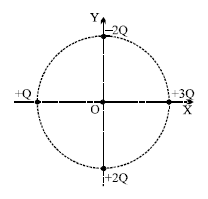
Four charges are placed on the circumference of a circle of radius R, 90° apart as shown in the figure . The electric field strength at the centre of the circle is

1. \frac{1}{4\pi\varepsilon_{0}}\frac{2\sqrt{5}Q}{R^{2}}, making angle tan^{-1}2 with the -ve axis
2. \frac{1}{4\pi\varepsilon_{0}}\frac{2\sqrt{5}Q}{R^{2}}, making angle tan^{-1}2 with the +ve axis
3. \frac{1}{4\pi\varepsilon_{0}}\frac{4\sqrt{2}Q}{R^{2}}, making angle tan^{-1}\frac{1}{2} with the -ve axis
4. \frac{1}{4\pi\varepsilon_{0}}\frac{4\sqrt{2}Q}{R^{2}}, making angle tan^{-1}\frac{1}{2} with the +ve axis
View Answer
Question 45: difficult

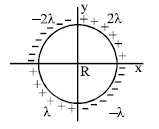
The charge per unit length of the four quadrant of the ring is 2λ , – 2λ , λ and -λ respectively. The electric field at the centre is

1. -\frac{\lambda}{2\pi\varepsilon_{0}R}\hat{i}
2. \frac{\lambda}{2\pi\varepsilon_{0}R}\hat{j}
3. \frac{\sqrt{2}\lambda}{4\pi\varepsilon_{0}R}\hat{i}
4. None
View Answer
Question 46: moderate

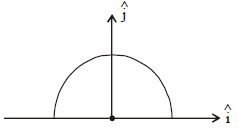
A thin semi-circular ring of radius r has a positive charge q distributed uniformly over it. The net field \overrightarrow{E} at the centre O is :

1. -\frac{q}{2\pi^{2}\varepsilon_{0}r^{2}}\hat{j}
2. \frac{q}{2\pi^{2}\varepsilon_{0}r^{2}}\hat{j}
3. \frac{q}{4\pi^{2}\varepsilon_{0}r^{2}}\hat{j}
4. -\frac{q}{4\pi^{2}\varepsilon_{0}r^{2}}\hat{j}
View Answer
Question 47: moderate

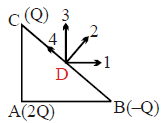
In the figure , ΔABC is in an isosceles triangle with A = 90°. D is the mid point of BC. Three charges 2Q, –Q and Q are placed at A, B, C respectively.
The net electric field at D due to three charges is directed along the numbered arrow :

1. 1
2. 2
3. 3
4. 4
View Answer
Question 48: moderate

Find the electric field due to a circular arc of radius R and charge / length λ at the origin. The arc is in xy plane and extends from θ = π/3 to θ = π w .r.t.x-axis .


1. \frac{\sqrt{3}k\lambda}{R}\left[ cos30^{0}\hat{i}-sin30^{0}\hat{j} \right]
2. \frac{\sqrt{3}k\lambda}{R}\left[ cos60^{0}\hat{i}-sin60^{0}\hat{j} \right]
3. \frac{k\lambda}{2R}\left[ cos30^{0}\hat{i}-sin30^{0}\hat{j} \right]
4. \frac{k\lambda}{2R}\left[ cos60^{0}\hat{i}-sin60^{0}\hat{j} \right]
View Answer
Question 49: moderate

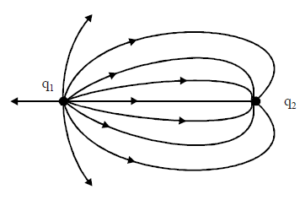
The figure shows the electric field lines in the vicinity of two point charges . Which one of the following statements concerning this situation is true ?

1. q1 is negative and q2 is positive
2. The magnitude of the ratio (q2/q1) is less than one
3. Both q1 and q2 have the same sign of charge
4. The electric field is strongest midway between the charges .
View Answer

Number of electric field lines coming out of a charge represents magnitude of charge. Here number of field line coming out of q1 is more than that of q2 so, |q2/q1 |<1.

Question 50: moderate

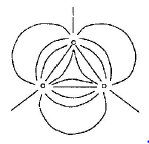
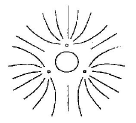
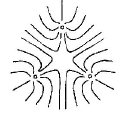
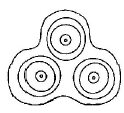
Three positive charges of equal value q are placed at the vertices of an equilateral triangle . The resulting lines of force should be sketched as in

1.
2.
3.
4.
View Answer

Option 1 is wrong as electric field lines will emerge out of +ve charge and should submerge only at -ve charge.

Option 2 is wrong as electric field lines can not be circular loop.

Option 3 is correct.

Option 4 is wrong because it is representing equipotential surface not field lines