Electrostatics - NEET Physics Questions
← All Chapters

Electrostatics

Question 121: moderate

A point Q lies on the perpendicular bisector of an electric dipole of dipole moment p. If the distance of Q from the dipole is r (much larger than the size of the dipole) then electric field at Q is proportional to :

1. \(p^{-1} \)and \( r^{-2}\)
2. p and \( r^{-2}\)
3. \(p^{2}\)  and \(r^{-3}\)
4. p and \( r^{-3}\)
View Answer

For a point \( Q \) on the perpendicular bisector of an electric dipole (distance \( r \) from the center, where \( r \gg \text{dipole length} \)):

1. Electric Field on Perpendicular Bisector: The electric field \( E \) at a point on the perpendicular bisector of a dipole is given by:
\[
E \propto \frac{p}{r^3}
\]

2. Dependence:
- Directly proportional to the dipole moment \( p \).
- Inversely proportional to \( r^3 \).

Answer:
The electric field at \( Q \) is proportional to:
\[
p \quad \text{and} \quad r^{-3}
\]

Question 122: easy

The electric potential at a point due to an electric dipole is :

1. \[k(\overrightarrow{p}.\overrightarrow{r}/r^{3})\]
2. \[k(\overrightarrow{p}.\overrightarrow{r}/r^{2})\]
3. \[ k(\overrightarrow{p}\times \overrightarrow{r}/r^{3})\]
4. \[k(\overrightarrow{p}\times \overrightarrow{r}/r^{2})\]
View Answer

The electric potential \( V \) at a point \( P \) due to an electric dipole with dipole moment \( \overrightarrow{p} \) is given by:

\[
V = \frac{k \, \overrightarrow{p} \cdot \overrightarrow{r}}{r^3}
\]

Explanation:
1. Dipole Moment: The dipole moment \( \overrightarrow{p} = q \cdot d \), where \( q \) is the charge and \( d \) is the separation between charges.

2. Position Vector \( \overrightarrow{r} \): This is the vector from the center of the dipole to the point \( P \).

3. Dot Product: The potential depends on the angle between \( \overrightarrow{p} \) and \( \overrightarrow{r} \), hence \( \overrightarrow{p} \cdot \overrightarrow{r} = p r \cos \theta \).

4. Result: The formula is:
\[
V = \frac{k (\overrightarrow{p} \cdot \overrightarrow{r})}{r^3}
\]

This matches the correct answer:
\[
V = \frac{k (\overrightarrow{p} \cdot \overrightarrow{r})}{r^3}
\]

Question 123: easy

A cylinder of radius R and length L is placed in a uniform electric field E parallel to the cylinder axis. The total flux from the surface of the cylinder is:

1. \[2\pi R^{2}E\]
2. \[\pi R^{2}E\]
3. \[\left( \pi R^{2}+\pi R^{2} \right)/E\]
4. zero
View Answer

Since the electric field \( E \) is parallel to the cylinder's axis, the field lines enter and exit symmetrically through the two flat circular ends. The curved surface has no perpendicular component of the field, so no flux passes through it.

By Gauss's law, the net flux through the entire surface is:
\[
\Phi = \text{Charge enclosed} / \varepsilon_0
\]

As no charge is enclosed, \( \Phi = 0 \).

Question 124: easy

The electric flux Φ through a hemisphere surface of radius R, placed in a uniform electric field of intensity E parallel to the axis of its circular plane is:

1. \[2\pi RE\]
2. \[2\pi R^{2}E\]
3. \[\pi R^{2}E\]
4. \[\left( 4/3 \right)\pi R^{3}E\]
View Answer

The electric flux through the hemisphere is due to the uniform electric field passing perpendicularly through the circular plane of radius \( R \).

Flux through the circular plane:
\[
\Phi = E \cdot \text{Area of circular plane} = E \cdot \pi R^2
\]

Since no flux passes through the curved surface (field is parallel to it), the total flux is:
\[
\Phi = \pi R^2 E
\]

Question 125: easy

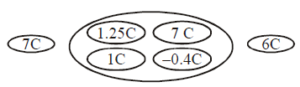
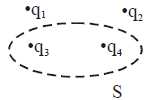
Figure shows four charges q1, q2, q3 and q4 fixed in space. Then the total flux of electric field through a closed surface S, due to all charges q1, q2, q3, and q4 is :

1. not equal to the total flux through S due to charges q3 and q4.
2. equal to the total flux through S due to charges q3 and q4.
3. zero if q1 + q2 = q3 + q4
4. twice the total flux through S due to charges q3 and q4 if q1 + q2 = q3 + q4
View Answer

Gauss's law states that the total electric flux passing through a closed surface is equal to the charge enclosed within the surface divided by the permittivity of the medium.

In short: The net electric field around a closed surface depends on the charge inside it.

Question 126: easy

The mathematical form of Gauss’ law is :

\[\varepsilon_{0}\oint_{}^{}\overrightarrow{E}.d\overrightarrow{S}=q\]
In this reference which of the following is correct?

1. E depends on the charge q which is enclosed within the Gaussian surface only
2. E depends on the charge which is inside and outside the Gaussian surface.
3. E does not depend on the magnitude of charge q
4. All of the above
View Answer

The question states the mathematical form of Gauss's law as:

\[
\varepsilon_{0}\oint \overrightarrow{E} \cdot d\overrightarrow{S} = q
\]

Where:
- \(\varepsilon_0\) is the permittivity of free space,
- \(\overrightarrow{E}\) is the electric field vector,
- \(d\overrightarrow{S}\) is the infinitesimal area vector on the Gaussian surface,
- \(q\) is the total charge enclosed within the Gaussian surface.

Key Points in Gauss's Law:

1. The electric flux through the Gaussian surface (\(\oint \overrightarrow{E} \cdot d\overrightarrow{S}\)) depends only on the charge enclosed (\(q\)) within the surface.

2. The electric field \(\overrightarrow{E}\) at any point on the Gaussian surface depends on all charges in the system—both inside and outside the Gaussian surface.

Why Does \(E\) Depend on Charges Outside the Gaussian Surface?

While Gauss's law calculates flux based only on enclosed charge, the electric field \(\overrightarrow{E}\) at a point on the Gaussian surface is influenced by all charges, regardless of their location (inside or outside the surface). Here's why:

- Charges inside the Gaussian surface: These contribute directly to the net flux as per Gauss's law.
- Charges outside the Gaussian surface: These do not contribute to the net flux (their contributions cancel out overall due to symmetry), but they **still influence the local value of \(\overrightarrow{E}\)**.

Example:

- Imagine a spherical Gaussian surface around a point charge \(q_1\). If another charge \(q_2\) is placed outside the sphere, it doesn't affect the total flux, but it does contribute to the electric field at various points on the sphere.

Thus, the electric field \(\overrightarrow{E}\) depends on all charges in the vicinity, while the total flux (as per Gauss's law) depends solely on the charges enclosed. This is why the correct answer is:

"E depends on the charge which is inside and outside the Gaussian surface."
Question 127: easy

What is the electric flux linked with closed surface?

1. /[10^{11} N-m^{2}/C/]
2. /[10^{12} N-m^{2}/C/]
3. /[10^{10} N-m^{2}/C/]
4. /[8.86\times 10^{13} N-m^{2}/C/]
View Answer
Question 128: easy

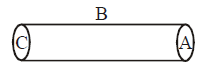
A hollow cylinder has charge q coulomb within it. If Φ is the electric flux in units of V-m associated with the curved surface B, the flux linked with the plane surface A in unit of V-m will be :

1. /[\frac{q}{2\varepsilon_{0}}/]
2. /[\frac{\phi}{3}/]
3. /[\frac{q}{\varepsilon_{0}}-\phi/]
4. /[\frac{1}{2}\left( \frac{q}{\varepsilon_{0}}-\phi \right)/]
View Answer
Question 129: easy

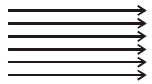
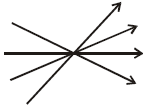
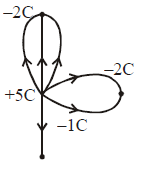
Which of the following configurations of electric lines of force is not possible ?

1.
2.
3.
4. both (2) and (3)
View Answer

Option 2 is wrong because electric field lines emerge out of +ve charge and submerge into -ve charge.

In option 3 number of electric field lines is proportional to amount of charge. From +5C charge 6 field lines are emerging out where as from 1C charge only one electric field line is present.

Question 130: moderate

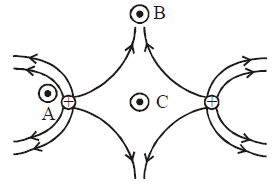
The figure below shows the electric field lines due to two positive charges. The magnitudes \(E_{A},E_{B} and E_{C}\) of the electric fields at points A, B, and C respectively are related as :


1. \[E_{A}>E_{B}>E_{C}\]
2. \[E_{B}>E_{A}>E_{C}\]
3. \[E_{A}=E_{B}>E_{C}\]
4. \[E_{A}>E_{B}=E_{C}\]
View Answer

Number of Electric field line in space represents electric field intensity. As number of field line is maximum at A followed by B then at C. so, \(E_{A}>E_{B}>E_{C}\)