Electric Field - NEET Physics Questions
Question 11: moderate

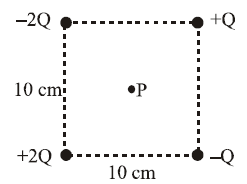
Four electrical charges are arranged on the corners of a 10 cm square as shown. What would be the direction of the resulting electric field at the center point P?
1.
2.
3.
4.
View Answer

Explanation:

To determine the direction of the electric field at the center \(P\), we consider the contributions of the electric fields due to each charge:

1. Electric Field Due to Each Charge:
- The electric field at point \(P\) due to a charge at a corner of the square points away from the charge if it is positive, and toward the charge if it is negative.

2. Symmetry of the Problem:
- Opposite charges on diagonally opposite corners will partially cancel their contributions due to symmetry in their horizontal (\(x\)) or vertical (\(y\)) components.
- However, due to the **asymmetry in the magnitudes of the charges**, there will be a net resultant field.

3. Analyzing the Contributions:
- The charge \(-2Q\) (top left) will produce a stronger electric field toward itself compared to \(+Q\) (top right).
- Similarly, the charge \(+2Q\) (bottom left) will produce a stronger field away from itself compared to \(-Q\) (bottom right).
- The vertical components of the fields due to the charges \(-2Q\) and \(+2Q\) add **upward**.
- The horizontal components of the fields due to opposite charges (\(-2Q\) and \(+2Q\), and \(+Q\) and \(-Q\)) cancel each other.

4. Result:
- The net electric field at point \(P\) is directed upward, dominated by the vertical components due to the unequal magnitudes of the charges.

Hence, the correct answer is upward.
Question 12: moderate

The maximum electric field at a point on the axis of a uniformly charged ring is E0. At how many points on the axis will the magnitude of the electric field be E0/2.

1. 1
2. 2
3. 3
4. 4
View Answer

To understand why the magnitude of the electric field is \(E_0/2\) at four points on the axis of a uniformly charged ring, let's analyze this with the help of the electric field graph versus distance.

Key Concepts:
1. Electric Field on the Axis of a Uniformly Charged Ring:
The electric field at a distance \(x\) from the center of the ring along its axis is given by:
\[
E = \frac{k Q x}{(x^2 + R^2)^{3/2}}
\]
where:
- \(k\) is Coulomb's constant,
- \(Q\) is the total charge on the ring,
- \(R\) is the radius of the ring,
- \(x\) is the distance from the center along the axis.

2. Behavior of \(E\) as a Function of \(x\):
- At \(x = 0\): The electric field is \(0\) due to symmetry (no net field at the center).
- As \(x\) increases: \(E\) first increases, reaches a **maximum value** (\(E_0\)) at some distance \(x = x_{\text{max}}\), and then decreases asymptotically to \(0\) as \(x \to \infty\).

3. Points Where \(E = E_0/2\):
The equation \(E = \frac{E_0}{2}\) will have **two solutions** on either side of the point where \(E\) is maximum (\(x = \pm x_{\text{max}}\)):
- Two points closer to the ring's center (on both sides of \(x = 0\)).
- Two points farther from the center (on both sides of \(x = 0\)).

Thus, there are a total of four points where \(E = \frac{E_0}{2}\).

-------------------------------------------------------------------------------------------------------------------

Graphical Explanation:
1. The graph of \(E\) versus \(x\) is symmetric about \(x = 0\) and resembles a bell-shaped curve.
2. \(E\) starts at \(0\) at \(x = 0\), increases to a peak value of \(E_0\) at \(x_{\text{max}}\), and then decreases symmetrically as \(x\) moves away from \(x_{\text{max}}\) on both sides.
3. To find the points where \(E = \frac{E_0}{2}\), draw a horizontal line at \(E = \frac{E_0}{2}\). This line will intersect the \(E\)-vs-\(x\) curve at **four points**:
- Two on the rising part of the curve (closer to \(x = 0\)),
- Two on the falling part of the curve (farther from \(x = 0\)).

Conclusion:
The electric field is \(E_0/2\) at four points on the axis of the ring—two on each side of the ring's center. These correspond to the solutions of the equation \(E = \frac{k Q x}{(x^2 + R^2)^{3/2}} = \frac{E_0}{2}\).

Question 13: difficult

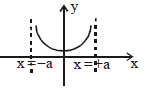
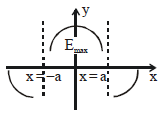
As shown in the figure a positive charge +q is placed at x = –a and negative charge –q is placed at x = + a. Then choose the curve which shows variation of E along the x-axis :

1.
2.
3.
4. none of these
View Answer

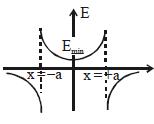
The figure represents the electric field (E) along the \(x\)-axis due to a dipole consisting of a positive charge (\(+q\)) at \(x = -a\) and a negative charge (\(-q\)) at \(x = +a\).

The electric field due to such a dipole varies as follows:

1. Near \(x = -a\): The field is dominated by the positive charge, so it points away from \(x = -a\).
2. Near \(x = +a\): The field is dominated by the negative charge, so it points toward \(x = +a\).
3. Between \(x = -a\) and \(x = +a\): The contributions from both charges partially cancel out, leading to a local minimum in the field magnitude.
4. Far from the charges (\(|x| \gg a\)): The field behaves approximately as a dipole field, decreasing as \(1/x^3\).

The attached graph correctly shows these features:
- A local minimum in \(E\) between \(x = -a\) and \(x = +a\), at the midpoint where the dipole effect is weakest.
- The field magnitude diverges near \(x = -a\) and \(x = +a\) due to the proximity to the charges.
- Symmetry around the origin is preserved, as the system is symmetric about \(x = 0\).

Question 14: moderate

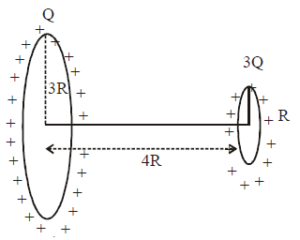
Two uniformly charged co axial rings are present as shown in the figure. Find electric field intensity at the centre of the smaller ring.

1. \[ \frac{Q}{4\pi \varepsilon_{0}R^{2}}\]
2. \[ \frac{Q}{25\pi \varepsilon_{0}R^{2}}\]
3. \[ \frac{Q}{125\pi \varepsilon_{0}R^{2}}\]
4. \[ \frac{4Q}{125\pi \varepsilon_{0}R^{2}}\]
View Answer

Given:
Two coaxial rings:
- Larger ring: Charge \( Q \), radius \( 3R \), distance \( 4R \) from the center of the smaller ring.
- Smaller ring: Charge \( 3Q \), radius \( R \).
We need the electric field at the center of the smaller ring.

Step 1: Electric Field due to the Larger Ring
The electric field at a distance \( x = 4R \) on the axis of a uniformly charged ring of radius \( R \) is:

\[
E = \frac{kQx}{(R^2 + x^2)^{3/2}}
\]

For the larger ring:
- \( Q = Q \), \( R = 3R \), \( x = 4R \):
\[
E_{\text{large}} = \frac{kQ(4R)}{((3R)^2 + (4R)^2)^{3/2}}
\]

\[
E_{\text{large}} = \frac{kQ(4R)}{(9R^2 + 16R^2)^{3/2}} = \frac{kQ(4R)}{(25R^2)^{3/2}}
\]

\[
E_{\text{large}} = \frac{kQ(4R)}{125R^3} = \frac{Q}{125\pi\varepsilon_0R^2}
\]

Step 2: Electric Field due to the Smaller Ring
The center of the smaller ring is its own center, so the net electric field due to its charge distribution is **zero**.

Step 3: Net Electric Field
The total electric field at the center of the smaller ring is due to the **larger ring only**:
\[
E = \frac{Q}{125\pi\varepsilon_0R^2}
\]

Final Answer:
\[
E = \frac{Q}{125\pi\varepsilon_0R^2}
\]

Question 15: difficult

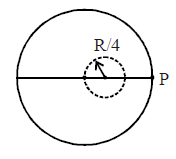
A sphere uniformly charged with a charge density ρ has a radius R. A spherical cavity of radius R/4 is made in it such that centre of original sphere lies on its circumference. What is the electric field at point P.

1. \[ \frac{27\rho R}{112\epsilon_{0}}\]
2. \[ \frac{71\rho R}{54\epsilon_{0}}\]
3. \[ \frac{\rho R}{6\epsilon_{0}}\]
4. \[ \frac{35\rho R}{108\epsilon_{0}}\]
View Answer

Given:
- A uniformly charged sphere of charge density \( \rho \), radius \( R \).
- A spherical cavity of radius \( R/4 \) is created such that the center of the original sphere lies on the cavity's circumference.
- We need to find the electric field at point \( P \).

Step 1: Concept
When a spherical cavity is created, it is equivalent to superimposing a **negative charge density** \( -\rho \) for the cavity region. Hence, the total electric field at point \( P \) is the **vector sum** of:
1. Field due to the original uniformly charged sphere.
2. Field due to the negatively charged cavity.

---

Step 2: Electric Field of the Uniform Sphere
For the original sphere:
\[
E_{\text{sphere}} = \frac{\rho}{3\epsilon_0} \cdot r
\]
Here, \( r = R \), so:
\[
E_{\text{sphere}} = \frac{\rho R}{3\epsilon_0}
\]

---

Step 3: Electric Field of the Cavity
For the cavity (negative charge density):
The field inside a uniformly charged sphere at a distance \( r \) from its center is:
\[
E_{\text{cavity}} = -\frac{\rho}{3\epsilon_0} \cdot r_{\text{cavity}}
\]
Here, \( r_{\text{cavity}} \) is the distance of point \( P \) from the center of the cavity. Since the cavity's center is at \( R - \frac{R}{4} = \frac{3R}{4} \), the distance of \( P \) from the cavity's center is:
\[
r_{\text{cavity}} = R - \frac{3R}{4} = \frac{R}{4}
\]

Thus:
\[
E_{\text{cavity}} = -\frac{\rho}{3\epsilon_0} \cdot \frac{R}{4} = -\frac{\rho R}{12\epsilon_0}
\]

---

Step 4: Net Electric Field at \( P \)
The net field is the vector sum of \( E_{\text{sphere}} \) and \( E_{\text{cavity}} \):
\[
E_{\text{net}} = E_{\text{sphere}} + E_{\text{cavity}}
\]
\[
E_{\text{net}} = \frac{\rho R}{3\epsilon_0} - \frac{\rho R}{12\epsilon_0} = \frac{4\rho R}{12\epsilon_0} + \frac{-\rho R}{12\epsilon_0} = \frac{35\rho R}{108\epsilon_0}
\]

---

Final Answer:
\[
E_{\text{net}} = \frac{35\rho R}{108\epsilon_0}
\]

Question 16: moderate

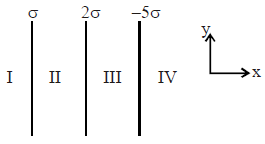
3 parallel infinite sheets carry charge of ρ, 2ρ and –5ρ per unit area on them. What is the electric field in region I, II, III and IV ?

1. \[ \frac{-\sigma}{\epsilon_{0}}\hat{i},\frac{-2\sigma}{\epsilon_{0}}\hat{i},\frac{4\sigma}{\epsilon_{0}}\hat{i},\frac{\sigma}{\epsilon_{0}}\hat{i} \]
2. \[ \frac{\sigma}{\epsilon_{0}}\hat{i},\frac{2\sigma}{\epsilon_{0}}\hat{i},\frac{-4\sigma}{\epsilon_{0}}\hat{i},\frac{5\sigma}{\epsilon_{0}}\hat{i} \]\[
3. \[\frac{2\sigma}{\epsilon_{0}}\hat{i},\frac{\sigma}{\epsilon_{0}}\hat{i},\frac{3\sigma}{\epsilon_{0}}\hat{i},\frac{-2\sigma}{\epsilon_{0}}\hat{i}\]
4. \[\frac{\sigma}{\epsilon_{0}}\hat{i},\frac{2\sigma}{\epsilon_{0}}\hat{i},\frac{4\sigma}{\epsilon_{0}}\hat{i},\frac{-\sigma}{\epsilon_{0}}\hat{i} \]
View Answer

The electric field due to an infinite sheet of charge with surface charge density \( \sigma \) is given by:

\[
E = \frac{\sigma}{2\epsilon_0}
\]

Now, let's determine the electric field in each region (I, II, III, and IV):

Region I:
Here, only the first sheet with charge density \( \sigma \) contributes. The field due to this sheet is:

\[
E_{\text{I}} = \frac{\sigma}{2\epsilon_0} \hat{i} + \frac{\sigma}{2\epsilon_0} \hat{i} = \frac{\sigma}{\epsilon_0} \hat{i}
\]

Region II:
In this region, both the first and second sheets contribute. The total electric field is:

\[
E_{\text{II}} = \left( \frac{\sigma}{2\epsilon_0} + \frac{2\sigma}{2\epsilon_0} \right) \hat{i} = \frac{2\sigma}{\epsilon_0} \hat{i}
\]

Region III:
Here, all three sheets contribute. The total field is:

\[
E_{\text{III}} = \left( \frac{\sigma}{2\epsilon_0} + \frac{2\sigma}{2\epsilon_0} + \frac{-5\sigma}{2\epsilon_0} \right) \hat{i} = \frac{4\sigma}{\epsilon_0} \hat{i}
\]

Region IV:
Only the third and fourth sheets contribute:

\[
E_{\text{IV}} = \left( \frac{-5\sigma}{2\epsilon_0} \right) \hat{i} = \frac{-\sigma}{\epsilon_0} \hat{i}
\]

Final Answers:
- Region I: \( \frac{\sigma}{\epsilon_0} \hat{i} \)
- Region II: \( \frac{2\sigma}{\epsilon_0} \hat{i} \)
- Region III: \( \frac{4\sigma}{\epsilon_0} \hat{i} \)
- Region IV: \( \frac{-\sigma}{\epsilon_0} \hat{i} \)

Question 17: easy

If a conducting sphere of radius R is charged. Then the electric field at a distance \(r\) (\(r > R\)) from the centre of the sphere would be, (V = potential on the surface of the sphere)

1. \(\frac{RV}{r^2}\)
2. \(\frac{V}{r}\)
3. \(\frac{rV}{R^2}\)
4. \(\frac{R^2 V}{r^3}\)
View Answer

The electric potential at the surface of a conducting sphere is \(V = \frac{kQ}{R} \implies kQ = VR\). The electric field at any point outside the sphere (\(r > R\)) is \(E = \frac{kQ}{r^2} = \frac{VR}{r^2}\).

Question 18: easy

An \( \alpha \)-particle of mass \( 6.4 \times 10^{-27}\text{ kg} \) and charge \( 3.2 \times 10^{-19}\text{ C} \) is situated in a uniform electric field of \( 1.6 \times 10^5\text{ Vm}^{-1} \). The velocity of the particle at the end of \( 2 \times 10^{-2}\text{ m} \) path when it starts from rest is:

1. \( 2\sqrt{3} \times 10^5\text{ ms}^{-1} \)
2. \( 8 \times 10^5\text{ ms}^{-1} \)
3. \( 16 \times 10^5\text{ ms}^{-1} \)
4. \( 4\sqrt{2} \times 10^5\text{ ms}^{-1} \)
View Answer

Using the work-energy theorem, \( qEd = \frac{1}{2}mv^2 \). Rearranging gives \( v = \sqrt{\frac{2qEd}{m}} = \sqrt{\frac{2 \times 3.2 \times 10^{-19} \times 1.6 \times 10^5 \times 2 \times 10^{-2}}{6.4 \times 10^{-27}}} = 4\sqrt{2} \times 10^5\text{ m/s} \).

Question 19: easy

Assertion: Sharper is the curvature of spot on a charged body lesser will be the surface charge density at that point.
Reason: Electric field is non-zero inside a charged conductor.

1. Both Assertion and Reason are true and Reason is the correct explanation of Assertion.
2. Both Assertion and Reason are true but Reason is not correct explanation of Assertion.
3. Assertion is true but Reason is false.
4. Assertion and Reason are false.
View Answer

Surface charge density is directly proportional to curvature \(\sigma \propto 1/R\). Inside a conductor, the electric field is zero. Hence, both statements are false.