Mutual Induction - NEET Physics Questions
Question 1: easy

Two circular coils can be arranged in any of the three situations shown in the figure. Their
mutual inductance will be :
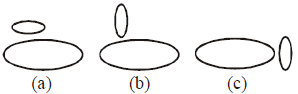
1. maximum In situation (a)
2. maximum In situation (b)
3. maximum In situation (c)
4. the same in all situations
View Answer

Based on the visual arrangement of the coils, the mutual inductance is maximum in situation (a).

This is because the coils are placed co-axially (one above the other), allowing the maximum amount of magnetic flux from the primary coil to pass through the secondary coil, resulting in the highest coupling coefficient.

Question 2: easy

Two coils X and Y are placed in a circuit such that a current changes by 2 A in coil X and the magnetic flux change of 0.4 Wb occurs in coil Y. The value of mutual inductance of coils is :

1. 0.2 H
2. 2 H
3. 0.5 H
4. 5 H
View Answer

The mutual inductance ($M$) is calculated by the ratio of flux change in coil Y to the current change in coil X:

$$M = \frac{\Delta \phi_Y}{\Delta I_X} = \frac{0.4 \text{ Wb}}{2 \text{ A}}$$

$M = 0.2 \text{ H}$

Question 3: easy

A small square loop of wire of side l is placed inside a large square loop of wire of side L ( L > l ). The loops are coplanar and their centres coincide. The mutual inductance of the system is proportional to :

1. l / L
2. / L
3. L/l
4. L²/l
View Answer

The mutual inductance M is found by calculating the magnetic flux through the small loop due to the current I in the large loop. Using the formula for the magnetic field at the center of a square loop, B  \frac{I}{L}.

Since the small loop is much smaller than the large one \(L \gg l)\, the field is approximately uniform across its area \A = l^2\. The flux \Phi = B \cdot A$ is therefore proportional to \\frac{I}{L} \cdot l^2\.

Because $M = \frac{\Phi}{I}$, the mutual inductance scales as:

$$M \propto \frac{l^2}{L}$$
Question 4: easy

Two coils of self inductance \(2\text{ mH}\) and \(8\text{ mH}\) are placed so close together that the effective flux in one coil is completely linked with the other. The mutual inductance between these coils is:

1. \(16\text{ mH}\)
2. \(10\text{ mH}\)
3. \(6\text{ mH}\)
4. \(4\text{ mH}\)
View Answer

For complete coupling, the coupling coefficient \(k = 1\). The mutual inductance is given by \(M = k\sqrt{L_1 L_2} = \sqrt{2 \times 8} = 4\text{ mH}\).

Question 5: easy

Two conducting circular loops of radii \(R_1\) and \(R_2\) are placed in the same plane with their centres coinciding. If \(R_1 \gg R_2\), the mutual inductance \(M\) between them will be directly proportional to

1. \(\frac{R_2^2}{R_1}\)
2. \(\frac{R_1}{R_2}\)
3. \(\frac{R_2}{R_1}\)
4. \(\frac{R_1^2}{R_2}\)
View Answer

The magnetic field produced by the larger loop 1 at the center is \(B_1 = \frac{\mu_0 I_1}{2 R_1}\). The magnetic flux through the smaller loop 2 is \(\phi_2 = B_1 A_2 = \frac{\mu_0 I_1}{2 R_1} \pi R_2^2\). Therefore, \(M = \frac{\phi_2}{I_1} = \frac{\mu_0 \pi R_2^2}{2 R_1}\), which means \(M \propto \frac{R_2^2}{R_1}\).