A copper rod AB of length L, pivoted at one end A, rotates at constant angular velocity ω, at right angles to a uniform magnetic field of induction B. The e.m.f developed between the mid point C of the rod and end B is :
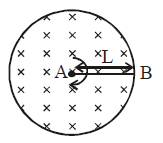
1. \[\frac{B\omega l^{2}}{4}\]
2. \[\frac{B\omega l^{2}}{2}\]
3. \[\frac{3B\omega l^{2}}{4}\]
4. \[\frac{3B\omega l^{2}}{8}\]
View Answer
Assertion (A): The probability of burn out of a dc motor is maximum, when the motor is just switched on.
Reason (R): No back emf is developed in the armature of dc motor, when it is just switched on.
1. Both (A) & (R) are true and the (R) is the correct explanation of the (A)
2. Both (A) & (R) are true but the (R) is not the correct explanation of the (A)
3. (A) is true but (R) is false
4. Both (A) and (R) are false
View Answer
Assertion (A) is true: When a DC motor starts, its speed is zero, thus the back EMF (\(epsilon_b\)) is zero. This leads to the maximum current (\(I = \frac{V - \epsilon_b}{R_a}\)) drawn from the supply, which can cause burnout. Reason (R) is true: Back EMF is proportional to the motor's angular speed (\(epsilon_b = k\Phi\omega\)), so it is zero at startup (\(omega = 0\)). Reason (R) correctly explains Assertion (A).