Relation between Current and Drift Velocity - NEET Physics Questions
← Back to Current Electricity

Relation between Current and Drift Velocity

Question 1: moderate

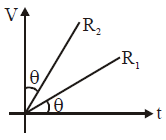
The V-I graph for two conductor of resistance R1 & R2 are as shown in the figure, the resistance of their series combination (R2 + R1) is proportional to :

1. /[\frac{1}{sin^{2}\theta cos^{2}\theta}/]
2. /[\frac{1}{sin\theta cos\theta}/]
3. /[\frac{cos\theta}{sin^{2}\theta}/]
4. /[\frac{tan2\theta}{sin^{2}\theta}/]
View Answer
Question 2: moderate

If the number of free electrons is \(5\times 10^{28} m^{-3}\) then the drift velocity of electron in a conductor of area of cross-section \(10^{-4} m^{2}\) for a current of 1.2 A is:


1. \[1.5\times 10^{-2} m/s\]
2. \[1.5\times 10^{-3} m/s\]
3. \[1.5\times 10^{-4} m/s\]
4. \[1.5\times 10^{-6} m/s\]
View Answer

To find the drift velocity

vdv_d

of the electrons, we use the formula for current in terms of drift velocity:


I=nAevdI = n A e v_d


Where:


  • II
     

    is the current (1.2 A),


  • nn
     

    is the number of free electrons per unit volume ( 5Γ—1028 mβˆ’35 \times 10^{28} \, \text{m}^{-3} 

    ),


  • AA
     

    is the cross-sectional area of the conductor ( 10βˆ’4 m210^{-4} \, \text{m}^2 

    ),


  • ee
     

    is the charge of an electron ( 1.6Γ—10βˆ’19 C1.6 \times 10^{-19} \, \text{C} 

    ),


  • vdv_d
     

    is the drift velocity of the electrons (which we need to calculate).

Step 1: Rearranging the formula to solve for vdv_d


vd=InAev_d = \frac{I}{n A e}


Step 2: Substituting the given values


vd=1.2(5Γ—1028)Γ—(10βˆ’4)Γ—(1.6Γ—10βˆ’19)v_d = \frac{1.2}{(5 \times 10^{28}) \times (10^{-4}) \times (1.6 \times 10^{-19})}


Step 3: Performing the calculation


vd=1.2(5Γ—1028)Γ—(10βˆ’4)Γ—(1.6Γ—10βˆ’19)v_d = \frac{1.2}{(5 \times 10^{28}) \times (10^{-4}) \times (1.6 \times 10^{-19})}


vd=1.28Γ—106v_d = \frac{1.2}{8 \times 10^{6}}


vd=1.5Γ—10βˆ’7 m/sv_d = 1.5 \times 10^{-7} \, \text{m/s}


Final Answer:

The drift velocity of the electrons is

1.5Γ—10βˆ’7 m/s\boxed{1.5 \times 10^{-7} \, \text{m/s}}

.

Question 3: moderate

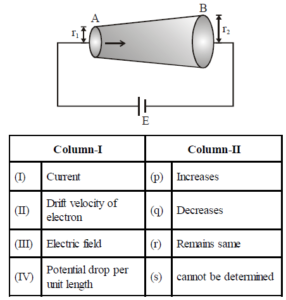
A battery of emf E is connected across a conductor as shown. As one observes from A to B.

Now, match the given columns and select the correct option from the codes given below :
Codes :

1. I-p, II-q, III-r, IV-s
2. I-r, II-q, III-q, IV-q
3. I-q, II-p, III-s, IV-r
4. I-s, II-q, III-q, IV-p
View Answer
Question 4: moderate

The resultant resistance value of n resistance each of r ohm when connected in parallel, is x. When these n resistances are connected in series, the resultant value is :


1. nx
2. nΒ²x
3. rnx
4. rΒ²x/n
View Answer

Let's break this down step by step.

1. Resistances connected in parallel

When

nn

resistors, each of resistance

rr

, are connected in parallel, the total or equivalent resistance

RparallelR_{\text{parallel}}

is given by the formula:


1Rparallel=1r+1r+β‹―+1r(nΒ terms)\frac{1}{R_{\text{parallel}}} = \frac{1}{r} + \frac{1}{r} + \cdots + \frac{1}{r} \quad \text{(n terms)}


This simplifies to:


1Rparallel=nr\frac{1}{R_{\text{parallel}}} = \frac{n}{r}


So, the equivalent resistance is:


Rparallel=rnR_{\text{parallel}} = \frac{r}{n}


We're told that the resultant resistance when connected in parallel is

xx

, so:


x=rnx = \frac{r}{n}


2. Resistances connected in series

When the same

nn

resistors, each of resistance

rr

, are connected in series, the total or equivalent resistance

RseriesR_{\text{series}}

is simply the sum of the individual resistances:


Rseries=r+r+β‹―+r(nΒ terms)R_{\text{series}} = r + r + \cdots + r \quad \text{(n terms)}


So:


Rseries=nΓ—rR_{\text{series}} = n \times r


3. Relating the two scenarios

From the parallel connection, we know that:


x=rnx = \frac{r}{n}


Thus, the resistance when the resistors are connected in series is:
 

Rseries=nΓ—r=nΓ—(xΓ—n)=rΓ—nΓ—xR_{\text{series}} = n \times r = n \times \left( x \times n \right) = r \times n \times x


Therefore, the resistance when these

nn

resistors are connected in series is:
 

rΓ—nΓ—x\boxed{r \times n \times x}


Question 5: moderate

Three copper wires have lengths and cross-sectional areas as : (l, A), (2l, A/2) and (l/2, 2A). Resistance is minimum in :

1. Wire of cross-sectional area A/2
2. Wire of cross-sectional area A
3. Wire of cross-sectional area 2A
4. Same in all the three cases
View Answer

The resistance

RR

of a wire is given by the formula:


R=ρlAR = \rho \frac{l}{A}


Where:


  • ρ\rho
     

    is the resistivity of the material (which is constant for copper),


  • ll
     

    is the length of the wire,


  • AA
     

    is the cross-sectional area of the wire.

Given:

  • Wire 1: Length =
    ll
     

    , Area = AA 

  • Wire 2: Length =
    2l2l
     

    , Area = A2\frac{A}{2} 

  • Wire 3: Length =
    l2\frac{l}{2}
     

    , Area = 2A2A 

We will calculate the resistance for each wire.

Step 1: Calculate the resistance for each wire

Wire 1: Length = ll


, Area = AA


R1=ρlAR_1 = \rho \frac{l}{A}


Wire 2: Length = 2l2l


, Area = A2\frac{A}{2}


R2=ρ2lA2=ρ2lΓ—2A=ρ4lAR_2 = \rho \frac{2l}{\frac{A}{2}} = \rho \frac{2l \times 2}{A} = \rho \frac{4l}{A}


Wire 3: Length = l2\frac{l}{2}


, Area = 2A2A


R3=ρl22A=ρl4AR_3 = \rho \frac{\frac{l}{2}}{2A} = \rho \frac{l}{4A}


Step 2: Compare the resistances


  • R1=ρlAR_1 = \rho \frac{l}{A}
     

  • R2=ρ4lAR_2 = \rho \frac{4l}{A}
     

  • R3=ρl4AR_3 = \rho \frac{l}{4A}
     

Clearly,

R3R_3

is the smallest resistance because

l4A\frac{l}{4A}

is the smallest fraction compared to

lA\frac{l}{A}

and

4lA\frac{4l}{A}

.

Step 3: Conclusion

The wire with the minimum resistance is Wire 3, which has a cross-sectional area of

2A2A

.

Thus, the answer is Wire 3.

Question 6: moderate

The number of free electrons per 100 mm of ordinary copper wire is /[ 2 \times 10^{21} /] . Average drift speed of electrons is 0.25 mm/s. The current flowing is :

1. 5 A
2. 80 A
3. 8 A
4. 0.8 A
View Answer

The current I is calculated by:

$$I = \frac{N \cdot e \cdot v_d}{L} = \frac{(2 \times 10^{21}) \times (1.6 \times 10^{-19}) \times (0.25 \times 10^{-3})}{0.1} = 0.8\text{ A}$$

Thus, the correct answer is 0.8 A (Option 4)