Question 1:
difficult
For given circuit, heat produced by a current in resistance of 5Ω is 10 Cal/sec. Then the heat produced in resistance of 4Ω is
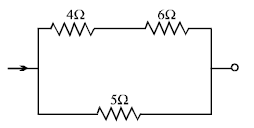
For given circuit, heat produced by a current in resistance of 5Ω is 10 Cal/sec. Then the heat produced in resistance of 4Ω is
There are 45 number of cells with internal resistance of each cell is 0.5Ω To get the maximum current through a resistance of 2.5Ω, one can use m rows of cells, each row having n cells. The values of m and n are:
Let's go through a more detailed, step-by-step approach to solving the problem correctly, and we’ll arrive at the answer
and
.
.
We are arranging the cells in series and parallel, so:
= number of rows (parallel branches of cells)
= number of cells in each row (connected in series)
When
cells are connected in series, the internal resistance for each row (denoted as
) is the sum of the internal resistances of each cell:
Since there are
rows connected in parallel, the total internal resistance
of the entire setup is:
The total resistance in the circuit is the sum of the external resistance
and the total internal resistance of the cells
:
The current through the circuit can be calculated using Ohm's Law,
, where
is the total voltage supplied by the cells.
For maximum current, we want to minimize
, which means minimizing
.
We are given that there are 45 cells in total, so:
Thus,
.
Substitute
into the formula for
:
Simplifying this:
Now, to minimize the total resistance, we need to minimize
.
Since
decreases as
increases, we need to check the values of
that are divisors of 45.
Let’s try a few possible values for
:
:
:
:
:
The configuration that minimizes the total resistance and maximizes the current is when
and
, which results in a total resistance of 5Ω. Thus, the answer is:
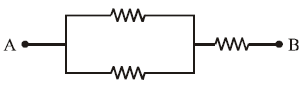
Three 10Ω, 2 W resistors are connected as in Fig. The maximum possible voltage between points A and B without exceeding the power dissipation limits of any of the resistors is: