Measuring Devices ( Galvanometer, Voltmeter and Ammeter & Meter Bridge ) - NEET Physics Questions
← Back to Current Electricity

Measuring Devices ( Galvanometer, Voltmeter and Ammeter & Meter Bridge )

Question 1: moderate

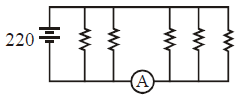
Five identical resistors, each of value 1100Ξ©, are connected to a 220V battery as shown. The reading of ideal ammeter is :

1. \[\frac{1}{3} A\]
2. \[\frac{1}{5} A\]
3. \[\frac{3}{5} A\]
4. \[\frac{4}{5} A\]
View Answer

Current through each resistor is 220/1100 = 1/5 A

Total current through ammeter = 3 * 1/5 A= 3/5 A

Question 2: moderate

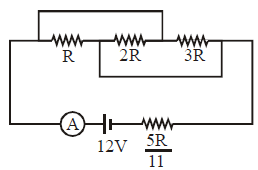
In the circuit shown the reading of ammeter is 2A. The ammeter has negligible resistance. The value of R equals.

1. 2Ξ©
2. 4Ξ©
3. 6Ξ©
4. 8Ξ©
View Answer
Question 3: moderate

An ammeter and a voltmeter are joined in series to a cell. Their readings are A and V respectively. If a resistance is now joined in parallel with the voltmeter

1. both A and V will increase
2. both A and V will decrease
3. A will decrease, V will increase
4. A will increase, V will decrease
View Answer


Initial Setup:

  1. An ammeter and a voltmeter are connected in series to a cell.
  2. The ammeter reading is
    AA
     

    (current through the circuit).

  3. The voltmeter reading is
    VV
     

    (potential difference across the cell).


What Happens When a Resistance is Added in Parallel with the Voltmeter?

  • The voltmeter has a high internal resistance (
    RvR_v
     

    ) to minimize current flow through it.

  • When an additional resistance (
    RR
     

    ) is connected in parallel with the voltmeter, the effective resistance of the voltmeter decreases because: Reff=Rvβ‹…RRv+R.R_{\text{eff}} = \frac{R_v \cdot R}{R_v + R}. 

    Since RR 

    is finite, Reff<RvR_{\text{eff}} < R_v 

    .


Effect on the Circuit:

  1. Decrease in total resistance:
    • The voltmeter (and its parallel combination) is in series with the ammeter.
    • The decrease in
      ReffR_{\text{eff}}
       

      reduces the total resistance of the circuit.

    • Lower resistance means higher total current through the circuit (Ohm's law:
      I=VRtotalI = \frac{V}{R_{\text{total}}}
       

      ).

    • Thus, the ammeter reading (
      AA
       

      ) increases.

  2. Voltage across the voltmeter decreases:
    • With the reduced effective resistance of the voltmeter, a smaller fraction of the total voltage is dropped across it.
    • Hence, the voltmeter reading (
      VV
       

      ) decreases.


Conclusion:

When a resistance is added in parallel with the voltmeter:

  • The ammeter reading (
    AA
     

    ) increases.

  • The voltmeter reading (
    VV
     

    ) decreases.

Question 4: moderate

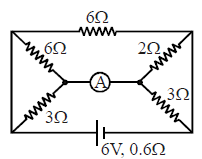
The resistance of the ammeter shown in figure is 0.8 Ξ© . Its reading is

1. zero
2. 0.6 A
3. 1.2 A
4. none of these
View Answer
Question 5: moderate

A galvanometer has a coil of resistance 100 Ξ© showing a full–scale deflection at 50 ΞΌA. Consider following statements.

(A) The resistance needed to use it as a voltmeter of range 50 volt is \(10^{6}\Omega\).

(B) The resistance needed to use it as a voltmeter of range 50 volt is \(10^{5}\Omega\)

(C) The resistance needed to use it as an ammeter of range 10 mA is 0.5 Ξ©

(D) The resistance needed to use it as an ammeter of range 10 mA is 1.0 Ξ©

Select correct alternative :

1. Only A, D
2. Only A, C
3. Only B, D
4. Only B, C
View Answer


Case 1: Using the galvanometer as a voltmeter

Given Data:

  • Coil resistance of galvanometer:
    Rg=100 ΩR_g = 100 \, \Omega
     

    ,

  • Full-scale deflection current of the galvanometer:
    Ig=50 μA=50Γ—10βˆ’6 AI_g = 50 \, \mu A = 50 \times 10^{-6} \, \text{A}
     

    ,

  • Range of the voltmeter to be designed:
    V=50 VV = 50 \, \text{V}
     

    .

Total Resistance Required ( RvR_v


):

The total resistance

RvR_v

of the voltmeter is determined using Ohm's law:


Rv=VIg=5050Γ—10βˆ’6=106 Ω.R_v = \frac{V}{I_g} = \frac{50}{50 \times 10^{-6}} = 10^6 \, \Omega.


Since the galvanometer already has a resistance

Rg=100 ΩR_g = 100 \, \Omega

, the additional series resistance

RsR_s

required is:


Rs=Rvβˆ’Rg=106βˆ’100β‰ˆ106 Ω.R_s = R_v - R_g = 10^6 - 100 \approx 10^6 \, \Omega.


Conclusion:

  • To use the galvanometer as a voltmeter of range 50 V, the series resistance required is
    106 Ω\mathbf{10^6 \, \Omega}
     

    (Option A is correct).


Case 2: Using the galvanometer as an ammeter

Given Data:

  • Full-scale deflection current of the galvanometer:
    Ig=50 μA=50Γ—10βˆ’6 AI_g = 50 \, \mu A = 50 \times 10^{-6} \, \text{A}
     

    ,

  • Resistance of the galvanometer:
    Rg=100 ΩR_g = 100 \, \Omega
     

    ,

  • Range of the ammeter to be designed:
    I=10 mA=10Γ—10βˆ’3 AI = 10 \, \text{mA} = 10 \times 10^{-3} \, \text{A}
     

    .

Shunt Resistance ( RsR_s


):

The shunt resistance is connected in parallel with the galvanometer to allow the additional current (

Iβˆ’IgI - I_g

) to pass through it. The voltage across the galvanometer and the shunt must be equal:


Vg=Vs⇒IgRg=IsRs,V_g = V_s \quad \Rightarrow \quad I_g R_g = I_s R_s,


where

Is=Iβˆ’Ig=10Γ—10βˆ’3βˆ’50Γ—10βˆ’6=9.95Γ—10βˆ’3 AI_s = I - I_g = 10 \times 10^{-3} - 50 \times 10^{-6} = 9.95 \times 10^{-3} \, \text{A}

.

Using the above relation, the shunt resistance is:


Rs=IgRgIs=(50Γ—10βˆ’6)β‹…1009.95Γ—10βˆ’3=0.5 Ω.R_s = \frac{I_g R_g}{I_s} = \frac{(50 \times 10^{-6}) \cdot 100}{9.95 \times 10^{-3}} = 0.5 \, \Omega.


Conclusion:

  • To use the galvanometer as an ammeter of range 10 mA, the shunt resistance required is
    0.5 Ω\mathbf{0.5 \, \Omega}
     

    (Option C is correct).


Final Answer:

The correct options are:
 

AΒ andΒ C\boxed{\text{A and C}}


Question 6: moderate

A milliammeter of range 10 mA has a coil of resistance 1 Ξ©. To use it as an ammeter of range 1 A, the required shunt must have a resistance of:

1. 1/101 Ξ©
2. 1/100 Ξ©
3. 1/99 Ξ©
4. 1/9 Ξ©
View Answer

To solve this, we need to determine the shunt resistance (

RSR_S

) required to extend the range of the milliammeter from 10 mA to 1 A.

Key Points:

  1. Milliammeter Current and Resistance:
    • Maximum current through the milliammeter coil:
      Im=10 mA=0.01 AI_m = 10 \, \text{mA} = 0.01 \, \text{A}
       

      ,

    • Resistance of the milliammeter coil:
      Rm=1 ΩR_m = 1 \, \Omega
       

      .

  2. Total Current for the Ammeter:
    • The total current to be measured by the modified ammeter:
      I=1 AI = 1 \, \text{A}
       

      .

  3. Shunt Current:
    • The shunt carries the remaining current,
      IS=Iβˆ’Im=1 Aβˆ’0.01 A=0.99 AI_S = I - I_m = 1 \, \text{A} - 0.01 \, \text{A} = 0.99 \, \text{A}
       

      .

  4. Voltage Across Shunt and Milliammeter:
    • The shunt is connected in parallel with the milliammeter, so the voltage across them is the same:
      Vm=VS.V_m = V_S.
       
  5. Ohm's Law:
    • Voltage across the milliammeter:
      Vm=Imβ‹…Rm=0.01β‹…1=0.01 V.V_m = I_m \cdot R_m = 0.01 \cdot 1 = 0.01 \, \text{V}.
       
    • Voltage across the shunt:
      VS=ISβ‹…RS=0.01 V.V_S = I_S \cdot R_S = 0.01 \, \text{V}.
       
  6. Solve for Shunt Resistance (
    RSR_S
     

    ):

    • From the voltage equation:
      RS=VSIS=0.010.99=199 Ω.R_S = \frac{V_S}{I_S} = \frac{0.01}{0.99} = \frac{1}{99} \, \Omega.
       

Final Answer:

The required shunt resistance is:


199 Ω.\boxed{\frac{1}{99} \, \Omega}.


Question 7: moderate

An ammeter is to be constructed which can read currents upto 2.0 A. If the coil has a resistance of 25 Ξ© and takes 1 mA for full-scale deflection, what should be the resistance of the shunt used?

1. \[1.25\times 10^{-2}\Omega\]
2. \[2.5\times 10^{-2}\Omega\]
3. \[0.5\times 10^{-2}\Omega\]
4. \[10^{-2}\Omega\]
View Answer

To construct an ammeter that can read currents up to

2.0 A2.0 \, \text{A}

, we need to calculate the resistance of the shunt. Here's the step-by-step calculation:

  1. Full-scale current through the coil:
    The coil takes 1 mA=10βˆ’3 A1 \, \text{mA} = 10^{-3} \, \text{A} 

    for full-scale deflection.

  2. Remaining current through the shunt:
    When the total current is 2.0 A2.0 \, \text{A} 

    , the current through the shunt is:

    Is=Itotalβˆ’Ic=2.0βˆ’10βˆ’3=1.999 A.I_s = I_{\text{total}} - I_c = 2.0 - 10^{-3} = 1.999 \, \text{A}. 

  3. Voltage across the coil:
    The resistance of the coil is 25 Ω25 \, \Omega 

    . Using Ohm's law, the voltage across the coil is:

    Vc=IcRc=(10βˆ’3)(25)=0.025 V.V_c = I_c R_c = (10^{-3})(25) = 0.025 \, \text{V}. 

  4. Resistance of the shunt:
    The voltage across the shunt must equal the voltage across the coil:Β  Vs=Vc=0.025 V.V_s = V_c = 0.025 \, \text{V}.Using Ohm's law for the shunt:


    Rs=VsIs=0.0251.999β‰ˆ1.25Γ—10βˆ’2 Ω.R_s = \frac{V_s}{I_s} = \frac{0.025}{1.999} \approx 1.25 \times 10^{-2} \, \Omega. 

Thus, the resistance of the shunt is:


1.25Γ—10βˆ’2 Ω.\boxed{1.25 \times 10^{-2} \, \Omega.}