Capacitors - NEET Physics Questions
Question 21: moderate

Minimum number of 8 μF and 250 V capacitors used to make a combination of 16 μF and 1000 V are:

1. 32
2. 16
3. 8
4. 4
View Answer

To solve this, we determine the combination of capacitors required to achieve the desired capacitance and voltage.


Given:

  • Individual capacitor:
    C=8μFC = 8 \, \mu\text{F}
     

    , Vmax=250VV_{\text{max}} = 250 \, \text{V} 

  • Desired combination:
    Creq=16μFC_{\text{req}} = 16 \, \mu\text{F}
     

    , Vreq=1000VV_{\text{req}} = 1000 \, \text{V} 


Step 1: Voltage requirement

To achieve

Vreq=1000VV_{\text{req}} = 1000 \, \text{V}

, multiple capacitors must be connected in series because the voltage across a series combination adds up. The number of capacitors required in series is:


n=VreqVmax=1000250=4n = \frac{V_{\text{req}}}{V_{\text{max}}} = \frac{1000}{250} = 4


Thus, 4 capacitors in series are required to handle 1000 V.


Step 2: Capacitance in series

The effective capacitance of

nn

capacitors in series is given by:


Cseries=Cn=84=2μFC_{\text{series}} = \frac{C}{n} = \frac{8}{4} = 2 \, \mu\text{F}


So, a series of 4 capacitors provides

Cseries=2μFC_{\text{series}} = 2 \, \mu\text{F}

.


Step 3: Capacitance requirement

To achieve

Creq=16μFC_{\text{req}} = 16 \, \mu\text{F}

, multiple such series groups must be connected in parallel because capacitance in parallel adds up. The number of such series groups required is:


m=CreqCseries=162=8m = \frac{C_{\text{req}}}{C_{\text{series}}} = \frac{16}{2} = 8


Thus, 8 series groups are required.


Step 4: Total capacitors

Each series group contains 4 capacitors, and there are 8 such groups. Therefore, the total number of capacitors is:


Total capacitors=nm=48=32\text{Total capacitors} = n \cdot m = 4 \cdot 8 = 32


Final Answer:

The minimum number of capacitors required is:
 

32\boxed{32}


Question 22: difficult

Three capacitors 2 μF, 3 μF and 5 μF can withstand voltages to 3V, 2V and 1V respectively. Their series combination can withstand a maximum voltage equal to

1. 5 Volts
2. (31/6) Volts
3. (26/5) Volts
4. None
View Answer

Let's verify and calculate the correct answer step-by-step:

Given Data:

  • Capacitances:
    C1=2μF,C2=3μF,C3=5μFC_1 = 2 \, \mu\text{F}, C_2 = 3 \, \mu\text{F}, C_3 = 5 \, \mu\text{F}
     
  • Maximum voltages:
    V1=3V,V2=2V,V3=1VV_1 = 3 \, \text{V}, V_2 = 2 \, \text{V}, V_3 = 1 \, \text{V}
     

Step 1: Maximum charge each capacitor can store:


Q1=C1V1=23=6μCQ_1 = C_1 \cdot V_1 = 2 \cdot 3 = 6 \, \mu\text{C}


Q2=C2V2=32=6μCQ_2 = C_2 \cdot V_2 = 3 \cdot 2 = 6 \, \mu\text{C}


Q3=C3V3=51=5μCQ_3 = C_3 \cdot V_3 = 5 \cdot 1 = 5 \, \mu\text{C}


The capacitor with the minimum charge capacity limits the system. Here,

Qmax=5μCQ_{\text{max}} = 5 \, \mu\text{C}

, dictated by

C3C_3

.


Step 2: Voltage distribution across each capacitor:

In series, charge

QQ

is the same on all capacitors, and the voltage across each capacitor is:


V1=QC1,V2=QC2,V3=QC3V_1 = \frac{Q}{C_1}, \quad V_2 = \frac{Q}{C_2}, \quad V_3 = \frac{Q}{C_3}


Total voltage across the series combination:


Vtotal=V1+V2+V3V_{\text{total}} = V_1 + V_2 + V_3


Substitute

Q=5μCQ = 5 \, \mu\text{C}

:


V1=52=2.5V,V2=531.67V,V3=55=1VV_1 = \frac{5}{2} = 2.5 \, \text{V}, \quad V_2 = \frac{5}{3} \approx 1.67 \, \text{V}, \quad V_3 = \frac{5}{5} = 1 \, \text{V}


Step 3: Total voltage:


Vtotal=V1+V2+V3=2.5+1.67+1=156+106+66=316V.V_{\text{total}} = V_1 + V_2 + V_3 = 2.5 + 1.67 + 1 = \frac{15}{6} + \frac{10}{6} + \frac{6}{6} = \frac{31}{6} \, \text{V}.


Final Answer:

The maximum voltage the series combination can withstand is:


316V5.17V.\boxed{\frac{31}{6} \, \text{V}} \approx 5.17 \, \text{V}.


Question 23: difficult

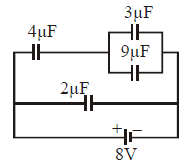
A combination of capacitors is set up as shown in the figure. The magnitude of the electric field, due to a point charge Q (having a charge equal to the sum of the charges on the 4μF and 9μF capacitors), at a point distant 30 m from it, would equal :

1. 480 N/C
2. 240 N/C
3. 360 N/C
4. 420 N/C
View Answer
Question 24: moderate

A parallel plate capacitor of capacitance C consists of two identical plates A and B. A charge q is given to plate A and charge –q is given to plate B. The space between plates is vacuum. The separation between plates is d. The electric intensity at a point situated between plates is :

1. q/Cd
2. q/2Cd
3. 3q/2Cd
4. none of these
View Answer
Question 25: difficult

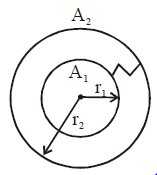
Two spherical conductors A1 and A2 of radii r1 and r2 are placed concentrically in air. The two are connected by a copper A wire as shown in figure. Then the equivalent capacitance of the system is :

1. \[\frac{4\pi\varepsilon_{0}Kr_{1}r_{2}}{r_{2}-r_{1}}\]
2. \[4\pi\varepsilon_{0}(r_{2}+r_{1})\]
3. \[4\pi\varepsilon_{0}r_{2}\]
4. \[4\pi\varepsilon_{0}r_{1}\]
View Answer

The problem involves two spherical conductors

A1A_1

and

A2A_2

connected by a copper wire. Let’s analyze and compute the equivalent capacitance of the system.

Given:


  • A1A_1
     

    and A2A_2 

    are concentric spherical conductors.

  • Radii of the spheres:
    r1r_1
     

    (inner) and r2r_2 

    (outer).

  • The medium is air, so the permittivity is
    ε0\varepsilon_0
     

    .

Key Concepts:

  1. Potential Difference Between the Spheres: The two conductors are connected by a wire, meaning they are at the same potential. As a result, the electric field exists only between the two spheres.
  2. Capacitance of a Single Isolated Sphere: If only
    A2A_2
     

    existed as a spherical conductor, its capacitance would be: 

    Csingle=4πε0r2.C_{\text{single}} = 4 \pi \varepsilon_0 r_2. 

  3. Why the System is Equivalent to an Isolated Sphere: Since
    A1A_1
     

    is connected to A2A_2 

    via a conducting wire, any charge added to A1A_1 

    immediately flows to A2A_2 

    , making the system behave as if there is only one conductor of radius r2r_2 

    .

Equivalent Capacitance:

Thus, the capacitance of the system is:


Cequivalent=4πε0r2.C_{\text{equivalent}} = 4 \pi \varepsilon_0 r_2.


Final Answer:

The equivalent capacitance of the system is:


4πε0r2.\boxed{4 \pi \varepsilon_0 r_2}.


Question 26: moderate

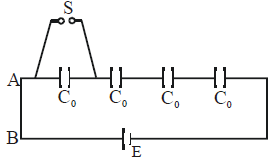
In the given figure, find the charge flowing through section AB when switch S is closed:


1. \[C_{0}E/12\]
2. \[C_{0}E/4\]
3. \[C_{0}E/3\]
4. none of these
View Answer

When Switch is open Ceq= C/4 Charge given by the Battery is CE/4.

When Switch is open Ceq= C/3 Charge given by the Battery is CE/3.

Extra Charge flowing through the circuit it = \( \frac{CE}{3}-\frac{CE}{4}= \frac{CE}{12}\)


Question 27: moderate

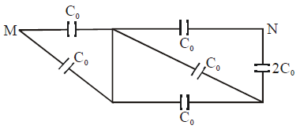
The equivalent capacitance between points M and N is:

1. \[\frac{10}{11}C_{0}\]
2. \[2C_{0}\]
3. \[C_{0}\]
4. none of these
View Answer

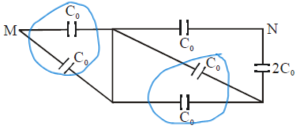
Combination of Capacitors

Circircled ones are in parallel

Question 28: easy

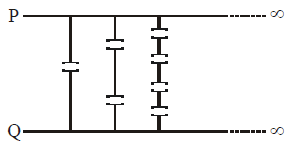
If each capacitor has C = I F, the capacitance across P and Q is:


1. 0.5 F
2. 1 F
3. 2 F
4. infinity
View Answer

First Branch has a capacitance of 1F , for second branch it is 1/2F , for third branch it is 1/4 F and so, on . As all these branches are in parallel

\[ C_{eq}=C_{1}+C_{2}+C_{3}+....\]

\[ C_{eq}= 1 + \frac{1}{2} + \frac{1}{4}+ \frac{1}{8}+....=\frac{1}{1-\frac{1}{2}}=2\mu F\]

Question 29: difficult

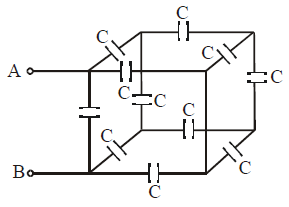
The equivalent capacitance between A and B is :

1. 5C/7
2. 7C/5
3. 7C/12
4. 12C/7
View Answer

To find the equivalent capacitance for this cubical capacitor network, where each edge of the cube has a capacitance

CC

, here’s the shortest solution:

Step-by-Step:

  1. Symmetry analysis:
    • By symmetry, all corners of the cube can be grouped into equivalent potential nodes.
    • The cube's symmetry allows reduction to a simpler circuit.
  2. Key nodes:
    • Node
      AA
       

      is connected to one corner of the cube.

    • Node
      BB
       

      is connected to the diagonally opposite corner.

  3. Effective connections:
    • Due to symmetry, three capacitors are effectively in parallel between
      AA
       

      and an intermediate point.

    • Similarly, three capacitors are effectively in parallel between
      BB
       

      and the same intermediate point.

    • Two capacitors remain directly between
      AA
       

      and BB 

      .

  4. Simplification:
    • The three parallel capacitors at each node result in:
      Cparallel=3CC_{\text{parallel}} = 3C
       
    • The equivalent circuit becomes two
      3C3C
       

      capacitors in series with a 2C2C 

      capacitor: Series combination:1Ceq=13C+13C+12C\text{Series combination:} \quad \frac{1}{C_{\text{eq}}} = \frac{1}{3C} + \frac{1}{3C} + \frac{1}{2C} 

  5. Calculation:
    • Combine series:
      1Ceq=23C+12C=46C+36C=76C\frac{1}{C_{\text{eq}}} = \frac{2}{3C} + \frac{1}{2C} = \frac{4}{6C} + \frac{3}{6C} = \frac{7}{6C}
       
    • Invert to find
      CeqC_{\text{eq}}
       

      : Ceq=6C7×2=12C7C_{\text{eq}} = \frac{6C}{7} \times 2 = \frac{12C}{7} 

Thus, the equivalent capacitance is:


Ceq=12C7C_{\text{eq}} = \frac{12C}{7}


Question 30: easy

A capacitor is charged by using a battery, which is then disconnected. A dielectric slab is then slided between the plates which results in :

1. reduction of charge on the plates and increase of potential difference across the plates
2. increase in the potential difference across the plates, reduction in stored energy but no change in the charge on the plates
3. decrease in the potential difference across the plates, reduction in stored energy, but no change in the charge on the plates
4. none of the above
View Answer

Let's break down the situation step by step:

Given:

  • A capacitor is charged using a battery and then disconnected (so no current can flow after disconnection).
  • A dielectric slab is inserted between the plates of the capacitor after disconnecting the battery.

Key concepts:

  • Capacitance with Dielectric: When a dielectric slab is inserted, the capacitance of the capacitor increases. The new capacitance
    CC'
     

    is related to the original capacitance CC 

    by the dielectric constant KK 

    C=KCC' = K \cdot Cwhere

    KKis the dielectric constant of the material.

  • Charge on the Plates: Since the capacitor is disconnected from the battery, no additional charge can flow onto the plates. Thus, the charge
    QQ
     

    remains the same, given by: 

    Q=CVQ = C \cdot Vwhere

    VVis the potential difference across the plates. Since the charge remains constant, the equation becomes:


    Q=CVQ = C' \cdot V'where

    VV'is the new potential difference across the plates.

  • Potential Difference: Since the capacitance increases and the charge stays constant, the potential difference
    VV'
     

    must decrease (because Q=CVQ = C' \cdot V' 

    and C>CC' > C 

    ).

  • Stored Energy: The energy stored in a capacitor is given by: 

    U=Q22CU = \frac{Q^2}{2C}Since the capacitance increases and the charge is constant, the stored energy

    UUdecreases, as it is inversely proportional to the capacitance.

Conclusion:

  • Decrease in potential difference: The potential difference across the plates decreases because the capacitance increases while the charge remains constant.
  • Reduction in stored energy: The energy stored in the capacitor decreases because the capacitance increases.
  • No change in charge: The charge on the plates remains the same since the capacitor is disconnected from the battery.

Thus, the correct answer is: "Decrease in the potential difference across the plates, reduction in stored energy, but no change in the charge on the plates."