Solution:
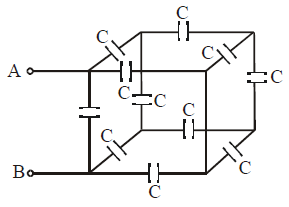
To find the equivalent capacitance for this cubical capacitor network, where each edge of the cube has a capacitance
, here’s the shortest solution:
Step-by-Step:
- Symmetry analysis:
- By symmetry, all corners of the cube can be grouped into equivalent potential nodes.
- The cube's symmetry allows reduction to a simpler circuit.
- Key nodes:
- Node
is connected to one corner of the cube.
- Node
is connected to the diagonally opposite corner.
- Node
- Effective connections:
- Due to symmetry, three capacitors are effectively in parallel between
and an intermediate point.
- Similarly, three capacitors are effectively in parallel between
and the same intermediate point.
- Two capacitors remain directly between
and
.
- Due to symmetry, three capacitors are effectively in parallel between
- Simplification:
- The three parallel capacitors at each node result in:
- The equivalent circuit becomes two
capacitors in series with a
capacitor:
- The three parallel capacitors at each node result in:
- Calculation:
- Combine series:
- Invert to find
:
- Combine series:
Thus, the equivalent capacitance is:
Leave a Reply