Charging and Discharging of Capacitors - NEET Physics Questions
← Back to Capacitors

Charging and Discharging of Capacitors

Question 1: moderate

In the circuit shown in the figure, the switch S is initially open and the capacitor is initially uncharged. I1, I2 and I3 represent the current in the resistance 2Ω, 4Ω and 8Ω respectively.
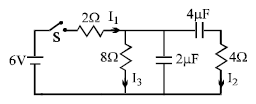
1. Just after the switch S is closed, I1 = 3A, I2 = 3A and I3 = 0
2. Just after the switch S is closed, I1 = 3A, I2 = 0 and I3 = 0
3. long time after the switch S is closed, I1 = 0.6 A, I2 = 0 and I3 = 0
4. long after the switch S is closed, I1 = I2 = I3 = 0.6 A.
View Answer

Here's the short solution for the circuit:

  1. Just after the switch is closed:
    • The capacitors act as open circuits because they are initially uncharged (capacitor voltage cannot change instantaneously).
    • This means no current flows through the branches containing the capacitors.
  2. Current Distribution:
    • The total resistance in the circuit is only the sum of the resistors in the main loop (2Ω + 8Ω), as the branches with capacitors are effectively open.
    • Total resistance =
      2Ω+8Ω=10Ω2\Omega + 8\Omega = 10\Omega
       

      .

    • Current
      I1=VoltageResistance=6V2Ω+8Ω=0.6AI_1 = \frac{\text{Voltage}}{\text{Resistance}} = \frac{6V}{2\Omega + 8\Omega} = 0.6A
       

      .

  3. Branch currents:

    • I3=0I_3 = 0
       

      since the capacitor branch is open.


    • I2=0I_2 = 0
       

      for the same reason as above.

Final Answer:

  • \( I_1 = 0.6 A, \ I_2 = 0\)
Question 2: moderate

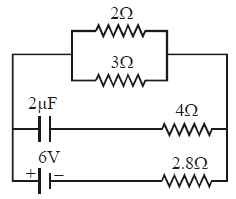
In the figure shown, the capacity of the condenser C is 2μF. The current in 2Ω resistor in steady state:

1. 9 A
2. 0.9 A
3. 1/9 A
4. 1/0.9 A
View Answer

In steady state no current flows through the capacitor so, current through 4 ohm resistor will be zero.

In absence of 4 ohm resistor, total resistance of circuit is (1.2+2.8)= 4 ohm.

Total current given by battery = 6/4=1.5 Ampere.

In parallel combination current divides in reverse ratio of resistors: (3/5)*1.5= 0.9 Ampere

Question 3: moderate

The electric field between the plates of a parallel-plate capacitor of capacitance \(2.0~\mu\text{F}\) drops to one third of its initial value in \(4.4~\mu\text{s}\) when the plates are connected by a thin wire. Find the resistance of the wire.

1. \(0.5~\Omega\)
2. \(0.1~\Omega\)
3. \(2~\Omega\)
4. \(1~\Omega\)
View Answer

The electric field in a discharging capacitor drops as \(E = E_0 e^{-t/RC}\). Given \(E = E_0/3\), we have \(RC = \frac{t}{\ln 3}\). Solving for \(R = \frac{4.4 \times 10^{-6}}{2.0 \times 10^{-6} \times 1.1} = 2~\Omega\).

Question 4: moderate

A \(5.0~\mu\text{F}\) capacitor having a charge of \(20~\mu\text{C}\) is discharged through a wire of resistance \(5.0~\Omega\). Find the heat dissipated in the wire between 25 to 50 \(\mu\text{s}\) after the connections are made.

1. \(40\left(\frac{1}{e^2} - \frac{1}{e^4}\right)~\mu\text{J}\)
2. \(40\left(\frac{1}{e} - \frac{1}{e^2}\right)~\mu\text{J}\)
3. \(40\left(\frac{1}{e^2} - \frac{1}{e^3}\right)~\mu\text{J}\)
4. None of these
View Answer

The remaining energy in the capacitor is \(U(t) = \frac{q_0^2}{2C}e^{-2t/tau}\), where \(tau = RC = 25~\mu\text{s}\). The heat dissipated is \(H = U(t_1) - U(t_2) = \frac{q_0^2}{2C}\left(e^{-2} - e^{-4}\right)\) where \(frac{q_0^2}{2C} = 40~\mu\text{J}\).

Question 5: moderate

Let C be the capacitance of a capacitor discharging through a resistor R. Suppose \(t_1\) is the time taken for the energy stored in the capacitor to reduce to half its initial value and \(t_2\) is the time taken for the charge to reduce to one-fourth its initial value. Then the ratio \(t_1/t_2\) will be :

1. 2
2. 1
3. 1/2
4. ⇒1/4
View Answer

Energy is \(U \propto q^2 \propto e^{-2t/RC}\), so \(e^{-2t_1/RC} = 1/2 ⇒ t_1 = \frac{RC\ln 2}{2}\). Charge is \(q \propto e^{-t/RC}\), so \(e^{-t_2/RC} = 1/4 t_2 = 2RC\ln 2\). Thus, the ratio \(t_1/t_2 = 1/4\).

Question 6: moderate

A capacitor of capacitance \(C\) is connected to a battery of emf \(\varepsilon\) at \(t = 0\) through a resistance \(R\). Find the maximum rate at which energy is stored in the capacitor. When does the rate has this maximum value ?

1. \(\frac{\varepsilon^2}{4R}\)
2. \(\frac{\varepsilon^2}{2R}\)
3. \(RC\)
4. \(CR \ln 2\)
View Answer

The energy stored rate is \(P = \frac{\varepsilon^2}{R} e^{-t/RC}(1-e^{-t/RC})\). This is maximum when \(e^{-t/RC} = \frac{1}{2}\). The maximum rate is \(P_{max} = \frac{\varepsilon^2}{4R}\). This occurs at \(t = RC \ln 2\).