Charging and Discharging of Capacitors - NEET Physics Questions
← Back to Capacitors

Charging and Discharging of Capacitors

Question 1: difficult

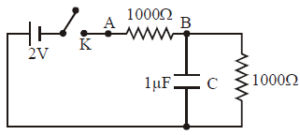
When the key K is pressed at t = 0, which of the following statements about the current I in the resistor AB of the given circuit is true ?

1. I = 2 mA at all t
2. I oscillates between 1 mA and 2 mA
3. I = 1 ma at all t
4. at t = 0, I = 2mA and with time it goes to 1 mA
View Answer

At t =0 capacitor behaves as closed circuit to the 1000 ohm resistor connected in parallel with capacitor will get short circuited.

currentΒ  through the other resistor = 2/1000 = 2mA

At t = infinite capacitor behaves as open circuit so equivalent resistance becomes R=1000+1000 = 2000 Ohm

currentΒ  through theΒ  resistor = 2/2000 = 1 mA

Question 2: difficult

A capacitor is charged from a cell with the help of a resistor. The circuit has a time constant Ο„. The capacitor collects 10% of the steady charge at time t given by :

1. Ο„ln(1.1)
2. Ο„ ln (10/9)
3. Ο„ ln (0.9)
4. Ο„ ln (0.1)
View Answer

The charging of a capacitor through a resistor is described by the following equation:


Q(t)=Qmax(1βˆ’eβˆ’t/Ο„)Q(t) = Q_{\text{max}} \left( 1 - e^{-t/\tau} \right)


Where:


  • Q(t)Q(t)
     

    is the charge on the capacitor at time tt 

    ,


  • QmaxQ_{\text{max}}
     

    is the maximum (steady-state) charge the capacitor can hold,


  • Ο„\tau
     

    is the time constant, Ο„=Rβ‹…C\tau = R \cdot C 

    , where RR 

    is the resistance and CC 

    is the capacitance,


  • tt
     

    is the time.

Step 1: Given condition (10% of steady charge)

We are told that at time

tt

, the capacitor has collected 10% of the steady charge, so:


Q(t)=0.1β‹…QmaxQ(t) = 0.1 \cdot Q_{\text{max}}


Step 2: Substitute into the charging equation

Substitute

Q(t)=0.1β‹…QmaxQ(t) = 0.1 \cdot Q_{\text{max}}

into the charging formula:


0.1β‹…Qmax=Qmax(1βˆ’eβˆ’t/Ο„)0.1 \cdot Q_{\text{max}} = Q_{\text{max}} \left( 1 - e^{-t/\tau} \right)


Cancel

QmaxQ_{\text{max}}

from both sides:


0.1=1βˆ’eβˆ’t/Ο„0.1 = 1 - e^{-t/\tau}


Step 3: Solve for tt


Rearrange the equation to solve for

eβˆ’t/Ο„e^{-t/\tau}

:


eβˆ’t/Ο„=1βˆ’0.1=0.9e^{-t/\tau} = 1 - 0.1 = 0.9


Take the natural logarithm of both sides:


βˆ’tΟ„=ln⁑(0.9)-\frac{t}{\tau} = \ln(0.9)


t=βˆ’Ο„ln⁑(0.9)t = -\tau \ln(0.9)


Using the fact that

ln⁑(0.9)=βˆ’ln⁑(10/9)\ln(0.9) = -\ln(10/9)

:


t=Ο„ln⁑(109)t = \tau \ln\left(\frac{10}{9}\right)


Final Answer:

The time at which the capacitor has collected 10% of the steady charge is

t=Ο„ln⁑(109)t = \tau \ln\left(\frac{10}{9}\right)

.

Question 3: difficult

A capacitor is connected to a \(12~\text{V}\) battery through a resistance of \(10~Omega\). It is found that the potential difference across the capacitor rises to \(4.0~\text{V}\) in \(1~\mu\text{s}\). Find the capacitance of the capacitor. (Take : \(ln \frac{3}{2} = 0.4\))

1. \(0.5~\mu\text{F}\)
2. \(0.25~\mu\text{F}\)
3. \(5.0~\mu\text{F}\)
4. \(1.0~\mu\text{F}\)
View Answer

Using \(V = V_0(1 - e^{-t/RC})\), we get \(4 = 12(1 - e^{-t/RC})β‡’ e^{-t/RC} = 2/3\). Taking the natural logarithm, \(\frac{t}{RC} = \ln(1.5) = 0.4\), which yields \(C = \frac{10^{-6}}{10 \times 0.4} = 0.25~\mu\text{F}\).

Question 4: difficult

A resistor ‘R’ and \(2~\mu\text{F}\) capacitor in series is connected through a switch to \(200~\text{V}\) direct supply. Across the capacitor is a neon bulb that lights up at \(120~\text{V}\). Calculate the value of R to make the bulb light up \(5~\text{s}\) after the switch has been closed. \((log_{10} 2.5 = 0.4)\)

1. \(2.7 \times 10^6~\Omega\)
2. \(3.3 \times 10^7~\Omega\)
3. \(1.3 \times 10^4~\Omega\)
4. \(1.7 \times 10^5~\Omega\)
View Answer

The charging voltage is \( V = V_0(1 - e^{-t/RC})\), so \(120 = 200(1 - e^{-t/RC})\) β‡’ \(e^{t/RC} = 2.5\). This gives \(t/RC = \ln 2.5 = 2.303 \log_{10} 2.5 \approx 0.921\). Solving with \(t = 5~text{s}\) and \(C = 2~\mu\text{F}\) gives \(R \approx 2.7 \times 10^6~\Omega\).