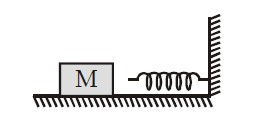
A body of mass 2 kg collides with a massless spring of force constant K = 4 N/m. The spring compresses by 1m. If coefficient of friction between the body and the surface is 0.1, the speed of the body at the time of collision is :
1. 2 m/s
2. 4 m/s
3. 6 m/s
4. 0.5 m/s
View Answer
The Kinetic Energy of the object will go to increase potential energy of the spring and a part of energy will be lost to friction
U1= ½ K x²= ½ × 4× 1² = 2J
Work done against friction = ü.mg.x= 0.1× 20 × 1= 2 J
So total kinetic energy is 4 = ½× 2 ×v ² ⇒ v = 2 m/s
A particle is released from height \(S\) from the surface of the Earth. At a certain height its kinetic energy is three times its potential energy. The height from the surface of Earth and the speed of the particle at that instant are respectively:
(2021)
1. \(h = \frac{S}{4}, v = \sqrt{\frac{3gS}{2}}\)
2. \(h = \frac{S}{2}, v = \sqrt{\frac{3gS}{2}}\)
3. \(h = \frac{S}{4}, v = \frac{3gS}{4\sqrt{2}}\)
4. \(h = \frac{S}{4}, v = \frac{3gS}{4\sqrt{2}}\)
View Answer
Let the initial height be \(S\). At height \(h\), \(KE = 3PE = 3mgh\). By conservation of energy, \(mgS = mgh + 3mgh = 4mgh\), so \(h = S/4\). Also, \(KE = \frac{1}{2}mv^2 = 3mgh\), substituting \(h\) gives \(v^2 = 6g(S/4) = \frac{3gS}{2}\), so \(v = \sqrt{\frac{3gS}{2}}\).
A child is sitting on a swing. Its minimum and maximum heights from the ground is \(0.75\text{ m}\) and \(2\text{ m}\) respectively, its maximum speed will be:
(2001)
1. \(10\text{ m/s}\)
2. \(5\text{ m/s}\)
3. \(1\text{ m/s}\)
4. \(15\text{ m/s}\)
View Answer
Maximum speed occurs at minimum height, where potential energy is lowest and kinetic energy is highest. Minimum speed (zero) occurs at maximum height. By conservation of mechanical energy: \(mgh_{max} + \frac{1}{2}mv_{min}^2 = mgh_{min} + \frac{1}{2}mv_{max}^2\). With \(v_{min}=0\), \(mg(2) = mg(0.75) + \frac{1}{2}mv_{max}^2\). \(2g - 0.75g = \frac{1}{2}v_{max}^2 \Rightarrow 1.25g = \frac{1}{2}v_{max}^2\). Using \(g = 10\text{ m/s}^2\), \(v_{max}^2 = 2.5 \times 10 = 25\), so \(v_{max} = 5\text{ m/s}\).