A body is released from position A as shown in figure. The speed of body at position B is
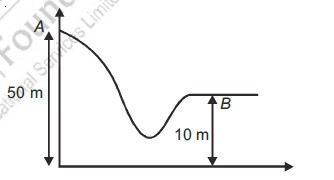
From Principal of Conservation of Energy
Ui + Ki= Uf+ Kf
⇒ mg(50) + 0 = mg(10) + ½ m v²
⇒ v² = 800
⇒ v = 20√2 m/s
A body is released from position A as shown in figure. The speed of body at position B is
From Principal of Conservation of Energy
Ui + Ki= Uf+ Kf
⇒ mg(50) + 0 = mg(10) + ½ m v²
⇒ v² = 800
⇒ v = 20√2 m/s
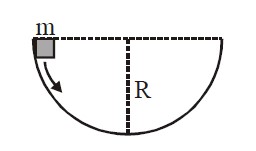
A mass m slips along the wall of a hemispherical surface of radius R. The velocity at the bottom of the surface is

From Principal of conservation of Energy in absence of non-conservative forces,
Ui+ Ki= Uf+ Kf
mgR+0= 0+ ½mv²
v= √2gR
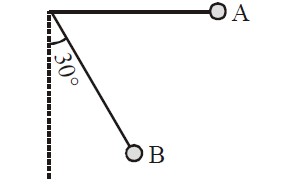
A simple pendulum is released from A as shown. If m and l represent the mass of the bob and length of the pendulum, the gain in kinetic energy at B is

From Principal of conservation of Energy in absence of non-conservative forces,
Ui+ Ki= Uf+ Kf
⇒ Ui- Uf= Kf - Ki
⇒ Loss in Potential Energy = Gain in Kinetic Energy
⇒ Gain in Kinetic Energy = m.g. l .cos 30° = √3mgl/2
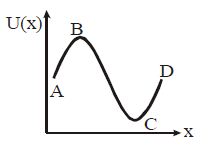
The potential energy of a particle varies with distance x as shown in the graph :

The force acting on the particle is zero at
For Equilibrium dU/dx =0 so, Points of maxima and minima in U-x graph are point of equilibrium.
So, Points B and C are equilibrium positions