For a body of mass 1 kg U-x graph is shown in If the body is released from rest at x = 2m, then its speed when it crosses x = 5m is
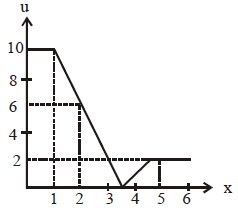
From Principal of Conservation of Energy
Ui + Ki = Uf + Kf
10 +0 = 2 + ½v²
⇒ v ² = 16 ⇒ v = 4 m/s
For a body of mass 1 kg U-x graph is shown in If the body is released from rest at x = 2m, then its speed when it crosses x = 5m is

From Principal of Conservation of Energy
Ui + Ki = Uf + Kf
10 +0 = 2 + ½v²
⇒ v ² = 16 ⇒ v = 4 m/s
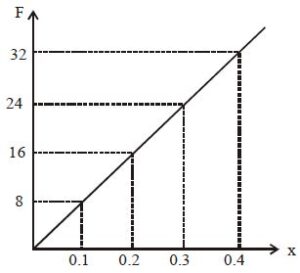
For a spring force-compression graph is shown in figure. A body of mass 5 kg moving with a speed of 8 ms–1 collides the The maximum compression in the spring is


Using this graph we can find value of Spring constant.
F = - K.x
So, K = 80 N/m
Kinetic Energy of the block will convert into spring potential energy
so, ½mv² = ½ k x²
solving x = 2 m
If potential energy between electron and proton at a distance r is given by U =-(ke²/3r³), then force acting is
Force F = - dU/dr = d ((ke²/3r³))/dr = ke²/r^4
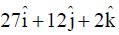
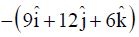
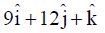
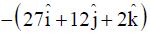
If Potential energy is given by U = (x³ + y³ + z²). Calculate force at a point (3, 2, 1) :
A body of mass 2 kg collides with a massless spring of force constant K = 4 N/m. The spring compresses by 1m. If coefficient of friction between the body and the surface is 0.1, the speed of the body at the time of collision is :
The Kinetic Energy of the object will go to increase potential energy of the spring and a part of energy will be lost to friction
U1= ½ K x²= ½ × 4× 1² = 2J
Work done against friction = ü.mg.x= 0.1× 20 × 1= 2 J
So total kinetic energy is 4 = ½× 2 ×v ² ⇒ v = 2 m/s
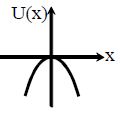
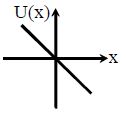
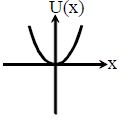
A particle is placed at the origin and a force F = kx is acting on it (where k is positive constant). If U(0) = 0, the graph of U(x) versus x will be (where U is the potential energy function) :
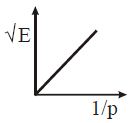
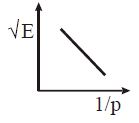
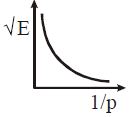
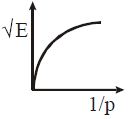
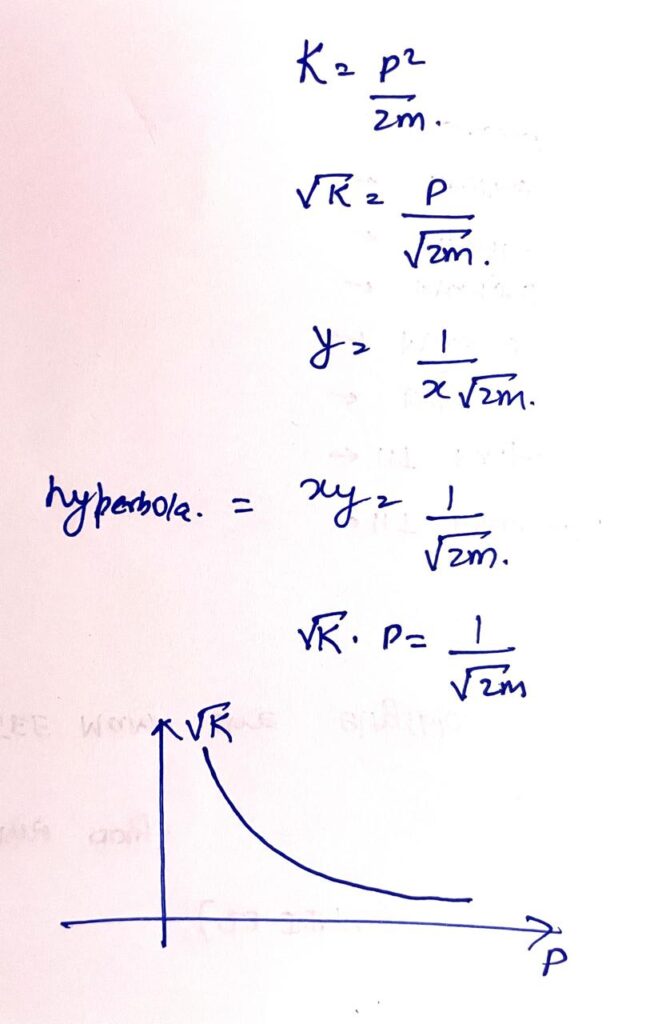
The graph between √E and 1/p is (E = kinetic energy and p = momentum):
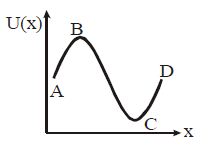
The potential energy of a particle varies with distance x as shown in the graph :

The force acting on the particle is zero at
For Equilibrium dU/dx =0 so, Points of maxima and minima in U-x graph are point of equilibrium.
So, Points B and C are equilibrium positions
A system absorbs 600 J of the system works equivalent to –900 J by The value of ΔE for the system is :
Work done by external agent = -900 J and energy supplied is 600 J So, change in kinetic energy is -300 J