Work Energy and Power - NEET Physics Questions
← All Chapters

Work Energy and Power

Question 31: moderate

A child on a swing is 1 m above the ground at the lowest point and 6 m above the ground at the highest point. The horizontal speed of the child at the lowest point of the swing is approximately

1. 8 m/s
2. 10 m/s
3. 12 m/s
4. 14 m/s
View Answer

From Principal of conservation of Energy in absence of non-conservative forces,

Ui+ Ki= Uf+ Kf

⇒mg(6) +0 = mg(1) + ½mv²

mg(5)= ½mv²

v²=100 or v =10 m/s

Question 32: easy

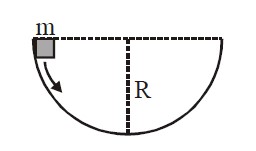
A mass m slips along the wall of a hemispherical surface of radius R. The velocity at the bottom of the surface is

1. √Rg
2. 2√Rg
3. √3Rg
4. √2Rg
View Answer

From Principal of conservation of Energy in absence of non-conservative forces,

Ui+ Ki= Uf+ Kf

mgR+0= 0+ ½mv²

v= √2gR

Question 33: moderate

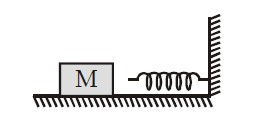
The block of mass M moving on the frictionless horizontal surface collides with the spring of spring constant K and compresses it by length L. The maximum momentum of the block after collision is

1. Zero
2. ML²/K
3. (MK)½ L
4. KL²/2M
View Answer

From Principal of conservation of Energy in absence of non-conservative forces,

Ui+ Ki= Uf+ Kf

½KL²+ 0 = ½mv²

⇒v= √(KL²/m)

Momentum is P= m.v = m. √(KL²/m) =(mK)½ L

Question 34: easy

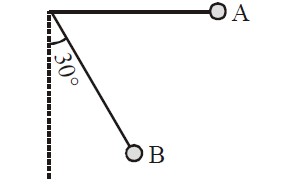
A simple pendulum is released from A as shown. If m and l represent the mass of the bob and length of the pendulum, the gain in kinetic energy at B is

1. mgl/2
2. mgl/√2
3. 2mgl/√3
4. √3mgl/2
View Answer

From Principal of conservation of Energy in absence of non-conservative forces,

Ui+ Ki= Uf+ Kf

⇒ Ui- Uf= Kf - Ki

⇒ Loss in Potential Energy = Gain in Kinetic Energy

⇒ Gain in Kinetic Energy = m.g. l .cos 30° = √3mgl/2

Question 35: moderate

The position of a particle of mass 1 kg moving along x-axis at time t is given by x=t²/2. The work done by the force from t=0 to t=3 sec

1. 1.5 J
2. 3 J
3. 4.5 J
4. 6.0 J
View Answer

Given, x = t²/2 differentiating v=dx/dt= t 

Initial Speed Vi= 0 m/s

Final Speed Vf= 3 m/s

From Work Energy Theorem, Work done is equal to change in kinetic energy

So, Work Done = ½m (Vf² - Vi²)= 1/2 × 1× (9-0) = 4.5 J

Question 36: moderate

A force act on a 2 kg particle such a way that position of the particle as a function of time is given by x = 3t -4t²+t³, Where x is in meter and t is in second. Work done during first 4 second is 

1. 20 J
2. 32 J
3. 176 J
4. 352 J
View Answer

Given x = 3t -4t²+t³ differentiating v = dx/dt = 3-8t+ 3t², 

Initial speed = 3 m/s

Final speed = 3-32+48= 19 m/s

From Work Energy Theorem,

Work Done = Change in Kinetic Energy= ½×2×(19²-3²)= 352 J 

Question 37: moderate

A 5 kg ball when falls through a height of 20 m acquires a speed of 10 m/s. Find the work done by air resistance

1. 500 J
2. -500 J
3. -750 J
4. + 750 J
View Answer

From work energy theorem, work done by all the forces is equal to change in kinetic energy.

So, Work done by gravity + Work done by air resistance = Final Kinetic Energy - Initial Kinetic Energy

5×10×20 + Work done by air resistance = 1/2× 5 ×(10²-0)

⇒ 1000 + Work done by air resistance = 250

⇒ Work done by air resistance = 250 -1000= -750 J

Question 38: moderate

The potential energy of a particle oscillating on x-axis is given as : U = 20 + (x – 2)2 Joules. If total mechanical  energy of the particle is 36 J, then its maximum kinetic energy is:

1. 10 J
2. 16 J
3. 20 J
4. 30 J
View Answer

Given  U = 20 + (x – 2)2

For Equilibrium , dU/dx = 2 (x-2) =0, So, x=2 is the point of Equilibrium.

d²U/dx²= 2 >0 so, x= 2 is the point of stable equilibrium.

U min = 20 J

As Total Energy is 36 J.

U min  + K max  = 36 J

⇒ K max  = 16 J

Question 39: moderate

A person draws water from a 5m deep well in a bucket of mass 2 kg of capacity 8 litre by a rope of mass 1 kg. What is the total work done by the person ? [g = 10 m/s2]

1. 550 J
2. 525 J
3. 125 J
4. 500 J
View Answer

Work Done in Pulling the Bucket + Rope System= 

Mgh+mg(h/2)

10×10× 5 + 1×10×(5/2) =525 J

Question 40: moderate

A bullet of mass 10g is fired horizontally with a velocity 1000 ms–1 from a rifle situated at a height 50m above the If the bullet reaches the ground with a velocity 500 ms–1, the work done against air resistance on the bullet is : (g = 10 ms–2)

1. 5005 J
2. 3755 J
3. -3755 J
4. -5005 J
View Answer

From Work Energy Theorem,

Total Work Done = Change in Kinetic Energy

Work Done by Gravity + Work Done by Air Resistance = ½m (Vf 2 - Vi 2 )

0.001 × 10×50 + Work done by Air Resistance = ½× 0.001×( 500² - 1000²)

Solving We get, Work Done by Air Resistance = - 3755 J