Thermal Physics - NEET Physics Questions
← All Chapters

Thermal Physics

Question 71: moderate

A cylinder of capacity 20 litres is filled with H2 gas. The total average kinetic energy of translatory motion of its molecules is \( 1.5\times 10^{5}\) J. The pressure of hydrogen in the cylinder is

1. \[ 2\times 10^{6} N/m^{2}\]
2. \[ 3\times 10^{6} N/m^{2}\]
3. \[ 4\times 10^{6} N/m^{2}\]
4. \[ 5\times 10^{6} N/m^{2}\]
View Answer

The total average kinetic energy \( E \) of translatory motion for an ideal gas is given by:

\[
E = \frac{3}{2} nRT
\]

where:
- \( n \) is the number of moles,
- \( R \) is the gas constant (\( 8.314 \, \text{J/mol·K} \)),
- \( T \) is the temperature in Kelvin.

We can rearrange to find \( nRT \):

\[
nRT = \frac{2}{3} E
\]

The ideal gas law also gives us:

\[
PV = nRT
\]

Thus,

\[
P = \frac{nRT}{V} = \frac{\frac{2}{3} E}{V}
\]

Substitute \( E = 1.5 \times 10^5 \, \text{J} \) and \( V = 20 \, \text{litres} = 20 \times 10^{-3} \, \text{m}^3 \):

\[
P = \frac{\frac{2}{3} \times 1.5 \times 10^5}{20 \times 10^{-3}}
\]

\[
P = \frac{10^5}{20 \times 10^{-3}} = 5 \times 10^6 \, \text{N/m}^2
\]

So, the pressure is \( 5 \times 10^6 \, \text{N/m}^2 \).
Question 72: difficult

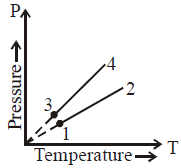
Pressure versus temperature graph of an ideal gas of equal number of moles (μ) of different volumes are plotted as shown in figure. Choose the correct alternative :

1. V1 = V2, V3 = V4 and V2 > V3
2. V1 = V2, V3 = V4 and V2 < V3
3. V1 = V2 = V3 = V4
4. V4 > V3 > V2 > V1
View Answer

Thank you for the clarification. Given the correct answer, let's interpret the graph accordingly.

In this pressure (\( P \)) vs. temperature (\( T \)) graph:

1. **Parallel Lines**: When two lines have the same slope, it implies they have the same volume. This is because the slope in a \( P \)-\( T \) graph (for constant \( V \)) is given by \( \frac{nR}{V} \).

- Since lines **1** and **2** are parallel, we have \( V_1 = V_2 \).
- Similarly, lines **3** and **4** are parallel, so \( V_3 = V_4 \).

2. **Comparing Slopes**: The line with a steeper slope corresponds to a smaller volume, and the line with a shallower slope corresponds to a larger volume.

- Since lines 1 and 2 have a shallower slope compared to lines 3 and 4, we conclude that \( V_1 = V_2 > V_3 = V_4 \).

Final Answer:
- \( V_1 = V_2 \), \( V_3 = V_4 \), and \( V_2 > V_3 \).

Question 73: moderate

The amount of heat required to raise the temperature of 2 mole of monoatomic gas under isobaric condition from 0°C to 50°C will be :

1. 75 R
2. 125 R
3. 150 R
4. 250 R
View Answer

For a monoatomic gas under isobaric (constant pressure) conditions, the heat required \( Q \) is given by:

\[
Q = n C_p \Delta T
\]

where:
- \( n = 2 \) moles,
- \( C_p = \frac{5}{2} R \) (specific heat at constant pressure for monoatomic gas),
- \( \Delta T = 50^\circ \text{C} - 0^\circ \text{C} = 50 \) K.

Substitute values:

\[
Q = 2 \times \frac{5}{2} R \times 50 = 250R
\]

So, the answer is \( 250R \).

Question 74: moderate

A mixture of n1 moles of monoatomic gas and n2 moles of diatomic gas has

\[ \frac{C_{p}}{C_{v}}=\gamma=1.5 \], then :

1. n1 = 2n2
2. 2n1 = 3n2
3. n1 = n2
4. n1 = 5n2
View Answer

For a mixture of \( n_1 \) moles of a monatomic gas and \( n_2 \) moles of a diatomic gas, the ratio \( \gamma = \frac{C_p}{C_v} \) of the mixture is given by:

\[
\gamma = \frac{\text{Total } C_p}{\text{Total } C_v}
\]

1. Molar heat capacities:
- For a monatomic gas: \( C_{v, \text{mono}} = \frac{3}{2} R \) and \( C_{p, \text{mono}} = \frac{5}{2} R \).
- For a diatomic gas: \( C_{v, \text{di}} = \frac{5}{2} R \) and \( C_{p, \text{di}} = \frac{7}{2} R \).

2. Total heat capacities:
- Total \( C_v = n_1 \cdot \frac{3}{2} R + n_2 \cdot \frac{5}{2} R \).
- Total \( C_p = n_1 \cdot \frac{5}{2} R + n_2 \cdot \frac{7}{2} R \).

3. Given \( \gamma = 1.5 \):

\[
\frac{C_p}{C_v} = \frac{n_1 \cdot \frac{5}{2} R + n_2 \cdot \frac{7}{2} R}{n_1 \cdot \frac{3}{2} R + n_2 \cdot \frac{5}{2} R} = 1.5
\]

4. Simplify by canceling \( R \) and multiplying through by 2:

\[
\frac{5n_1 + 7n_2}{3n_1 + 5n_2} = 1.5
\]

5. Cross-multiply to solve for \( n_1 \) in terms of \( n_2 \):

\[
5n_1 + 7n_2 = 1.5 (3n_1 + 5n_2)
\]

\[
5n_1 + 7n_2 = 4.5n_1 + 7.5n_2
\]

6. Rearrange terms:

\[
0.5n_1 = 0.5n_2
\]

\[
n_1 = n_2
\]

Question 75: easy

For a gas if γ = 1.4, then atomicity, Cp and Cv of the gas are respectively :

1. monoatomic, 5/2 R, 3/2 R
2. monoatomic, 7/2 R, 5/2 R
3. diatomic, 7/2 R, 5/2 R
4. triatomic, 7 R, 5 R
View Answer

For a gas with \( \gamma = \frac{C_p}{C_v} = 1.4 \):

1. Atomicity: For diatomic gases, \( \gamma = 1.4 \) (common for diatomic molecules like \(\text{O}_2\), \(\text{N}_2\), etc.).

2. Heat capacities:
- \( C_v = \frac{R}{\gamma - 1} = \frac{R}{1.4 - 1} = \frac{5}{2} R \).
- \( C_p = \gamma C_v = 1.4 \times \frac{5}{2} R = \frac{7}{2} R \).

Thus, the atomicity is diatomic, and the values of \( C_p \) and \( C_v \) are \( \frac{7}{2} R \) and \( \frac{5}{2} R \), respectively.

Question 76: moderate

N2 molecules is 14 times heavier than a H2 molecule. At what temperature will the rms speed of H2 molecules be equal to that of N2 molecule at 27° C :

1. 50° C
2. 40° C
3. 87° C
4. 21.4 K
View Answer

To have the same rms speed for \(\text{H}_2\) and \(\text{N}_2\), we use the formula for rms speed:

\[
v_{\text{rms}} = \sqrt{\frac{3k_B T}{m}}
\]

Since the rms speeds are equal, we can set up the equation:

\[
\sqrt{\frac{3k_B T_{\text{H}_2}}{m_{\text{H}_2}}} = \sqrt{\frac{3k_B T_{\text{N}_2}}{m_{\text{N}_2}}}
\]

Square both sides and simplify:

\[
\frac{T_{\text{H}_2}}{m_{\text{H}_2}} = \frac{T_{\text{N}_2}}{m_{\text{N}_2}}
\]

Since \(\text{N}_2\) is 14 times heavier than \(\text{H}_2\), we have \( m_{\text{N}_2} = 14 \, m_{\text{H}_2} \) and \( T_{\text{N}_2} = 27^\circ \text{C} = 300 \, \text{K} \).

Now solve for \( T_{\text{H}_2} \):

\[
T_{\text{H}_2} = \frac{T_{\text{N}_2}}{14} = \frac{300}{14} \approx 21.4 \, \text{K}
\]

So, the temperature at which \(\text{H}_2\) has the same rms speed as \(\text{N}_2\) at 27°C is approximately \( 21.4 \, \text{K} \).

Question 77: moderate

A mixture of 2 moles of helium gas (atomic mass = 4 amu) and 1 mole of argon gas (atomic mass = 40 amu) is kept at 300 K in a container. The ratio of the rms speeds \( \left( \frac{v_{rms}(helium)}{v_{rms}\left( argon \right)} \right) \) is:

1. 0.32
2. 0.45
3. 2.24
4. 3.16
View Answer

The root mean square (rms) speed \( v_{\text{rms}} \) of a gas is given by:

\[
v_{\text{rms}} = \sqrt{\frac{3RT}{M}}
\]

where \( M \) is the molar mass.

For helium (\( M = 4 \, \text{g/mol} \)) and argon (\( M = 40 \, \text{g/mol} \)) at the same temperature, the ratio of their rms speeds is:

\[
\frac{v_{\text{rms}(\text{He})}}{v_{\text{rms}(\text{Ar})}} = \sqrt{\frac{M_{\text{Ar}}}{M_{\text{He}}}} = \sqrt{\frac{40}{4}} = \sqrt{10} \approx 3.16
\]

Thus, the ratio \( \frac{v_{\text{rms}(\text{He})}}{v_{\text{rms}(\text{Ar})}} \) is approximately 3.16.

Question 78: moderate

A gas mixture consists of 2 moles of oxygen and 4 moles of argon at temperature T. Neglecting all vibrational modes the total internal energy of the system is :

1. 4 RT
2. 15 RT
3. 9 RT
4. 11 RT
View Answer

For a gas mixture of oxygen (\(\text{O}_2\)) and argon (\(\text{Ar}\)):

1. **Oxygen (\(\text{O}_2\))** is diatomic, so its internal energy per mole is:
\[
U_{\text{O}_2} = \frac{5}{2} RT
\]
For 2 moles, \( U_{\text{O}_2} = 2 \times \frac{5}{2} RT = 5 RT \).

2. **Argon (\(\text{Ar}\))** is monatomic, so its internal energy per mole is:
\[
U_{\text{Ar}} = \frac{3}{2} RT
\]
For 4 moles, \( U_{\text{Ar}} = 4 \times \frac{3}{2} RT = 6 RT \).

3. **Total internal energy**:
\[
U_{\text{total}} = U_{\text{O}_2} + U_{\text{Ar}} = 5 RT + 6 RT = 11 RT
\]

So, the total internal energy of the system is \( 11 RT \).

Question 79: moderate

At what temperature, the mean kinetic energy of O2 will be the same as that of H2 molecules at – 73°C ?

1. 127°C
2. 527°C
3. -73°C
4. -173°C
View Answer

The mean kinetic energy of gas molecules depends only on temperature and is given by:

\[
\text{KE} = \frac{3}{2} k_B T
\]

where \( T \) is the temperature in Kelvin, and \( k_B \) is Boltzmann's constant.

Since we want the mean kinetic energy of \(\text{O}_2\) to equal that of \(\text{H}_2\) at \( -73^\circ \text{C} \):

1. Convert \(-73^\circ \text{C}\) to Kelvin:
\[
T_{\text{H}_2} = -73 + 273 = 200 \, \text{K}
\]

2. Since kinetic energy depends only on temperature, set the temperature \( T_{\text{O}_2} = T_{\text{H}_2} = 200 \, \text{K} \).

Therefore, the temperature at which \(\text{O}_2\) has the same mean kinetic energy as \(\text{H}_2\) at \(-73^\circ \text{C}\) is \(200 \, \text{K}\).

Question 80: easy

According to kinetic theory of gases :
(A) Collisions are always elastic
(B) There is no force of attraction among the molecules
(C) Only a small number of molecules have very high velocity
(D) Between collisions, the molecules move in straight lines with constant velocities

1. Only (A)
2. Only (A) and (B)
3. Only (A), (B) and (C)
4. All (A), (B), (C) and (D)
View Answer

According to the kinetic theory of gases:

- (A) Collisions are always elastic: Gas molecule collisions do not lose kinetic energy, so they are elastic.
- (B) There is no force of attraction among the molecules: Assumption of ideal gases is no intermolecular forces.
- (C) Only a small number of molecules have very high velocity: Most molecules have moderate speeds; only a few have very high speeds.
- (D) Between collisions, the molecules move in straight lines with constant velocities: Molecules move with constant speed in straight lines until they collide.

All options are correct as per the assumptions of kinetic theory.