Thermal Physics - NEET Physics Questions
← All Chapters

Thermal Physics

Question 91: moderate

A black body is at a temperature of 5760 K. The energy of radiation emitted by the body at wavelength 250 nm is U1, at wavelength 500 nm is U2 and that at 1000 nm is U3. Wien’s constant, b=2.88\times 10^{6} nmK. Which of the following is correct?

1. U2 > U1
2. U1 = 0
3. U3 = 0
4. U1 > U2
View Answer

To solve this, we use Wien's Displacement Law, which states:

\[
\lambda_{\text{max}} = \frac{b}{T}
\]

Where:
- \(\lambda_{\text{max}}\) is the wavelength at which the maximum energy is emitted,
- \(b = 2.88 \times 10^6 \, \text{nmK}\) is Wien's constant,
- \(T = 5760 \, K\) is the temperature of the black body.

Step 1: Calculate \(\lambda_{\text{max}}\)
\[
\lambda_{\text{max}} = \frac{2.88 \times 10^6}{5760} = 500 \, \text{nm}
\]

This means that the maximum energy is emitted at a wavelength of 500 nm.

 Step 2: Compare the energies at different wavelengths

- At 500 nm (\( \lambda_{\text{max}} \)): This is where the black body emits the maximum energy. So, \(U_2\) will be the largest.
- At 250 nm: This wavelength is shorter than \(\lambda_{\text{max}}\), and the energy decreases as we move away from the peak, so \(U_1 < U_2\).
- At 1000 nm: This wavelength is longer than \(\lambda_{\text{max}}\), and the energy decreases further, so \(U_3 < U_2\).

Thus, \(U_2 > U_1\), and the correct comparison is \(U_2 > U_1\).
Question 92: easy

A piece of iron is heated in a flame. It first becomes dull red then becomes reddish yellow and finally turns to white hot. The correct explanation for the above observation is possible by using

1. Wien's displacement law
2. Kirchoff's law
3. Newton's law of cooling
4. Stefan's law
View Answer

The color change in the heated iron from dull red to reddish yellow to white hot can be explained using Wein's Displacement Law. This law states that the wavelength (\(\lambda_{max}\)) at which the maximum emission occurs is inversely proportional to the absolute temperature \(T\) of the object:

\[
\lambda_{max} \propto \frac{1}{T}
\]

As the iron's temperature increases, the peak wavelength of emitted radiation shifts toward shorter wavelengths (from red to yellow and eventually to white, which is a combination of all visible wavelengths). Thus, the observed color change corresponds to an increase in temperature, with shorter wavelengths being emitted at higher temperatures.

Question 93: easy

A black body is at 727°C. It emits energy at a rate which is proportional to

1. \[ \left( 727 \right)^{4}\]
2. \[ \left( 727 \right)^{2} \]
3. \[ \left( 1000 \right)^{4} \]
4. \[ \left( 1000 \right)^{2}\]
View Answer

The energy emitted by a black body is proportional to the fourth power of its absolute temperature, as per Stefan-Boltzmann Law:

\[
P \propto T^4
\]

Step 1: Convert temperature to kelvins

The temperature of the black body is \(727^\circ C\), which is:

\[
T = 727 + 273 = 1000\,K
\]

Step 2: Apply Stefan-Boltzmann Law

Since the energy emitted is proportional to \(T^4\):

\[
P \propto (1000)^4
\]

Thus, the rate of energy emission is proportional to \((1000)^4\).

Question 94: moderate

For a black body at temperature 727°C, its rate of energy loss is 20 watt and temperature of surrounding is 227°C. If temperature of black body is changed to 1227°C then its rate of energy loss will be

1. 304 W
2. 320/3 W
3. 240 W
4. 120 W
View Answer

To solve this, we use Stefan-Boltzmann Law for radiative heat transfer:

\[
P = \sigma A (T^4 - T_s^4)
\]

Where:
- \(P\) is the power (rate of energy loss),
- \(\sigma\) is the Stefan-Boltzmann constant,
- \(A\) is the area of the body,
- \(T\) is the temperature of the body in kelvins,
- \(T_s\) is the temperature of the surroundings in kelvins.

 Step 1: Convert temperatures to kelvins
- Initial temperature of the black body: \(727^\circ C = 727 + 273 = 1000\,K\)
- Surrounding temperature: \(227^\circ C = 227 + 273 = 500\,K\)
- New temperature of the black body: \(1227^\circ C = 1227 + 273 = 1500\,K\)

 Step 2: Ratio of power losses
Let the power at \(T_1 = 1000\,K\) be \(P_1 = 20\,W\). The new power at \(T_2 = 1500\,K\) is \(P_2\). Using the Stefan-Boltzmann law:

\[
\frac{P_2}{P_1} = \frac{T_2^4 - T_s^4}{T_1^4 - T_s^4}
\]

Substitute the values:

\[
\frac{P_2}{20} = \frac{1500^4 - 500^4}{1000^4 - 500^4}
\]

Step 3: Simplify the powers of temperatures
\[
\frac{P_2}{20} = \frac{1500^4 - 500^4}{1000^4 - 500^4}
\]

You can approximate the values:

\[
P_2 = 20 \times \frac{(1500^4 - 500^4)}{(1000^4 - 500^4)}
\]

After simplifying, you'll find:

\[
P_2 = \frac{320}{3} \text{ watts}
\]

Thus, the rate of energy loss at 1227°C is \(\frac{320}{3}\,W\).

Question 95: difficult

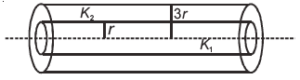
Two coaxial cylinders of radius r and 3r are made of material of thermal conductivity K1 and K2 respectively. The equivalent thermal conductivity of substance for axial heat flow may be

1. \[ \frac{4\left( K_{1}+K_{2} \right)}{9}\]
2. \[ \frac{K_{1}+6K_{2}}{9} \]
3. \[ \frac{K_{1}+8K_{2}}{9} \]
4. \[ \frac{K_{1}+K_{2}}{2} \]
View Answer

The system shows two coaxial cylinders made of materials with different thermal conductivities (\(K_1\) and \(K_2\)) and radii \(r\) and \(3r\). For axial heat flow, the conductivities act in parallel.

To find the equivalent thermal conductivity (\(K_{\text{eq}}\)) of the entire system, we use the formula for thermal conductivities in parallel, similar to how resistances in parallel are treated for electrical systems:

\[
K_{\text{eq}} = \frac{K_1 A_1 + K_2 A_2}{A_1 + A_2}
\]

Where:
- \(A_1 = \pi r^2\) is the area of the inner cylinder.
- \(A_2 = \pi (3r)^2 - \pi r^2\  = 8\pi r^2\) is the area of the outer cylinder.

Substituting into the equation:

\[
K_{\text{eq}} = \frac{K_1 (\pi r^2) + K_2 (8\pi r^2)}{\pi r^2 + 8\pi r^2}
\]

Simplifying:

\[
K_{\text{eq}} = \frac{K_1 + 8K_2}{1 + 8} = \frac{K_1 + 8K_2}{9}
\]

Thus, the equivalent thermal conductivity is:

\[
K_{\text{eq}} = \frac{K_1 + 8K_2}{9}
\]

Question 96: easy

In heat transfer, which method is based on gravitation

1. Natural convection
2. Conduction
3. Radiation
4. All of these
View Answer

In heat transfer, natural convection is the method that is based on gravity.

Explanation:

Natural convection occurs due to the **buoyancy forces** that arise because of differences in fluid density caused by temperature gradients. When a fluid (like air or water) is heated, its density decreases, and it becomes lighter. The warmer, less dense fluid rises, and the cooler, denser fluid sinks under the influence of **gravity**. This creates a circulation pattern known as convection currents.

Thus, gravity is essential for this process, as it causes the movement of the fluid based on density differences. Without gravity, natural convection wouldn’t occur because there would be no buoyancy forces to drive the fluid motion.

Question 97: easy

In which process, the rate of transfer of heat is maximum?

1. Conduction
2. Convection
3. Radiation
4. In all these, heat is transferred with the same velocity
View Answer

The process in which the rate of heat transfer is maximum is radiation.

Explanation:

Radiation is the transfer of heat through electromagnetic waves (infrared radiation), which does not require any medium (solid, liquid, or gas) to propagate. This means that heat can be transferred even through a vacuum (like the heat from the Sun reaching the Earth).

Radiation is capable of transferring heat at the speed of light, making it a very efficient method of heat transfer. The rate of heat transfer by radiation depends on several factors:
- Temperature: The higher the temperature of the emitting body, the more heat it radiates.
- Surface properties: Objects with dark and rough surfaces radiate more heat than shiny or reflective ones (as described by the **Stefan-Boltzmann Law**).
- Emissivity: The efficiency of a material in emitting radiation.

In comparison to conduction (which requires a medium and is slower) and **convection** (which involves the motion of fluid and also depends on the medium), radiation can occur at a much faster rate, especially over long distances and in a vacuum. Thus, the rate of heat transfer by radiation can be the maximum, depending on the context and conditions.

Question 98: easy

Good absorbers of heat are

1. Poor emitters
2. Non-emitters
3. Good emitters
4. Highly polished
View Answer

The statement "Good absorbers of heat are good emitters" is explained by Kirchhoff's Law of Thermal Radiation.

Explanation:

Kirchhoff's law states that, for a body in thermal equilibrium, the ability to absorb radiation (absorptivity) is equal to its ability to emit radiation (emissivity) at the same temperature and wavelength. In simpler terms, materials that are good at absorbing heat also radiate or emit heat efficiently.

- Good absorbers: A material that can absorb a large amount of radiation from its surroundings is considered a good absorber. For example, objects with **dark, rough surfaces** absorb more heat than those with light, shiny surfaces.

- Good emitters: The same objects that absorb heat well also tend to emit heat efficiently when they are at a higher temperature than their surroundings. This is why a dark object, after absorbing heat, cools down faster by emitting more radiation compared to a shiny object.

For example:
- A black object absorbs more heat from sunlight (good absorber) and, when placed in the shade, radiates heat more quickly (good emitter).

Practical Example:

A black pot heats up quickly in the sun (good absorber) and cools down quickly at night (good emitter). Conversely, a shiny or reflective surface absorbs less heat and also emits less heat, meaning it retains heat longer.

This relationship between absorption and emission helps in designing materials for applications like thermal insulation, radiators, and solar panels.

Question 99: easy

A body, which emits radiations of all possible wavelengths, is known as

1. Good conductor
2. Partial radiator
3. Absorber of photons
4. Perfectly black body
View Answer

A body that emits radiation at all possible wavelengths and absorbs all incident radiation, regardless of the wavelength or direction, is known as a perfect blackbody.

Explanation:

A perfect blackbody is an idealized object in thermodynamics and physics that has the following properties:

  1. Perfect Absorber: It absorbs all radiation that falls on it, meaning it doesn't reflect or transmit any radiation. This is why it appears perfectly black.
  2. Perfect Emitter: A blackbody is also the most efficient emitter of thermal radiation. At any given temperature, it emits the maximum amount of energy possible for that temperature across all wavelengths.

The radiation emitted by a blackbody is described by Planck's law and is dependent only on the body's temperature. The distribution of wavelengths emitted by a blackbody follows a characteristic curve, with the peak wavelength shifting according to Wien's displacement law as the temperature changes. The total energy emitted by the blackbody is given by the Stefan-Boltzmann law.

Examples:

  • A perfect blackbody doesn't exist in the real world, but certain objects can approximate blackbody behavior. For instance, a small hole in a cavity acts like a nearly perfect blackbody because any radiation entering the hole is unlikely to escape.
  • The Sun is often approximated as a blackbody in physics, though it's not perfect, it emits a nearly continuous spectrum of light.

Thus, a perfect blackbody is an ideal concept used to study and understand radiation emission and absorption.

Question 100: easy

A hot and a cold body are kept in vacuum separated from each other. Which of the following causes decrease in temperature of the hot body?

1. Radiation
2. Convection
3. Conduction
4. Temperature remains same
View Answer

In vacuum, the decrease in temperature of the hot body occurs due to radiation.

Explanation:

Since conduction and convection require a medium, they cannot occur in a vacuum. The only way heat can be transferred in a vacuum is through radiation, where the hot body emits electromagnetic waves (infrared radiation). This emission of radiation causes the temperature of the hot body to decrease over time, as it loses energy.