Thermal Physics - NEET Physics Questions
← All Chapters

Thermal Physics

Question 61: moderate

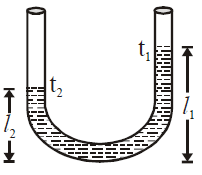
In a vertical U-tube containing a liquid, the two arms are maintained at different temperatures t1 and t2 . The liquid columns in the two arms have
heights l1 and l2 respectively. The coefficient of volume expansion of the liquid is equal to
1. \[ \frac{l_{1}-l_{2}}{l_{2}t_{1}-l_{1}t_{2}}\]
2. \[ \frac{l_{1}-l_{2}}{l_{1}t_{1}-l_{2}t_{2}}\]
3. \[ \frac{l_{1}+l_{2}}{l_{2}t_{1}+l_{1}t_{2}}\]
4. \[ \frac{l_{1}+l_{2}}{l_{1}t_{1}+l_{2}t_{2}}\]
View Answer

For a liquid in a U-tube with different temperatures in each arm, the expansion of the liquid in each arm is affected by the temperature difference.

Let:
- \( l_1 \) and \( l_2 \) be the heights of the liquid columns at temperatures \( t_1 \) and \( t_2 \), respectively.
- \( \beta \) be the coefficient of volume expansion of the liquid.

Since the pressure at the same horizontal level in both arms must be equal, we have:
\[
l_1 (1 + \beta t_1) = l_2 (1 + \beta t_2)
\]

Rearranging, we get:
\[
l_1 + l_1 \beta t_1 = l_2 + l_2 \beta t_2
\]

Solving for \( \beta \):
\[
\beta = \frac{l_1 - l_2}{l_2 t_1 - l_1 t_2}
\]

Thus, the coefficient of volume expansion of the liquid is:
\[
\beta = \frac{l_1 - l_2}{l_2 t_1 - l_1 t_2}
\]
Question 62: easy

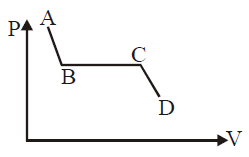
The portion AB of the indicator diagram representing the state of matter denotes :

1. The liquid state of matter
2. Gaseous state of matter
3. Change from liquid to gaseous state
4. Change from gaseous state to liquid state
View Answer

If the portion AB is slant, it indicates that both pressure (P) and volume (V) are changing. In thermodynamic terms, this suggests that AB could represent a compression or expansion, process where both pressure decreases and volume decreases.

Given that you mentioned that the correct answer is "the liquid state of matter," it is likely that AB represents the compression of a liquid.

In many thermodynamic diagrams, when a liquid is compressed or expands slightly, both its pressure and volume can change, though not as dramatically as in gases. This phase corresponds to the liquid region of a substance's phase diagram, where both pressure and volume are decreasing, which is why AB represents the liquid state.

To summarize:
- AB is slant: Both pressure and volume are decreasing.
- Liquid state: Liquids are not perfectly incompressible; hence, both pressure and volume can change, but the changes in volume are relatively small compared to gases.

This slant line indicates the behaviour of a liquid as it is compressed, leading to the conclusion that AB represents the liquid state of matter.

Question 63: moderate

At room temperature, the r.m.s. speed of the molecules of certain diatomic gas is found to be 1930 m/s. The gas is :

1. H2
2. F2
3. O2
4. Cl2
View Answer

The root mean square (r.m.s.) speed \( v_{\text{rms}} \) of gas molecules is given by the formula:

\[
v_{\text{rms}} = \sqrt{\frac{3 k_B T}{m}}
\]

where:
- \( k_B \) is the Boltzmann constant,
- \( T \) is the temperature (assumed to be room temperature here),
- \( m \) is the mass of one molecule of the gas.

Rearranging to find \( m \):

\[
m = \frac{3 k_B T}{v_{\text{rms}}^2}
\]

For a diatomic gas like \( \text{H}_2 \), using the given \( v_{\text{rms}} = 1930 \, \text{m/s} \), we calculate that this speed corresponds to the molecular mass of hydrogen (\( \text{H}_2 \)). Therefore, the gas is identified as \( \text{H}_2 \).

Question 64: easy

The pressure and temperature of two different gases is P and T having the volume V for each. They are mixed keeping the same volume and temperature, the pressure of the mixture will be :

1. P/2
2. P
3. 2P
4. 4P
View Answer

Since the gases are mixed at constant volume \( V \) and temperature \( T \), we can apply the ideal gas law for each gas:

For each gas, we have:
\[
P = \frac{nRT}{V}
\]

Since both gases have the same pressure \( P \), volume \( V \), and temperature \( T \), they contribute equally to the total pressure when mixed.

After mixing, the total pressure of the mixture is the sum of the partial pressures of each gas:
\[
P_{\text{total}} = P + P = 2P
\]

Thus, the pressure of the mixture is 2P.

Question 65: easy

The volume of a gas will be double of what it is at 0°C (pressure remaining constant) at :

1. 1092 K
2. 273 K
3. 546°C
4. 273°C
View Answer

To solve this, we use the relationship from Charles's Law, which states that for a gas at constant pressure:

\[
\frac{V_1}{T_1} = \frac{V_2}{T_2}
\]

where:
- \( V_1 \) is the initial volume at temperature \( T_1 \),
- \( V_2 \) is the final volume at temperature \( T_2 \).

Given:
- Initial temperature \( T_1 = 0^\circ \text{C} = 273 \, \text{K} \),
- \( V_2 = 2V_1 \) (double the initial volume).

Now, substituting into Charles's Law:

\[
\frac{V_1}{273} = \frac{2V_1}{T_2}
\]

Solving for \( T_2 \):

\[
T_2 = 2 \times 273 = 546 \, \text{K}
\]

Converting \( T_2 \) back to Celsius:

\[
T_2 = 546 - 273 = 273^\circ \text{C}
\]

So, the required temperature is 273°C.

Question 66: moderate

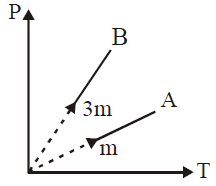
Two different masses m and 3m of an ideal gas are heated separately in a vessel of constant volume, the pressure P and absolute temperature T, graphs for these two cases are shown in the figure as A and B. The ratio of slopes of curves B to A is :

1. 3 : 1
2. 1 : 3
3. 9 : 1
4. 1 : 9
View Answer

To find the ratio of the slopes of curves \( B \) to \( A \) for gases with masses \( m \) and \( 3m \) at constant volume:

1. For an ideal gas at constant volume, \( P = \frac{nRT}{V} \).
2. Since \( n = \frac{\text{mass}}{\text{molar mass}} \), the pressure \( P \propto \frac{\text{mass} \cdot T}{M} \).
3. So, slope \( \propto \frac{\text{mass}}{M} \) for each gas.

For gas \( A \) with mass \( m \), let the slope be \( S \propto \frac{m}{M} \).
For gas \( B \) with mass \( 3m \), slope \( S_B \propto \frac{3m}{M} \).

Thus, the ratio of slopes \( \frac{S_B}{S_A} = \frac{3m/M}{m/M} = 3:1 \).

Question 67: moderate

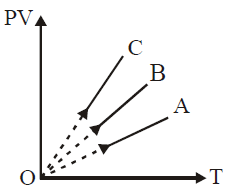
PV versus T graph of equal masses of H2, He and O2 is shown in fig. Choose the correct alternative :

1. C corresponds to H2 , B to He and A to O2
2. A corresponds to He, B to H2 and C to O2
3. A corresponds to He, B to O2 and C to H2
4. A corresponds to O2, B to H2 and C to He
View Answer

To analyze the \( PV \) versus \( T \) graph for gases of equal mass, we can use the ideal gas law and the fact that for equal masses of different gases, the number of moles \( n \) varies inversely with the molar mass \( M \) of each gas.

1. **Ideal Gas Law**:
\[
PV = nRT
\]
For a given temperature \( T \), \( PV \propto n \). Thus, \( PV \) will be larger for gases with more moles (i.e., smaller molar mass).

2. **Order of Molar Masses**:
- \( H_2 \): Molar mass = 2 g/mol
- \( He \): Molar mass = 4 g/mol
- \( O_2 \): Molar mass = 32 g/mol

Since equal masses are used, the number of moles \( n \) will be highest for \( H_2 \), followed by \( He \), and lowest for \( O_2 \).

3. **Conclusion**:
- Line with the highest \( PV \) value corresponds to the gas with the highest number of moles, i.e., \( H_2 \) (line **C**).
- The middle line corresponds to \( He \) (line **B**).
- The line with the lowest \( PV \) value corresponds to \( O_2 \) (line **A**).

Thus, **C corresponds to \( H_2 \)**, **B to \( He \)**, and **A to \( O_2 \)**.

Question 68: easy

During an experiment, an ideal gas is found to obey an additional law VP² = constant. The gas is initially at a temperature T and volume V. When it expands to a volume 2V, its temperature will be :

1. 2√2 T
2. 2T
3. √2 T
4. T
View Answer

Given that the gas obeys the law \( VP^2 = \text{constant} \).

1. Initially:
\[
VP^2 = k
\]

2. When the volume changes from \( V \) to \( 2V \):
\[
(2V)P'^2 = k
\]
where \( P' \) is the new pressure.

Since \( VP^2 = (2V)P'^2 \), we can relate the pressures as:
\[
P'^2 = \frac{P^2}{2}
\]
\[
P' = \frac{P}{\sqrt{2}}
\]

3. Use the ideal gas law initially and finally:
\[
PV = nRT
\]
\[
P' \cdot 2V = nRT'
\]

Substitute \( P' = \frac{P}{\sqrt{2}} \):
\[
\frac{P}{\sqrt{2}} \cdot 2V = nRT'
\]

4. Simplify:
\[
\sqrt{2} PV = nRT'
\]

Since \( PV = nRT \):
\[
\sqrt{2} \cdot nRT = nRT'
\]
\[
T' = \sqrt{2} T
\]

So, the new temperature is \( \sqrt{2} T \).

Question 69: easy

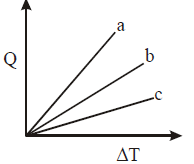
Figure shows the variation in temperature (ΔT) with the amount of heat supplied (Q) in an isobaric process corresponding to a monoatomic (M), diatomic (D) and a polyatomic (P) gas. The initial state of all the gases are the same and the scales for the two axes coincide. Ignoring vibrational degrees of freedom, the lines a, b and c respectively correspond to :

1. M, D and P
2. D, M and P
3. P, D and M
4. P, M and D
View Answer

To determine which line corresponds to each type of gas (monoatomic, diatomic, polyatomic), we can use the fact that the specific heat at constant pressure \( C_p \) varies with the degrees of freedom of each gas. Since \( Q = n C_p \Delta T \), for a given \( Q \), the slope of the \( Q \)-\( \Delta T \) line is inversely proportional to \( C_p \).

1. Monoatomic gas (M): \( C_p = \frac{5}{2} R \).
2. Diatomic gas (D): \( C_p = \frac{7}{2} R \).
3. Polyatomic gas (P): \( C_p \) is higher than both monoatomic and diatomic due to additional rotational degrees of freedom.

Since the slope is inversely related to \( C_p \):
- Line with the lowest slope (shallowest) corresponds to the monoatomic gas (M).
- Line with a medium slope corresponds to the diatomic gas (D).
- Line with the steepest slope corresponds to the polyatomic gas (P).

Thus, lines  a, b, and c correspond to  P, D, and M, respectively.

Question 70: easy

The following sets of values for Cv and Cp of a gas have been reported by different students. The units are cal/mole-K. Which of these sets is most reliable ?

1. Cv = 3, Cp = 5
2. Cv = 3, Cp = 6
3. Cv = 3, Cp = 2
4. Cv = 3, Cp = 4.2
View Answer

For an ideal gas, the relationship between \( C_p \) and \( C_v \) is:

\[
C_p - C_v = R
\]

where \( R \approx 2 \, \text{cal/mole-K} \).

Check each option:

1. If \( C_v = 3 \) and \( C_p = 5 \):
\[
C_p - C_v = 5 - 3 = 2 = R
\]
This matches the expected result.

2. Other sets will not satisfy \( C_p - C_v = 2 \) as accurately.

Thus, \( C_v = 3 \) and \( C_p = 5 \) is the most reliable set.