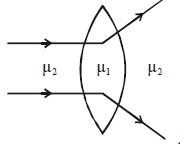
A lens of large focal length and large aperture is best suited as an objective of an astronomical telescope since
1. A large aperture contributes to the quality and visibility of the images.
2. A large area of the objective ensures better light gathering power.
3. A large aperture provides a better resolution.
4. All of the above
View Answer
A larger aperture lens collects more light (better visibility and brightness), has a higher resolving power (better resolution), and hence satisfies all specified criteria.
A glass sheet is grinded to form a double convex lens. The radius of curvature of two surfaces are 15 cm and 10 cm and the focal length of lens is 12 cm. Refractive index of glass sheet is
1. 1.2
2. 1.4
3. 1.5
4. 1.6
View Answer
By Lens-maker's formula, \( \frac{1}{f} = (\mu - 1) \left(\frac{1}{R_1} - \frac{1}{R_2}\right) \). Substituting \( f = 12 \text{ cm} \), \( R_1 = 15 \text{ cm} \), and \( R_2 = -10 \text{ cm} \), we get \( \frac{1}{12} = (\mu - 1)\left(\frac{1}{15} + \frac{1}{10}\right) = (\mu - 1)\frac{1}{6} ⇒ \mu - 1 = 0.5 ⇒ \mu = 1.5 \).
In the displacement method, a convex lens is placed in between an object and a screen. If magnification in the two positions are \(m_1\) and \(m_2\) \((m_1 > m_2)\) and the distance between two positions of the lens is \(x\), the focal length of the lens is
1. \[\frac{x}{m_1+m_2}\]
2. \[\frac{x}{m_1-m_2}\]
3. \[\frac{x}{(m_1+m_2)^2}\]
4. \[\frac{x}{(m_1-m_2)^2}\]
View Answer
In displacement method, the magnification values are \(m_1 = \frac{v_1}{u_1}\) and \(m_2 = \frac{v_2}{u_2} = \frac{u_1}{v_1}\). Also, \(x = v_1 - u_1\). Thus, \(m_1 - m_2 = \frac{x}{f}\), which gives \(f = \frac{x}{m_1 - m_2}\).
The refractive index of material of a plano-convex lens, if the radius of curvature of convex surface is \(10\text{ cm}\) and focal length of lens is \(30\text{ cm}\) is
1. \(\mu = \frac{2}{3}\)
2. \(\mu = \frac{1}{3}\)
3. \(\mu = \frac{4}{3}\)
4. \(\mu = \frac{1}{2}\)
View Answer
Using lens maker's formula for a plano-convex lens, \(f = \frac{R}{\mu - 1}\). Substituting \(R = 10\text{ cm}\) and \(f = 30\text{ cm}\), we get \(30 = \frac{10}{\mu - 1}\) which gives \(\mu - 1 = \frac{1}{3}\). Therefore, \(\mu = \frac{4}{3}\).
Assertion (A): A simple microscope may have different magnification for different persons.
Reason (R): All persons must have the same near point distance of \(25\text{ cm}\).
1. Both (A) & (R) are true and the (R) is the correct explanation of the (A)
2. Both (A) & (R) are true but the (R) is not the correct explanation of the (A)
3. (A) is true but (R) is false
4. Both (A) and (R) are false
View Answer
Assertion (A) is true as magnification depends on individual near point, which varies. Reason (R) is false as the near point varies for different individuals and is not universally \(25\text{ cm}\).
Assertion (A): If an object placed on the optic axis of a lens is illuminated by white light, then image formed will be coloured and not exactly white.
Reason (R): The lens has different focal lengths for different colours.
1. Both (A) & (R) are true and the (R) is the correct explanation of the (A)
2. Both (A) & (R) are true but the (R) is not the correct explanation of the (A)
3. (A) is true but (R) is false
4. Both (A) and (R) are false
View Answer
Assertion (A) is true due to chromatic aberration. Reason (R) is true and correctly explains (A) because the refractive index of lens material varies with wavelength, causing different focal lengths for different colors.
Assertion (A): Paraxial rays are always parallel to the principal axis.
Reason (R): A parallel beam parallel to principal axis converges at the focal point.
1. Both (A) & (R) are true and the (R) is the correct explanation of the (A)
2. Both (A) & (R) are true but the (R) is not the correct explanation of the (A)
3. (A) is true but (R) is false
4. Both (A) and (R) are false
View Answer
Assertion (A) is false; paraxial rays are simply close to the axis, not necessarily parallel. Reason (R) is also false because due to spherical aberration, a real parallel beam does not perfectly converge to a single focal point.