Binding energy per nucleon verses mass number curve for nuclei is shown in the figure. W, X, Y and Z are four nuclei indicated on the curve. The process that would release energy is :

Binding energy per nucleon verses mass number curve for nuclei is shown in the figure. W, X, Y and Z are four nuclei indicated on the curve. The process that would release energy is :
The binding energies per nucleon of deuteron \[\left( _{1}H^{2} \right)\] and helium atom \[\left( _{2}He^{4} \right)\] are 1.1 MeV and 7 MeV. If two deuteron atoms react to form a single helium atom, then the energy released is:
If the momentum of an electron is changed by P, then de-Broglie wavelength associated with it
changes by 0.2%. The initial momentum of electron will be about :
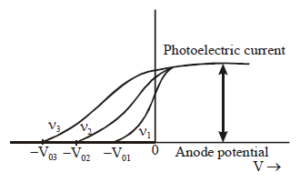
In photoelectric effect, the curve between photoelectric current and anode potential V (for
different frequencies) is shown in figure, then :

If the kinetic energy of the particle is increased to 16 times its previous value, the percentage
change in the de-Broglie wavelength of the particle is :
A radio isotope ‘X’ with a half life \[1.4\times 10^{9} years\] decays to ‘Y’ which is stable. A sample of the rock from a cave was found to contain ‘X’ and ‘Y’ in the ratio 1 : 7. The age of the rock is :
A common example of β-decay is
\[_{15}P^{32}\longrightarrow _{16}P^{32} + x + y\]
Then x and y stand for :
Initial number of nuclei of a radioactive substance is \[5\times 10^{16}\] and half life is 10 yrs. Find number of nuclei decayed in 5 yrs.
200 MeV of energy can be obtained by per fission. In a reactor generating 1000 kW find the number of nuclei under going the fission per second :
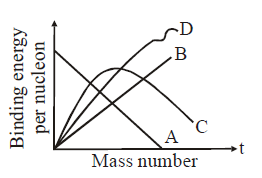
Binding energy per nucleon plot against the mass number for stable nuclei is shown in the figure. Which curve is correct :
