All electron ejected from a surface by incident of wavelength 200 nm can be stopped before
travelling 1 meter in the direction of a uniform electric field of 4 NCโยน the work function of the
surface is :
The ratio of momenta of an electron and ฮฑ-particle which are accelerated from rest by a
potential difference of 100 V is :
When monochromatic radiation of intensity I falls on a metal surface, the number of photoelectron and their maximum kinetic energy are N and T respectively. If the intensity of radiation is 2I, the number of emitted electrons and their maximum kinetic energy are respectively : (Assume frequency of radiation to be constant)
The threshold frequency for a photosensitive metal is \[3.3\times 10^{14} Hz\]. If light of frequency \[8.2\times 10^{14} Hz\] is incident on this metal, the cut-off voltage for the photoelectric emission is nearly :
A 200 W sodium street lamp emits yellow light of wavelength 0.6 ฮผm. Assuming it to be 25% efficient in converting electrical energy to light, the number of photons of yellow light it emits per second is :
When photons of energy hv fall on an aluminium plate (of work function E0), photoelectrons of maximum kinetic energy K are ejected. If the frequency of the radiation is doubled, the maximum kinetic energy of the ejected photoelectrons will be :
When a point source of monochromatic light is at a distance of 0.2 m from a photoelectric cell, the cut-off voltage and the saturation current are 0.6 volt and 18 mA respectively. If the same source is placed 0.6 m away from the photoelectric cell, then :
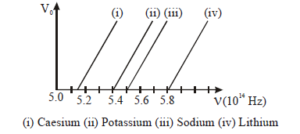
The figure shows different graphs between stopping potential (V0) and frequency (n) for photosensitive surface of caesium, potassium, sodium and lithium. The plots are parallel. Correct ranking of the targets according to their work function, greatest first, will be :

The energy that should be added to an electron to reduce its de Broglie wavelength from
\[10^{-10}m\]ย to \[0.5\times 10^{-10}m\] m will be :
The velocity of the most energetic electrons emitted from a metallic surface is doubled when the frequency v of the incident radiation is doubled. The work function of this metal is :