Question 1:
moderate
In the given nuclear reaction A, B, C, D, E represents

In the given nuclear reaction A, B, C, D, E represents
In the given reaction \[_{Z}X^{A}\longrightarrow _{Z}Y^{A’}+n\alpha+n’\beta\]. The ratio (Z/A) will be equal to.
Starting with a sample of pure \[Cu^{66}\], (7/8) of it decays into Zn in 15 minutes. The corresponding half-life is
Surface area of \[Al^{27}\] is S0, then surface area of \[Zn^{64}\] is :
A star initially has \[10^{40}\] deuterons. It produces energy via the processes ;

If the average power radiated by the star is \[10^{16}\] W, the deuteron supply of the star is
exhausted in a time of the order of :
A radioactive reaction is \[_{92}U^{238}\to _{82}Pb^{206}\] . How many α and β particles are emitted ?
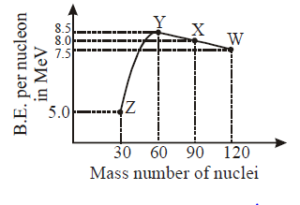
Binding energy per nucleon verses mass number curve for nuclei is shown in the figure. W, X, Y and Z are four nuclei indicated on the curve. The process that would release energy is :
If the energy released in the fission of one nucleus is 200 MeV. Then the number of nuclei required per second in a power plant of 16 kW will be :
Consider the following nuclear reactions and select the correct statements from the options that
follow.
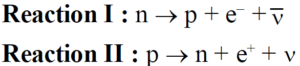
(A) Free neutron has higher mass than proton, therefore reaction I is possible
(B) Free proton has less mass than neutron, therefore reaction II is not possible for the free
proton
(C) Inside a nucleus, both decays (reaction I and II) are possible
(D) Inside a nucleus, reaction I is not possible but reaction II is possible.
Mark the incorrect statement :