If the energy released in the fission of one nucleus is 200 MeV. Then the number of nuclei required per second in a power plant of 16 kW will be :
The velocity of the most energetic electrons emitted from a metallic surface is doubled when the frequency v of the incident radiation is doubled. The work function of this metal is :
Monochromatic light of frequency f1 is incident on a photocell and the stopping potential is found to be V1. What is the new stopping potential of the cell if it is radiated by monochromatic light of frequency f2 ?
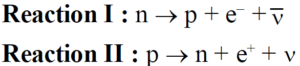
Consider the following nuclear reactions and select the correct statements from the options that
follow.

(A) Free neutron has higher mass than proton, therefore reaction I is possible
(B) Free proton has less mass than neutron, therefore reaction II is not possible for the free
proton
(C) Inside a nucleus, both decays (reaction I and II) are possible
(D) Inside a nucleus, reaction I is not possible but reaction II is possible.
Mark the incorrect statement :
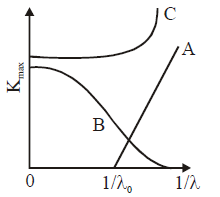
The correct graph between the maximum energy of a photoelectron and the inverse of wavelength of the incident radiation is given by the curve

A photon of wavelength 6630 Å is incident on a totally reflecting surface. The momentum delivered by the photon is equal to
The ratio of de-Broglie wavelengths of molecules of hydrogen and helium which are at temperature 27°C and 127° respectively is :
What is energy released in the β-decay of \[^{32}P\longrightarrow ^{32}S\] ?
\[\left( Given:atomic masses:-31.97391amu for ^{32}P and 31.97207amu for ^{32}S \right)\]
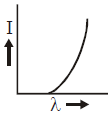
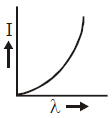
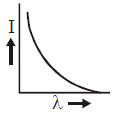
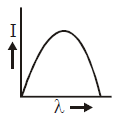
The anode voltage of a photocell is kept fixed. The wavelength λ of the light falling on the cathode is gradually changed. The plate current I of the photocell varies as given below :