Magnetic Effects of Current - NEET Physics Questions
← All Chapters

Magnetic Effects of Current

Question 11: difficult

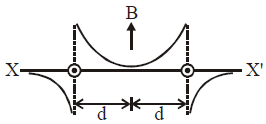
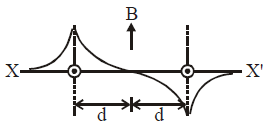
Two long parallel wires are at a distance 2d apart. The carry steady equal current flowing out of the plane of the paper as shown. The variation of the magnetic field along the line XX’ is given by :

1.
2.
3.
4.
View Answer
Question 12: difficult

Two identical wires A and B have the same length l and carry the same current I. Wire A is bent into a circle of radius R and wire B is bent to form a square of side a. If B1 and B2 are the values of magnetic induction at the centre of the circle and the centre of the square, respectively. then the ratio B1/B2 is :

1. (π² / 8)
2. (π² / 8√2)
3. (π² / 16)
4. (π² / 16√2)
View Answer
Question 13: difficult

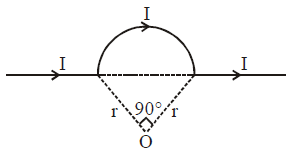
The magnetic field at center O of the arc in figure is :

1. \[\frac{\mu_{0}I}{4\pi\times r}\left[ \sqrt{2} +\pi \right]\]
2. \[\frac{\mu I}{2\pi r}\left[\frac{\pi}{4}+ \left( \sqrt{2}- 1 \right)\right]\]
3. \[\frac{\mu_{0}}{2\pi }\times \frac{I}{r}[\sqrt{2}-\pi ]\]
4. \[\frac{\mu_{0}}{4\pi }\times \frac{I}{r}[\sqrt{2}+\frac{\pi}{4} ]\]
View Answer
Question 14: difficult

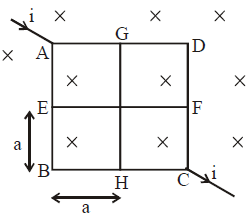
In figure, there is a uniform conducting structure in which each small square has side a. The
structure is kept in a uniform magnetic field B. Then the magnetic force on the structure will
be :

1. 2√2 iBa
2. √2 iBa
3. 2iBa
4. iBa
View Answer
Question 15: difficult

A straight section PQ of a circuit lies along the X-axis form x = –a/2 to x = a/2 and carries a steady current i. The magnetic field due to the section PQ at a point X = +a will be :

1. Proportional to a
2. Proportional to a²
3. Proportional to 1/a
4. Zero
View Answer
Question 16: difficult

A long straight wire carrying a current of 30A is placed in an external uniform magnetic field
of induction \[4\times 10^{-4} T\]. The magnetic field is acting parallel to the direction of current. The magnitude of the resultant magnetic induction in tesla at a point 2.0 cm away from the wire is
\[\left( \mu_{0}=4\pi\times 10^{-7}H/m \right)\]:

1. \[10^{-4}\]
2. \[3\times 10^{-4}\]
3. \[5\times 10^{-4}\]
4. \[6\times 10^{-4}\]
View Answer
Question 17: difficult

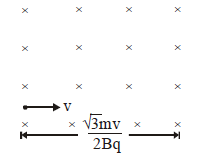
A charged particle of mass m, charge q is moving with speed v. It enters a uniform magnetic field acting perpendicular to the plane of paper inwards as shown in Fig. The width of the
magnetic field is √3 mv/2qB . Then time taken by charged particle to emerge from the magnetic
field is :

1. πm/2qB
2. πm/3qB
3. πm/6qB
4. πm/2√2qB
View Answer
Question 18: difficult

A hallow cylindrical wire carries current I, having inner & outer radius R & 2R respectively. Magnetic field at a point which is 5R/4 distance away from the wire :

1. \[\frac{5\mu_{0}I}{18\pi R}\]
2. \[\frac{\mu_{0}I}{36\pi R}\]
3. \[\frac{5\mu_{0}I}{36\pi R}\]
4. \[\frac{3}{40}\frac{\mu_{0}I}{\pi R}\]
View Answer

To solve for the magnetic field at a distance of

5R4\frac{5R}{4}

from the axis of a hollow cylindrical wire carrying current

II

, with inner radius

RR

and outer radius

2R2R

, we use Ampère's Law. The key steps are:

1. Magnetic Field Inside a Hollow Cylinder

For

R<r<2RR < r < 2R

(points within the shell of the cylinder):

  • Current density
    JJ
     

    is uniform, given by: 

    J=Iπ((2R)2R2)=I3πR2.J = \frac{I}{\pi \left((2R)^2 - R^2\right)} = \frac{I}{3\pi R^2}. 

  • The current enclosed within a radius
    rr
     

    (where R<r<2RR < r < 2R 

    ) is: 

    Ienc=Jarea enclosed=Jπ(r2R2).I_{\text{enc}} = J \cdot \text{area enclosed} = J \cdot \pi (r^2 - R^2).Substituting

    JJ:


    Ienc=I3πR2π(r2R2)=I3R2(r2R2).I_{\text{enc}} = \frac{I}{3\pi R^2} \cdot \pi (r^2 - R^2) = \frac{I}{3R^2}(r^2 - R^2). 

  • Using Ampère's Law: 

    B2πr=μ0Ienc,B \cdot 2\pi r = \mu_0 I_{\text{enc}}, 

    B=μ02πrI3R2(r2R2).B = \frac{\mu_0}{2\pi r} \cdot \frac{I}{3R^2}(r^2 - R^2). 

2. Magnetic Field at r=5R4r = \frac{5R}{4}


Since

5R4\frac{5R}{4}

lies within the shell (

R<r<2RR < r < 2R

), substitute

r=5R4r = \frac{5R}{4}

into the above equation:


B=μ02π5R4I3R2((5R4)2R2).B = \frac{\mu_0}{2\pi \cdot \frac{5R}{4}} \cdot \frac{I}{3R^2}\left(\left(\frac{5R}{4}\right)^2 - R^2\right).


Simplify:


  • r2=(5R4)2=25R216r^2 = \left(\frac{5R}{4}\right)^2 = \frac{25R^2}{16}
     

    ,


  • r2R2=25R216R2=25R21616R216=9R216r^2 - R^2 = \frac{25R^2}{16} - R^2 = \frac{25R^2}{16} - \frac{16R^2}{16} = \frac{9R^2}{16}
     

    .

Thus:


B=μ02π5R4I3R29R216.B = \frac{\mu_0}{2\pi \cdot \frac{5R}{4}} \cdot \frac{I}{3R^2} \cdot \frac{9R^2}{16}.


Simplify further:


B=μ02π45R9I48=μ0I2π36240R.B = \frac{\mu_0}{2\pi} \cdot \frac{4}{5R} \cdot \frac{9I}{48} = \frac{\mu_0 I}{2\pi} \cdot \frac{36}{240R}.


Final simplification:


B=340μ0IπR.B = \frac{3}{40} \frac{\mu_0 I}{\pi R}.


Final Answer:


B=340μ0IπR\boxed{B = \frac{3}{40} \frac{\mu_0 I}{\pi R}}


Question 19: difficult

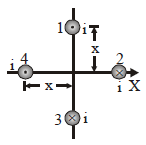
What will be the resultant magnetic field at origin due to four infinite length wires. If each wire produces magnetic field ‘B’ at origin:

1. 4B
2. √2 B
3. 2√2 B
4. Zero
View Answer
Question 20: difficult

A current I flows in a thin wire, shaped as regular polygon of n sides which can be
inscribed in a circle of radius R. The magnetic field induction at the centre of polygon due to
one side of the polygon is :

1. \[tan\frac{\pi}{n} tesla\]
2. \[\frac{\mu_{0}I}{\pi R}\left[ tan\frac{\pi}{n} \right] tesla\]
3. \[\frac{\mu_{0}I}{2\pi R}\left[ tan\frac{\pi}{n} \right] tesla\]
4. \[\frac{\mu_{0}I}{2\pi R}\left[ cos\frac{\pi}{n} \right]\]
View Answer