Laws of Motion - NEET Physics Questions
← All Chapters

Laws of Motion

Question 61:

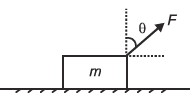
If block is at verge of motion, then select the correct option (where μ is the coefficient of friction)
neet friction based queestion

1. F = umg/sin θ
2. F = umg/( sin θ + u cosθ)
3. F = mg
4. F = umg
View Answer

If the angle θ\theta is with the vertical, then we need to adjust the force components accordingly:

  1. Normal Force:

    N=mgFcosθN = mg - F \cos \theta

  2. Friction Force:

    fs=μN=μ(mgFcosθ)f_s = \mu N = \mu (mg - F \cos \theta)

  3. Horizontal Component of Force:

    Fx=FsinθF_x = F \sin \theta

At the verge of motion:

Fsinθ=μ(mgFcosθ)F \sin \theta = \mu (mg - F \cos \theta)

Solving for FF:

F=μmgsinθ+μcosθF = \frac{\mu mg}{\sin \theta + \mu \cos \theta}

Question 62: easy

In translatory equilibrium

1. The net external force acting on particle is zero
2. The net external force acting on particle is constant (non-zero)
3. Particle is always at rest
4. Velocity of particle changes linearly with time
View Answer

In translational equilibrium the net force acting on the object is zero. so the object moves with constant velocity.

Question 63: easy

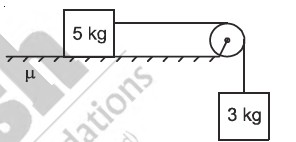
The minimum value of coefficient of friction (μ) such that block of mass ‘5 kg’ remains at rest is

1. 0.3
2. 0.4
3. 0.5
4. 0.6
View Answer

Given

m1=5m_1 = 5

kg,

m2=3m_2 = 3

kg, and

g=10g = 10

m/s²:

  • Tension:
    T=m2g=3×10=30T = m_2 g = 3 \times 10 = 30
     

    N

  • Friction force:
    f=μN=μ×50f = \mu N = \mu \times 50
     
  • At equilibrium:
    μ×50=30\mu \times 50 = 30
     

Solving,

μ=3050=0.6\mu = \frac{30}{50} = 0.6

.

Question 64:

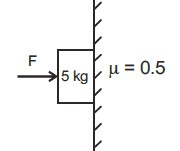
If the coefficient of friction between the block of mass 5 kg and wall is 0.5, then minimum force F required to hold the block with the wall is
(g = 10 m/s²)

1. 10 N
2. 100 N
3. 40 N
4. 50 N
View Answer

\[
\text{Given:} \quad m = 5 \text{ kg}, \quad g = 10 \text{ m/s}^2, \quad \mu = 0.5
\]

\text{Normal force:}
\[
N = F
\]

\text{Friction force:}
\[
f = \mu N = \mu F
\]

\text{For equilibrium:}
\[
\mu F = mg
\]

\text{Substituting values:}
\[
0.5 F = 5 \times 10
\]

\[
0.5 F = 50
\]

\[
F = \frac{50}{0.5} = 100 \text{ N}
\]

\textbf{Final Answer:}
\[
\mathbf{F = 100 N}
\]

Question 65: easy

Sand is poured on a conveyor belt at the rate of 2 kg/s. If belt is moving horizontally with velocity 4 m/s, then additional force required by engine to keep the belt moving with same constant velocity

1. 8 N
2. 10 N
3. 12 N
4. 14 N
View Answer

The force required to keep the conveyor belt moving at a constant velocity is given by the rate of change of momentum.

Momentum of sand per second:

Force=dPdt=dmdt×v\text{Force} = \frac{\text{dP}}{\text{dt}} = \frac{\text{dm}}{\text{dt}} \times v

Given dmdt=2\frac{dm}{dt} = 2 kg/s and v=4v = 4 m/s,

F=2×4=8 NF = 2 \times 4 = 8 \text{ N}

Thus, the additional force required is 8 N.

Question 66:

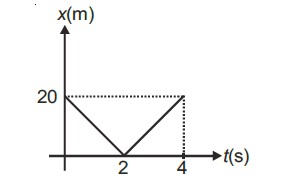
The position-time graph of a particle of mass 2 kg moving along x-axis is as shown in the figure. The magnitude of impulse on the particle at t = 2 s is


1. Zero
2. 10 N-s
3. 20 N-s
4. 40 N-s
View Answer

Solution:

Impulse is given by the change in momentum:

J=Δp=mΔvJ = \Delta p = m \Delta v

From the graph, we find velocity before and after t=2st = 2s:

  • Before t=2st = 2s:

    vinitial=x2x1t2t1=02020=10 m/sv_{\text{initial}} = \frac{x_2 - x_1}{t_2 - t_1} = \frac{0 - 20}{2 - 0} = -10 \text{ m/s}

  • After t=2st = 2s:

    vfinal=x3x2t3t2=20042=10 m/sv_{\text{final}} = \frac{x_3 - x_2}{t_3 - t_2} = \frac{20 - 0}{4 - 2} = 10 \text{ m/s}

Now, impulse:

J=m(vfinalvinitial)

J = m (v_{\text{final}} - v_{\text{initial}}) J=2×(10(10))=2×20=40 NsJ = 2 \times (10 - (-10)) = 2 \times 20 = 40 \text{ Ns}

Final Answer:

40 N-s\mathbf{40 \text{ Ns}}

Question 67: easy

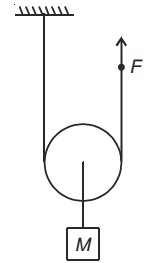
The force F needed to keep the block at equilibrium in given figure is (pulley and string are massless)

neet constrained motion questions

1. Mg/5
2. Mg/4
3. Mg/2
4. Mg/3
View Answer

For Equilibrium,

2F = Mg ⇒ F = Mg/2

Question 68: easy

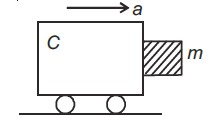
A block of mass m is in contact with the cart. The coefficient of static friction between the block and the cart is ü. The acceleration a of the cart that prevent the block from falling will be


neet pseudo force questions

1. a> (mg/ü)
2. a> (g/ü.m)
3. a ≥ (g/ü)
4. a ≤ (g/ü)
View Answer

The condition to prevent the block from falling is that the friction force must be at least equal to the weight of the block:

fsmgf_s \geq mg

Since static friction is given by fs=μNf_s = \mu N and the normal force is due to pseudo force N=maN = ma, we get:

μmamg\mu ma \geq mg

Dividing both sides by μm\mu m:

agμa \geq \frac{g}{\mu}

Thus, the required acceleration of the cart is agμa \geq \frac{g}{\mu}.

Question 69: easy

A truck is stationary and has a bob suspended by a light string, in a frame attached to the truck. The truck suddenly moves to the right with an acceleration of a. The pendulum will tilt

1. To the left and angle of inclination of the pendulum with the vertical is tan-¹(g/a)
2. To the left and angle of inclination of the pendulum with the vertical is sin-¹(g/a)
3. To the left and angle of inclination of the pendulum with the vertical is tan-¹(a/g)
4. To the left and angle of inclination of the pendulum with the vertical is sin-¹(a/g)
View Answer

When the truck accelerates to the right with aa, a pseudo force mama acts to the left on the bob in the truck's frame. The bob reaches equilibrium where the tension components balance forces:

tanθ=Pseudo forceWeight=mamg=ag\tan \theta = \frac{\text{Pseudo force}}{\text{Weight}} = \frac{ma}{mg} = \frac{a}{g} θ=tan1(ag)\theta = \tan^{-1} \left(\frac{a}{g} \right)

Thus, the pendulum tilts to the left at an angle θ=tan1(a/g)\theta = \tan^{-1}(a/g) with the vertical.

Question 70: easy

A body of mass m is kept on a rough horizontal surface (coefficient of friction = μ). A horizontal force is applied on the body, but it does not move. The resultant of normal reaction and the frictional force acting on the object is given by F, where F is:

1. F = mg
2. F = μmg
3. F = mg + μmg
4. F ≤ mg(1 + μ2) 1/2
View Answer

The forces acting on the body are: Normal reaction (N=mg) (upward) and Friction force fμmg (opposing applied force)

The resultant force is:

F=N2+f2=mg2+(μmg)2=mg1+μ2F = \sqrt{N^2 + f^2} = \sqrt{mg^2 + (\mu mg)^2} = mg \sqrt{1 + \mu^2}

F \leq mg(1 + \mu^2)^{1/2}