Kinematics - NEET Physics Questions
Question 41: moderate

A man wishes to swim across a river 0.5 km wide. If he can swim at the rate of 2 km/h in still water and the river flows at the rate of 1 km/h. The angle made by the directon (w.r.t. the flow of the river) along which he should swim so as to reach a point exactly opposite his starting point, should be :

1. 60°
2. 120°
3. 145°
4. 90°
View Answer

To swim across the river and reach a point directly opposite his starting point, the man must swim at an angle against the flow of the river to counteract the river's current.

### Given:
- Speed of the man in still water = 2 km/h
- Speed of the river flow = 1 km/h

Let \(\theta\) be the angle between the man's swimming direction and the river flow. To counteract the river's flow, the horizontal component of the man's velocity must equal the river's velocity.

\[
\text{Horizontal component} = 2 \sin \theta = 1
\]

Solving for \(\theta\):

\[
\sin \theta = \frac{1}{2}
\]
\[
\theta = \sin^{-1} \left( \frac{1}{2} \right) = 30^\circ
\]

Thus, the man should swim at an angle of:

\[
{120^\circ} \text{ upstream from the river flow.}
\]
Question 42: moderate

A bird is flying towards south with a velocity 40km/h and a train is moving with a velocity 40 km/h towards east. What is the velocity of the bird w.r.t. an observer in the train ?

1. 40 √2 km/h. N-E
2. 40 √2 km/h. S-E
3. 40 √2 km/h. S-W
4. 40 √2 km/h. N-W
View Answer

The relative velocity of the bird with respect to the observer in the train is found by combining the bird's velocity (south) and the train's velocity (east) using the Pythagorean theorem.

\[
v_{\text{relative}} = \sqrt{(40^2 + 40^2)} = \sqrt{3200} = 40\sqrt{2} \, \text{km/h}
\]

The direction is \( 45^\circ \) south of west.

Thus, the relative velocity is:

\[ {40\sqrt{2} \, \text{km/h} \text{ at } 45^\circ \text{ south of west}}
\]

Question 43: moderate

A boy is running on a levelled road with velocity (v) with a long hollow tube in his hand. Water is falling vertically downwards with velocity (u). At what angle to the vertical, should he incline the tube so that the water drops enters without touching its side :

1. \[tan^{-1}\left( \frac{v}{u} \right)\]
2. \[sin^{-1}\left( \frac{v}{u} \right)\]
3. \[tan^{-1}\left( \frac{u}{v} \right)\]
4. \[cos^{-1}\left( \frac{v}{u} \right)\]
View Answer

The tube should be inclined at an angle \(\theta\) such that the water's relative velocity to the boy is along the axis of the tube.

The horizontal velocity of the boy is \(v\), and the vertical velocity of the falling water is \(u\). The angle \(\theta\) between the tube and the vertical satisfies:

\[
\tan \theta = \frac{v}{u}
\]

Thus, the required angle is:

\[
\theta = \tan^{-1} \left( \frac{v}{u} \right)
\]

Question 44: moderate

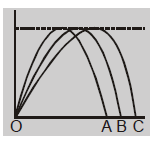
Three projectiles A, B and C are thrown from the same point in the same plane. Their trajectories are shown in the figure. Which of the following statement is true ?

1. The time of flight is the same for all the three
2. The launch speed is largest for particle C
3. The horizontal velocity component is largest for particle C
4. All of the above
View Answer

As maximum height is same is all three they will have same vertical speed.

Range of C is maximum so its horizontal speed is maximum.

Question 45: moderate

A projectile of mass 100 g is fired with a velocity of 20 ms–¹ making an angle of 30° with the horizontal. As it rises to the highest point of its path, its momentum changes by (g = 10 ms–²) :

1. 1/2 kg ms–¹
2. 1 kg ms–¹
3. 2 kg ms–¹
4. None of these
View Answer

The momentum change occurs only in the vertical direction as the horizontal component of velocity remains constant throughout the flight.

### Initial vertical component of velocity:
\[
u_y = u \sin \theta = 20 \times \sin 30^\circ = 20 \times \frac{1}{2} = 10 \, \text{m/s}
\]

At the highest point, the vertical component of velocity becomes zero.

### Change in vertical velocity:
\[
\Delta v_y = u_y - 0 = 10 \, \text{m/s}
\]

### Mass of the projectile:
\[
m = 100 \, \text{g} = 0.1 \, \text{kg}
\]

### Change in momentum:
\[
\Delta p = m \times \Delta v_y = 0.1 \times 10 = 1 \, \text{kg m/s}
\]

Thus, the change in momentum is \( 1 \, \text{kg m/s} \).

Question 46: moderate

Two tall buildings are 30 m apart. The speed with which a ball must be thrown horizontally from a window 150 m above the ground in one building so that it enters a window 27.5 m from the ground in the other building is :

1. \[2 ms^{-1}\]
2. \[6 ms^{-1}\]
3. \[4 ms^{-1}\]
4. \[8 ms^{-1}\]
View Answer

Given:

- Horizontal distance between buildings \( x = 30 \, \text{m} \)
- Height difference \( h = 150 - 27.5 = 122.5 \, \text{m} \)
- Use \( h = \frac{1}{2} g t^2 \) to find time \( t \):

\[
122.5 = \frac{1}{2} \times 10 \times t^2 \quad \Rightarrow \quad t^2 = 24.5 \quad \Rightarrow \quad t = \sqrt{24.5} \approx 4.95 \, \text{seconds}
\]

Horizontal velocity \( v = \frac{x}{t} = \frac{30}{4.95} \approx 6.06 \, \text{m/s} \).

Thus, the required speed is \( {6.0 \, \text{m/s}} \).

Question 47: moderate

P is the point of contact of a wheel and the ground. The radius of the wheel is 1m. The wheel rolls on the ground without slipping. The displacement of point P when the wheel completes half rotation is :

1. 2 m
2. \[\sqrt{\pi^{2}+4} m\]
3. π m
4. \[\sqrt{\pi^{2}+2} m\]
View Answer

Horizontal Displacement = πR

Vertical Displacement = 2R

Total Displacement = ((πR)^2+(2R)^2)^1/2=

\[\sqrt{\pi^{2}+4} m\]

Question 48: moderate

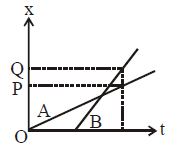
The position-time (x-t) graphs for two children A and B returning from their school O to their homes P and Q respectively are as shown in the figure. Choose the incorrect statement regarding these graphs :

1. A lives closer to the school than B
2. A starts from the school earlier than B
3. A walks faster than B
4. A and B reach home at the same time
View Answer

Slope of x-t graph represents velocity. slope is more for B so it will have higher velocity

Question 49: moderate

A body is projected at an angle of 30° with the horizontal and with a speed of 30 ms–¹. What is the angle with the horizontal after 1.5 seconds ? (Take g = 10 ms–²)

1.
2. 30°
3. 60°
4. 90°
View Answer

To find the angle with the horizontal after 1.5 seconds, we calculate the horizontal and vertical components of velocity at that moment.

- Initial speed: \( u = 30 \, \text{m/s} \)
- Angle of projection: \( \theta = 30^\circ \)
- Horizontal component of velocity (remains constant):
\[
u_x = u \cos \theta = 30 \times \frac{\sqrt{3}}{2} = 15\sqrt{3} \, \text{m/s}
\]
- Vertical component of velocity after 1.5 seconds:
\[
u_y = u \sin \theta - g t = 30 \times \frac{1}{2} - 10 \times 1.5 = 15 - 15 = 0 \, \text{m/s}
\]

Since the vertical component is 0, the angle with the horizontal is:

\[
\text{Angle} = 0^\circ
\]

Thus, the angle with the horizontal after 1.5 seconds is \( 0^\circ \).

Question 50: moderate

A projectile is fired from level ground at an angle θ above the horizontal. The elevation angle Φ of the highest point as seen from the launch point is related to θ by the relation :

1. \[tan\phi=\frac{1}{4}tan\theta\]
2. \[tan\phi=tan\theta\]
3. \[tan\phi=\frac{1}{2}tan\theta\]
4. \[tan\phi=2tan\theta\]
View Answer

\[ tan \phi= H/2R= \frac{1}{2}tan\theta \]