Kinematics - NEET Physics Questions
Question 51: moderate

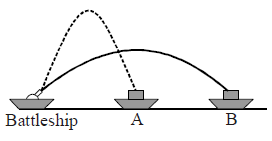
Two guns on a battleship simultaneously fires two shells with same speed at enemy ships. If the shells follow the parabolic trajectories as shown, which ship will get hit first ?
 

1. A
2. B
3. both at same time
4. need more information
View Answer

As A is having more maximum height it will have more vertical speed uy. So A will take more time than A.

So, ship B will be hit first.
Question 52: moderate

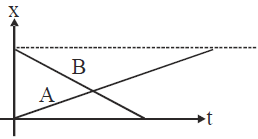
Figure shows position versus time graph of two rabbits running opposite to each other between two trees. Which of the following statements are true.

1. Rabbit A has greater magnitude of average velocity.
2. Rabbit B has greater magnitude of average velocity.
3. Both the Rabbits have same displacement.
4. Both the Rabbits have same constant speed.
View Answer

Distance is equal for both A and B. B is taking lesser time to complete so its speed is higher.

Question 53: moderate

A body is dropped from a tower. It covers 64% distance of its total height in last second. Find out the height of tower [g = 10 ms–²]

1. 31.25 m
2. 25.31 m
3. 40 m
4. 125 m
View Answer

\[ 0.36 H= \frac{1}{2}g(t-1)^{2} \]

\[ H= \frac{1}{2}g(t)^{2} \]

Dividing we get

\[ 0.36 = \frac{(t-1)^{2}}{t^{2}} \]

\[ 0.6 = \frac{(t-1)}{t} \]

0.4t =1

t= 2.5 sec

S= (1/2) ×10 ×(2.5)²= 31.25 m

Question 54: moderate

A particle is fired with velocity u making an angle θ with the horizontal. What is the change in velocity when it is at the highest point :

1. u cosθ
2. u
3. u sinθ
4. (u cosθ-u)
View Answer

At the highest point of its trajectory, the vertical component of the velocity becomes zero, while the horizontal component remains unchanged.

- Initial velocity: \( u \)
- Horizontal component: \( u_x = u \cos \theta \)
- Vertical component: \( u_y = u \sin \theta \)

At the highest point:
- Vertical velocity: \( u_y = 0 \)
- Horizontal velocity: \( u_x = u \cos \theta \)

The change in velocity is only in the vertical direction, from \( u \sin \theta \) to 0.

So, the change in velocity is:

\[
\Delta v = u \sin \theta
\]

Thus, the change in velocity is \( u \sin \theta \).

Question 55: moderate

A boat takes two hours to travel 4 km down and 4 km up the river when the water is still. How much time will the boat take to make the same trip when the river starts flowing at 2 kmph?

1. 2 hour
2. 2 hour 40 minute
3. 3 hour
4. 3 hour 40 minute
View Answer

Let the boat's speed in still water be x kmph. Given

8x=2\frac{8}{x} = 2

, we get x = 4 kmph.

With a 2 kmph current:

  • Downstream speed = 6 kmph, time =
    46=23\frac{4}{6} = \frac{2}{3}
     

    hours

  • Upstream speed = 2 kmph, time =
    42=2\frac{4}{2} = 2
     

    hours

Total time =

2232 \frac{2}{3}

hours or 2 hours 40 minutes.

Question 56: moderate

A taxi leaves the station X for station Y every 10 minutes. Simultaneously, a taxi leaves the station Y also for station X every 10 minutes. The taxis move at the same constant speed and go from X to Y or vice-versa in 2 hours. How many taxis coming from the other side will each taxi meet enroute from Y to X ?

1. 10
2. 11
3. 12
4. 23
View Answer

Each taxi takes 2 hours, and taxis leave every 10 minutes.

  • Taxis already on the route from X to Y:

    12010

  • Taxis that start after from X to Y:

    12010

  • Exclude the simultaneously departing taxi:

    12+11= 23 

Final Answer: 23 taxis.

Question 57: moderate

Two cars A and B are approaching each other head-on with speeds 20 m/s and 10 m/s respectively. When their separation is X then A and
B start braking at 4 m/s² and 2m/s² respectively. Minimum value of X to avoid collision is

1. 60 m
2. 75 m
3. 80 m
4. 90 m
View Answer

Using the stopping distance formula:


s=u22as = \frac{u^2}{2a}


For Car A (

uA=20u_A = 20

m/s,

aA=4a_A = 4

m/s²):


sA=2022×4=4008=50 ms_A = \frac{20^2}{2 \times 4} = \frac{400}{8} = 50 \text{ m}


For Car B (

uB=10u_B = 10

m/s,

aB=2a_B = 2

m/s²):


sB=1022×2=1004=25 ms_B = \frac{10^2}{2 \times 2} = \frac{100}{4} = 25 \text{ m}


Total minimum separation to avoid collision:


X=sA+sB=50+25=75 mX = s_A + s_B = 50 + 25 = 75 \text{ m}


Question 58: moderate

An object is projected horizontally from a 100 m high cliff with a speed of 10 m/s. What will be its velocity 1 second after projection?

1. 10 m/s
2. 20 m/s
3. 10√2 m/s
4. 10√3 m/s
View Answer

Given:

vx=10v_x = 10

m/s,

g=10g = 10

m/s²,

t=1t = 1

s

Vertical velocity:

vy=gt=10v_y = g t = 10

m/s

Resultant velocity:


v=vx2+vy2=102+102=10√2  m/sv = \sqrt{v_x^2 + v_y^2} = \sqrt{10^2 + 10^2} = 14.1 \text{ m/s}


Question 59: moderate

An object is projected horizontally from a 45 m high cliff with a speed of 40 m/s. With what speed will it strike the ground? (Take g=10 m/s²)

1. 20 m/s
2. 30 m/s
3. 40 m/s
4. 50 m/s
View Answer
  • Time to fall:
    t=2h/g=90/10=3t = \sqrt{2h/g} = \sqrt{90/10} = 3
     

    s

  • Vertical velocity:
    vy=gt=10×3=30v_y = gt = 10 \times 3 = 30
     

    m/s

  • Resultant velocity:
    v=vx2+vy2=402+302=50v = \sqrt{v_x^2 + v_y^2} = \sqrt{40^2 + 30^2} = 50
     

    m/s

Answer: 50 m/s

Question 60: moderate

The relation between times t and distance x is \(t = ax^2 + bx\), where a and b are constants. The acceleration is

1. \(-2abv^2\)
2. \(2bv^3\)
3. \(-2av^3\)
4. \(2av^2\)
View Answer

Differentiating \(t = ax^2 + bx\) with respect to \(t\) gives \(1 = (2ax + b)v\). Differentiating again with respect to \(t\) gives \(a = \frac{dv}{dt} = -2av^3\).